There’s much in the natural world scientists and engineers can use for materials inspiration. Take, for example, the ancient bristle sea worm Perinereis cultrifera. Its jaws are made of a unique material described as a “bio-metal,” which can rival copper or silver for hardness.
At a fundamental level, the jaws are constructed from structural proteins and metal ions. They can be used to hold, cut, crush, and chew food, as well as serving as a defense mechanism against predators.
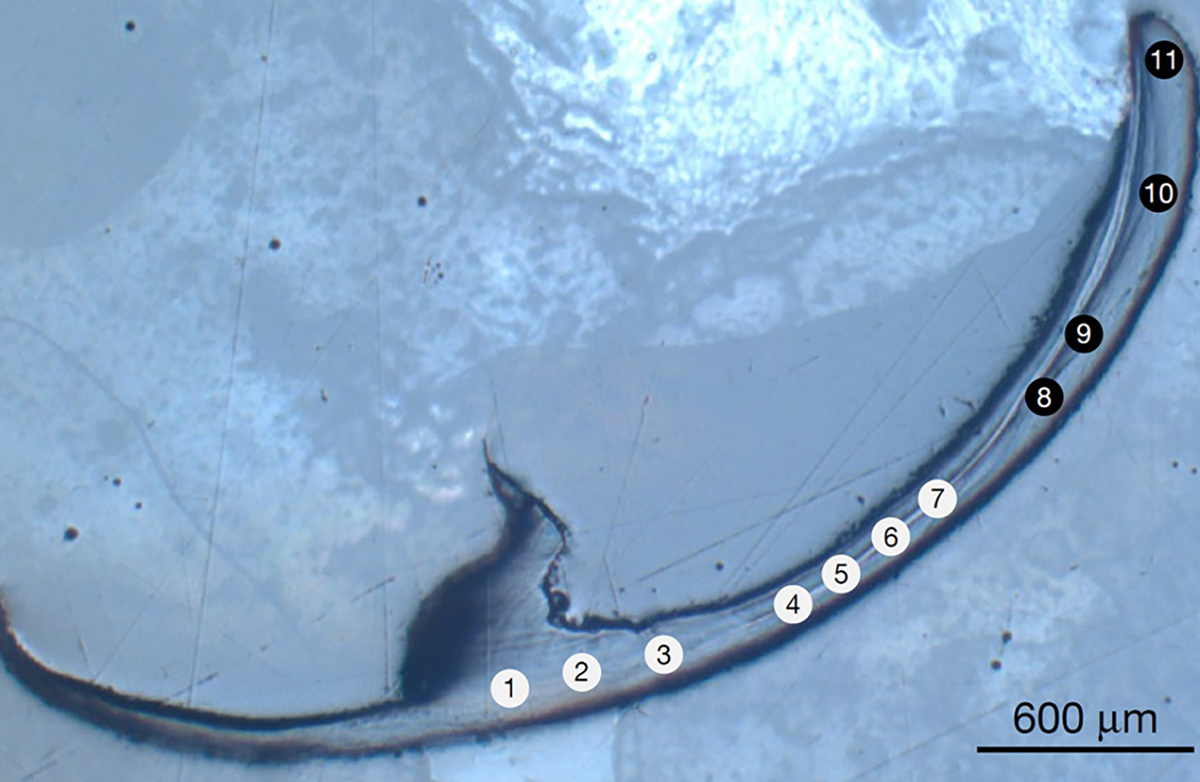
In a study published in Biophysics Reviews, researchers took a closer look at these bio-metal jaws, probing them by creating thousands of microscopic indents in the material and running a chemical analysis of their composition, while combining these efforts with high-resolution imagery and computational models.
Read more: “The Worm That Survived Multiple Apocalypses”
The investigation confirmed the metal-like properties of the worm jaws in terms of their hardness, strain mechanics, and ion-protein structure. One of the particular characteristics of the worm jaws that matched up with other crystalline metals was that smaller parts of the material were harder to dent—a phenomenon known as the Nix-Gao nanoindentation size effect, where disruption to the material’s atomic lattice causes it to become more densely packed. This contributes to the unusual hardness of the jaws, which is concentrated in the tip due to the higher metal ion concentration.
That said, the researchers also found differences to normal metals, demonstrating that the mouths of P. cultrifera contain something truly unique. Case in point: When indented, the elasticity of the material changes as well, which is a trait more common in glassy polymers.
“Bristle worm jaws also showed size-dependent elasticity—this is a distinguishing feature of bio-metals when compared to standard crystalline metals like copper or silver,” study author Christian Hellmich said in a statement.
The team developed mathematical models to explain this behavior right down to the atomic level, but there’s still a lot more to explore. The next steps are to look at other species of bristle worm to understand how their bio-metal jaws compare and to refine the math models further.
Ultimately, by determining how the genes of the P. cultrifera worm are coded to bring these bio-metals into being, we might be able to develop similar materials of our own: eco-friendly, and designed to order. Or as Hellmich explained, “All this comes with true excitement about the beauty, elegance, and refinement found in and produced by nature.” 
Enjoying Nautilus? Subscribe to our free newsletter.
Lead image: A close-up of the Perinereis cultrifera jaw, with indentation tests labeled. Photo from Zelaya-Lainez, L., et al. Biophysics Reviews (2026)