The United States government is finally open for business. But while the short-term spending bill passed by Congress and signed by President Trump this week ended the longest ever government shutdown, it may be threatening a marijuana-based industry valued at more than $28 billion that has grown astronomically over the past 7 years.
The newly signed spending bill contains a provision that would outlaw the sale of products containing derivatives and precursors of the psychoactive ingredient in cannabis, delta-9 tetrahydrocannabinol (delta-9 THC), which are derived from hemp. (Hemp is a variety of the Cannabis sativa plant, but with very low levels of delta-9 THC.) The banned products could disappear from store shelves, gas station displays, and websites selling them by next year.
In 2018, under farm bill legislation, products containing hemp-derived chemicals were allowed to skirt a 1970 ban on all uses of cannabis. That law defined hemp-derived chemicals as “any part of the cannabis plant or its derivatives containing no more than 0.3 percent delta-9 tetrahydrocannabinol on a dry-weight basis,” according to a congressional report.
Read more: “The Ecology of Good Weed”
Soon the market was flooded with seltzers, “flowers,” and other consumables that contained THC derivatives or precursors that are made from hemp, not marijuana, plants. These products mimic the psychoactive effects of delta-9 THC in users while containing less than 0.3 percent of the actual drug as it exists in the cannabis plant. But the total THC concentration, which includes non-delta-9 compounds, of most of these exceeds that 0.3 percent threshold. So what makes up the difference?
Here are some of the compounds that allowed purveyors of intoxicating products to sell cannabis-like highs on the open market.
Delta-8 THC: This is a major THC loophole. According to Cannabis Business Times, the market for products containing delta-8 THC grew more than 1,000 percent from 2022 to 2023. Because it only exists in trace amounts in the cannabis plants, and was not specified as an intoxicant in the 2018 Farm Bill, it was not technically illegal in the eyes of the federal government. Though it generates a milder buzz than delta-9, it was packed into many products, smokeable and edible, and sold to consumers.
Delta-10 THC: Similar to delta-8, delta-10 THC is another THC variant that occurs in minimal amounts naturally and is usually produced by converting CBD in a lab setting. It is also currently federally legal based on the same interpretation of the Farm Bill as delta-8.
Tetrahydrocannabinolic acid (THCA): This one is tricky. THCA is not psychoactive itself, but it is a chemical precursor to delta-9 THC. What input is needed to change it to delta-9 THC? Heat. So many of the loophole products involve heating THCA, converting it into the main intoxicating compound in weed. These products include cannabis that has been engineered and bred to have high levels of THCA rather than delta-9 THC, crystalline forms of THCA called “diamonds,” and oils and other liquids used in vape cartridges.
Tetrahydrocannabivarin (THCV ) and Tetrahydrocannabiphorol (THCP): As with THCA, THCV and THCP occur in federally legal hemp products because the law designates no limits to their concentration levels. These compounds are typically mixed with other cannabinoids in vapes, gummies, flowers sprayed with THCP distillate, and other products.
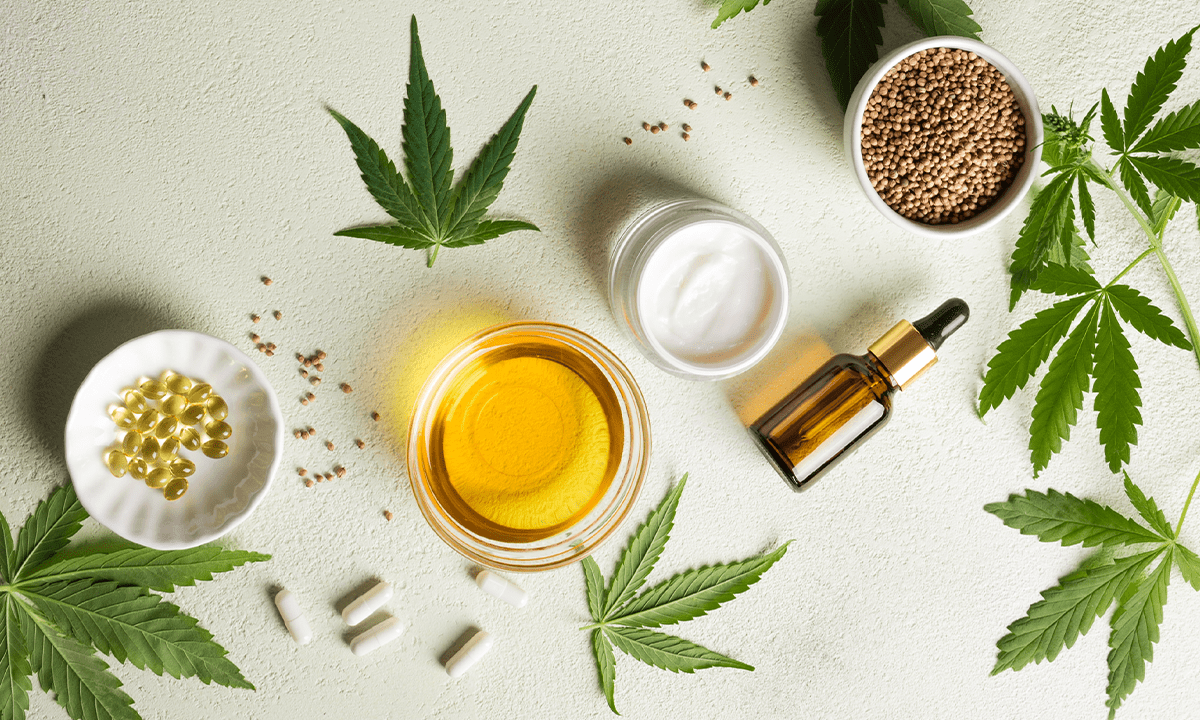
Many of the above compounds are made by extracting cannabidiol (CBD) from hemp plants and then manipulating that molecule through chemical reactions. Products that contain only CBD, which naturally occurs in hemp plants, but no THC or THC derivatives or precursors, may not be affected by the new stopgap funding bill. That $7 to $8 billion dollar market, which is projected to grow in leaps and bounds in the coming years, might be safe for now.
But if hemp now becomes illegal according to the federal government, those CBD products, as well as the THC workaround products that have proliferated in recent years, just might get yanked out by the root. 
Enjoying Nautilus? Subscribe to our free newsletter.
Lead image: Oksana Mizina / Shutterstock