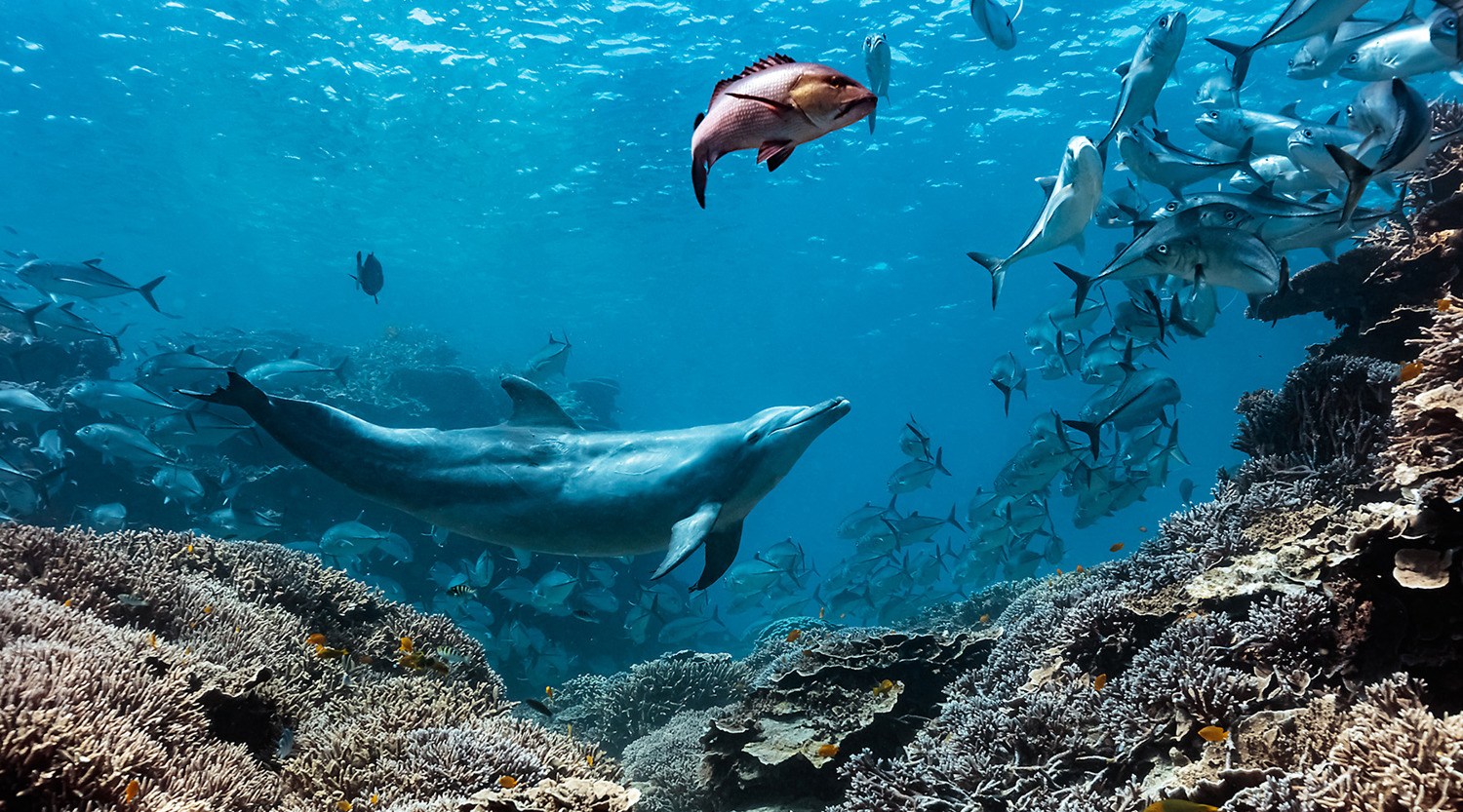
Because dolphins are highly social and have natural, smile-like jaw shapes, they’re stereotyped as happy creatures. But dolphins are predators, and like other predators, they go to great lengths to procure animal meat. In fact, in a recent study published in Ecology and Evolution, researchers based in Florida and Australia discovered that common bottlenose dolphins (Tursiops truncatus) will not only eat fish but also steal their meals.
The researchers observed the behavior of a dolphin in shallow waters on the southern Great Barrier Reef over a four-year period, both through snorkeling and video. Overall, the dolphin stole food 11 times. He employed a novel strategy of chasing bigeye trevally fishes (Caranx sexfasciatus) until they regurgitated their food and then consumed the morsels. His kleptoparasitic (food-stealing) behavior was facilitated by continual echolocation clicks and low-frequency vocalizations, which may have heightened the trevallys’ sense of fear.
“We observed him repeating this behavior over several years which suggests he may have learnt to target the fish with the fullest bellies, providing the most rewarding meals,” explained co-lead author Asia Haines, a marine biologist at the University of the Sunshine Coast in a press release.
This male dolphin, nicknamed “Bubbles,” always foraged alone, an atypical behavior since common bottlenose dolphins tend to hunt in groups, working collectively to corral schools of fishes within striking distance. The researchers theorize that given that Bubbles was by himself, he may have needed an alternative strategy that required less energy than catching fish. The bigeye trevally are the perfect hosts for such a kleptoparasite, as they gather in large concentrations, offering a predictable source of regurgitated food.
Read more: “Do Dolphins Have Conversations? We Still Can’t Say”
Dolphins are infamously smart, and Bubbles’ “behavior does demonstrate the species’ adaptability and flexibility when it comes to foraging,” according to co-lead study author Romney Edwards-Francis, a doctoral student at the University of the Sunshine Coast. Bubbles had frequented the area around Lady Elliot Island where the study was conducted since at least 2017. Given that he wasn’t observed directly eating the trevally, despite dolphins consuming them at other sites, the researchers concluded that Bubbles had learned his unique feeding approach.
It might not be fine dining, but it’s obviously kept him well fed. 
Enjoying Nautilus? Subscribe to our free newsletter.
Lead Image: Tracy Olive