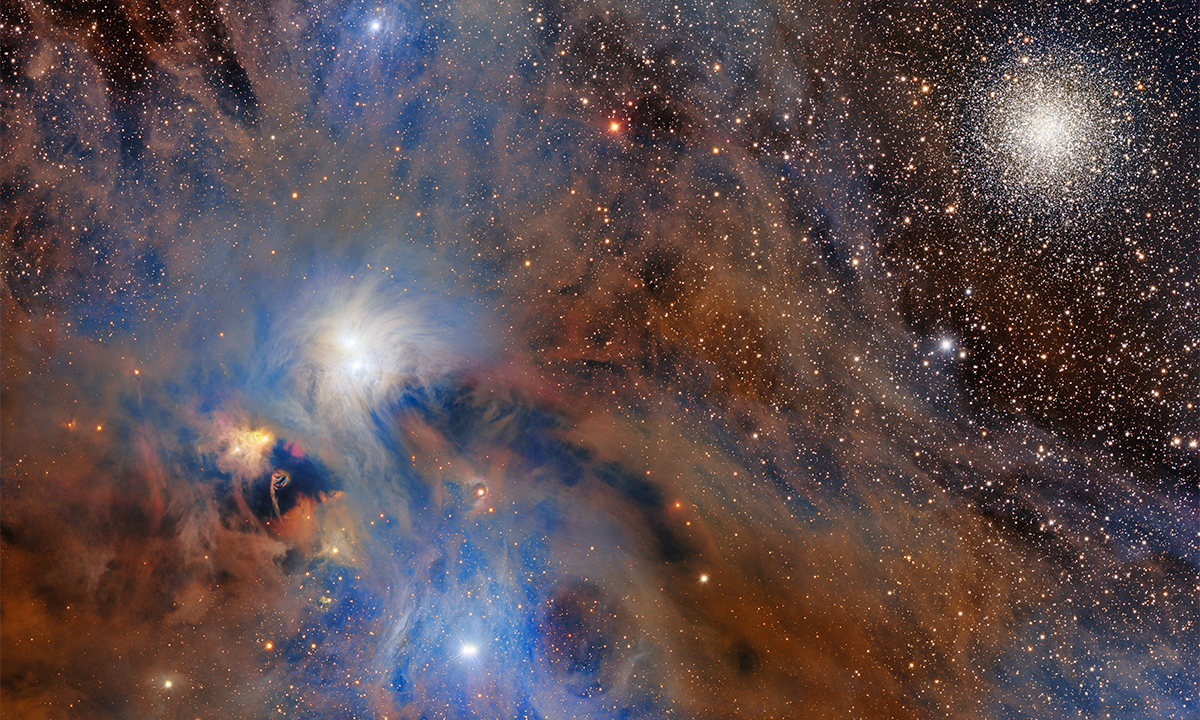
The latest image to be shared from the National Science Foundation’s National Optical-Infrared Astronomy Research Laboratory (NOIRLab)’s Dark Energy Camera (DECam) looks like a work of art. Specifically, Vincent van Gogh’s 1889 painting, The Starry Night.
With its distinctive brush strokes, impasto technique, and swirling representation of the cosmos, The Starry Night is one of the most recognizable paintings ever committed to canvas, and its swirls and grandeur are matched by the new photo from DECam.
The wispy, hazy composition to the left is the Corona Australis Molecular Cloud, around 430 light-years away from us. It includes both NGC 6726 (the two white dots in a blue haze) and NGC 6729 (the two white dots in an orange haze that isn’t labeled on the annotation).
The brighter orange region is binary star system R Coronae Australis, which includes a primary star in the teenage stage of its life: almost at full mass, but yet to start hydrogen fusion. The blue gas around R Coronae Australis is being illuminated by the formation of hundreds of thousands of young stars and the light they’re radiating.
Read more: “The Sean Carrolls Explain the Universe”
The sharper right side of the image includes a distinct globular cluster (a specific congregation of stars) designated as NGC 6723, more than 28,000 light-years away from Earth. It’s the brightest collection of stars that’s visible, known as the Chandelier Cluster. Astronomers think there could be millions of stars in this region.
That there’s so much in one picture is down to the capabilities of the DECam, which is mounted on the Víctor M. Blanco 4-meter Telescope at the Cerro Tololo Inter-American Observatory in Chile. It boasts a 570-megapixel resolution, a lens that’s nearly 3.3 feet across, and 74 tiled detectors for capturing the image.
This is obviously far more advanced than the canvas and paints van Gogh used, but they both captured the majesty of the sky. 
Enjoying Nautilus? Subscribe to our free newsletter.
Lead image: Millions of stars, at very different distances. Credit: Dark Energy Survey/DOE/FNAL/DECam/CTIO/NOIRLab/NSF/AURA.