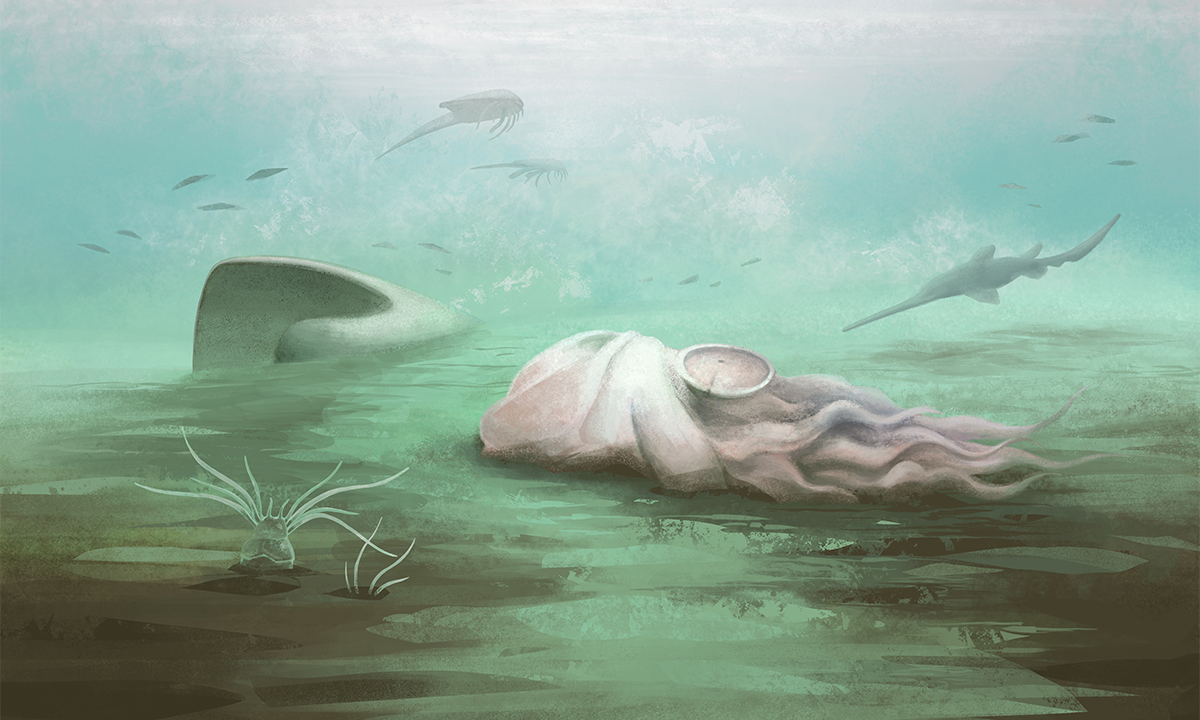
In 2003, a fossil found in northeastern Illinois was declared the earliest known octopus, earning it a place in the Guinness Book of World Records. The ancient cephalopod, dubbed Pohlsepia mazonensis, was exceptionally well preserved in rocks dating to more than 300 million years ago. With eight tentacles, a pair of eyes, structures resembling fins, and an apparent ink sac, the animal seemed like a dead ringer for living octopuses. A paper published today, however, deems it a case of mistaken identity.
An international team of researchers from the United Kingdom, Switzerland, Germany, France, and the United States used updated imaging techniques to peer inside the fossil. In particular, the images revealed a set of tiny teeth inside. Attached to a ribbon of chitin, such teeth comprise the “radula,” or feeding apparatus, in all cephalopods (octopus, squid, cuttlefish, nautilus, and kin). The number of teeth per row in the radula varies predictably across cephalopod types.
A count of the teeth on the P. mazonensis fossil yielded a surprise: It had 11 per row, which is closer to the nautilus tooth count of 13 than the count of 7 to 9 in octopuses (the fossil likely lost a couple of teeth during preservation, according to the study authors). Moreover, the shape of the teeth matched those from an ancient, shelled nautilus, Paleocadmus pohli, that had been discovered at the same site.
Read more: “Twilight of the Nautilus”
“It turns out the world’s most famous octopus fossil was never an octopus at all,” remarked lead author Thomas Clements in a press release. “It was a nautilus relative that had been decomposing for weeks before it became buried and later preserved in rock, and that decomposition is what made it look so convincingly octopus-like.”
Today, nautiluses are the only cephalopods with external shells, thought to be reminders of a lineage of similarly shelled cephalopods that was once widespread, after diverging from octopuses and squids about 400 million years ago.
The famous fossil is the oldest known soft tissue of a nautilus, which suggests that octopuses didn’t evolve until much later. Or as Clements put it, “It’s amazing to think a row of tiny hidden teeth, hidden in the rock for 300 million years, have fundamentally changed what we know about when and how octopuses evolved.” 
Enjoying Nautilus? Subscribe to our free newsletter.
Lead image: Clements, T. et al Proceedings of the Royal Society B (2026)