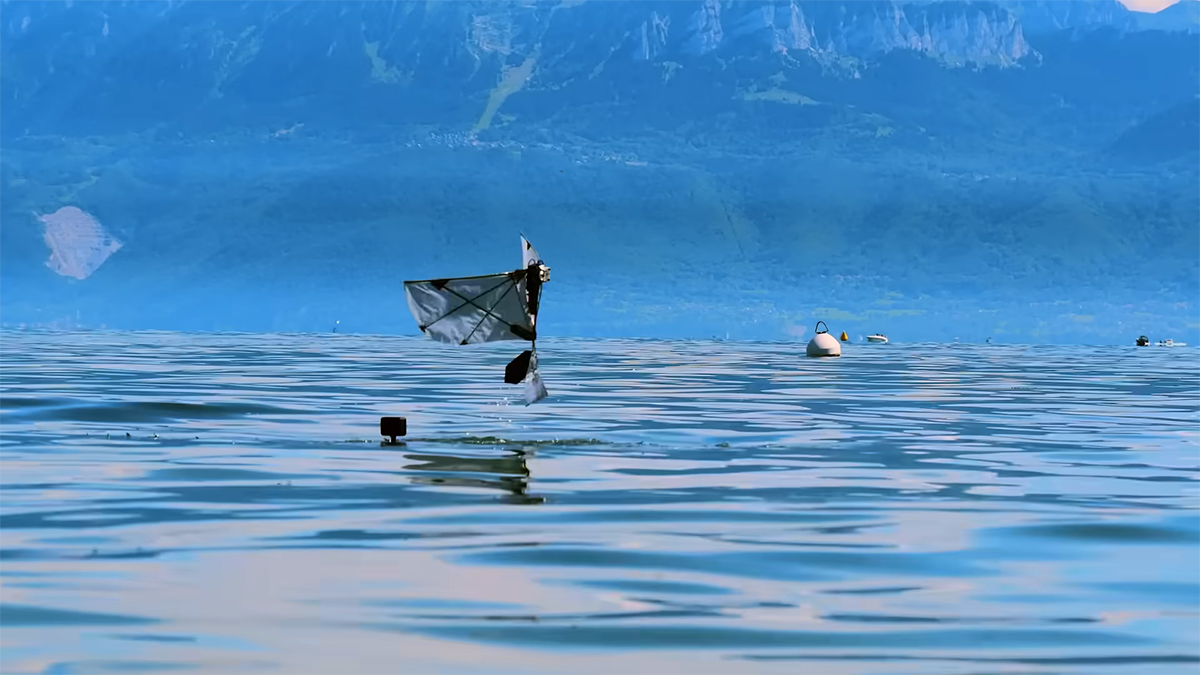
Imagine being a researcher wanting to take a closer look at the 80 percent of the ocean that remains unexplored: You drive to the coast, unpack a winged robot from your trunk, and then throw it into the air to take flight. Then comes the clever part: Once your robot reaches the area of the ocean you want to measure, it dives beneath the waves.
That scenario isn’t possible now, but we’re a big step closer to it thanks to a new “flapping-wing aerial-aquatic vehicle” (FAAV) developed by engineers at MIT and Swiss Federal Technology Institute of Lausanne, in Switzerland. They’ve published a study of their work in Science.
The FAAV takes inspiration from the more than 100 species of bird that can also swim through water (for instance, loons, gulls, puffins, and petrels). The robot is both lightweight (less than half a pound) and fully hydrophobic, characteristics that make it able to transition from one state to another and back again.
“You have to do some adaptation to make that transition work. But there’s a solution that exists in nature,” study author Raphael Zufferey from MIT said in a statement. “Birds like puffins can fly very fast through the air, and can dive and swim through water at speeds of 3 meters per second. They’re able to do pretty amazing things. So we knew it was possible. Just no one had tried this in a mobile robotic system."
Water is around a thousand times denser than air, and diving birds have a couple of tricks to move through both efficiently. First, they fold their wings when underwater; second, they flap them at a slower rate.
With the FAAV, the engineers built flexibility rather than a folding mechanism into the wings, enabling it to switch between flapping frequencies as needed.
Read more: “Is This New Swim Stroke the Fastest Yet?”
The robot features a body made up of an electric motor, battery, and crankshaft, which is connected to a motorized tail and wings made of thin membranes that can be swapped out for various sizes.
In lab tests and experiments in Lake Geneva, the team found that as long as the FAAV exited the water at an angle above 70 degrees, it could get back into the air—something no robot has managed previously.
There’s still a lot of work to do here—the FAAV can only transition from water to air at the moment, not the other way around—but the researchers can now use the robot as a basis for further study. And, eventually, it could give scientists a portable device they can launch from the shore or a boat deck.
“One of the major challenges in ocean science is collecting data both frequently and across many locations, which is something this robot could do in the future,” said Zufferey.
Hey, it’s all in the wing design. 
Enjoying Nautilus? Subscribe to our free newsletter.
Lead image: MIT Mechanical Engineering / YouTube