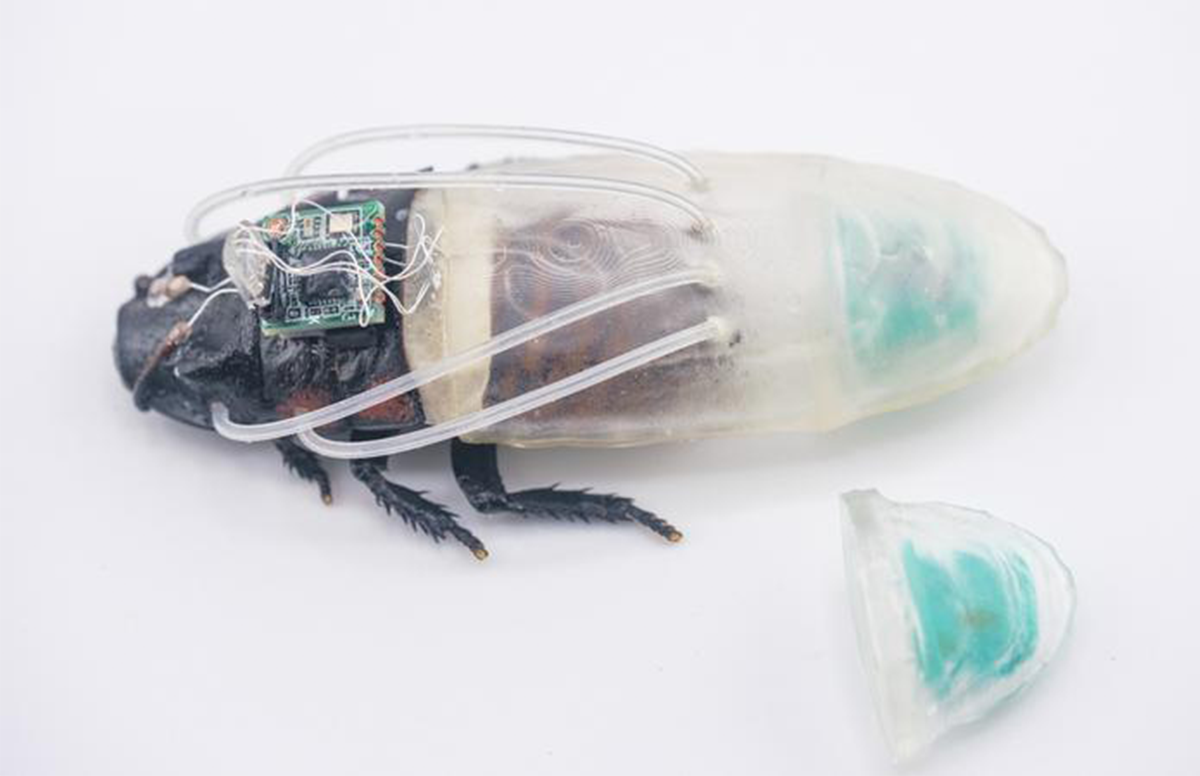
When a 7.7 magnitude earthquake struck Myanmar in 2025, an unconventional search-and-rescue team was deployed: cyborg cockroaches. Outfitted with tiny silver electrodes that let operators remotely guide their movements, Madagascar hissing cockroaches roamed the rubble searching for signs of life. Now these cybernetic insects have gotten an upgrade, according to a new study in Nature Communications—a miniature diving suit that allows them to breathe underwater.
The 3-D-printed SCUBA suit, built by engineers from Singapore’s Nanyang Technological University, consists of a small oxygen tank, tubes to deliver the gas straight to the cockroach’s body, and a flexible, waterproof shell. Oxygen is manufactured chemically using a sponge coated in manganese dioxide that catalyzes its production from hydrogen peroxide. From there, the oxygen travels through silicone tubes affixed to the cockroach’s spiracles with a strong adhesive (which performs double duty keeping water out of its airways).
Read more: “AI-Powered Rescue Dogs”
In tests, cockroaches outfitted with the suit performed admirably, paddling through flooded sections of 3-D-printed pipes and squeezing through spaces tighter than an inch. The suit allowed them to breathe for several hours longer than the scant two minutes naked cockroaches can survive while submerged. According to the team, this proof of concept could one day mean amphibious cyborg cockroaches see regular work navigating the treacherous terrain of disaster sites.
“This is important because real disaster sites can be challenging after heavy rain or flooding, blocking access routes in the rubble, drains, and narrow gaps,” study author Hirotaka Sato said in a statement. “By expanding the operating parameters of our cyborg insects to include underwater travel, we believe that they can enhance search and rescue efforts.”
When they’re not performing heroics, the augmented insects could be used to inspect pipes, tunnels, and other infrastructure that’s inaccessible by other means. In some ways, cyborg cockroaches already have a leg (or six) up on traditional robots. They don’t require bulky batteries and machinery to move, and because they maintain a degree of autonomy, they can safely maneuver around hazards without a lot of hands-on operation.
That means if you ever find yourself trapped, your salvation could come in the form of an enhanced insect in a supersuit. The future is now. 
Enjoying Nautilus? Subscribe to our free newsletter.
Lead image: NTU Singapore