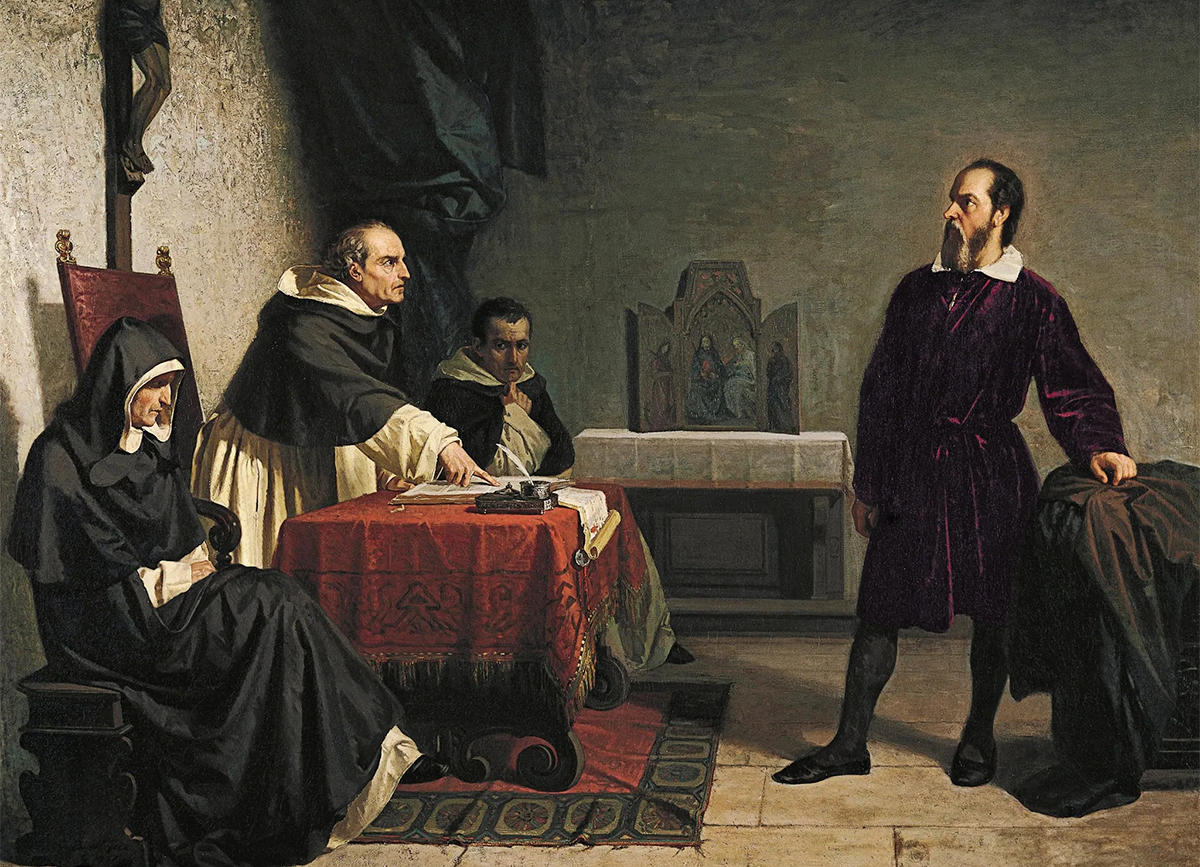
It must have been a rough Wednesday for Galileo. It was late June, and the visionary scientist had arrived in Rome months prior to face trial under “vehement suspicion of heresy.” His crime? Writing about and teaching the concept that the Earth was not the center of the universe, as the Catholic Church had held for generations.
Among all his insights and discoveries, the straw that broke the camel’s back was the 70-year-old luminary’s 1632 book Dialogue Concerning the Two Chief World Systems, a text in which Galileo compares the heliocentric model of the universe first championed by Nicolaus Copernicus against the church-backed, Aristotelian model of geocentrism. That text had church’s 1616 edict that banned any theory challenging its doctrine that the Earth was unmoving and the focal point of the cosmos as detailed in the Bible.
After decades of defending his view that the Earth moved around the sun, aided with the telescopes he had built and used, responding to attacks from fellow scientists and religious authorities alike, Galileo finally knelt before his accusers. Forced to recant his position under the threat of death, the scientific giant formally declared his guilt in a written document.
Read more: “Galileo the Science Publicist”
“I must altogether abandon the false opinion that the sun is the center of the world and immovable, and that the earth is not the center of the world, and moves,” he wrote, continuing that he would not teach or defend his former position verbally or in writing. He went on to curse his own work: “Therefore, desiring to remove from the minds of your Eminences, and of all faithful Christians, this vehement suspicion, justly conceived against me, with sincere heart and unfeigned faith I abjure, curse, and detest the aforesaid errors and heresies, and generally every other error, heresy, and sect whatsoever contrary to the said Holy Church,” he continued. He promised even to denounce any others who promoted his views about the relative centrality of the sun or Earth in the heavens.
In closing, Galileo promised to “submit myself to all the pains and penalties imposed and promulgated in the sacred canons and other constitutions, general and particular, against such delinquents.”
The offending book was banned and copies burnt.
But the real pain Galileo suffered was to spend the remaining 9 years of his life under house arrest. He continued to write, publishing a book that laid the foundation for modern physics, Two New Sciences, about kinematics and material science, in Holland to avoid censorship from the Catholic Church.
The Catholic Pope John Paul II would, in 1992, admit that the Inquisition that punished Galileo had erred in condemning the scientist and his heliocentric model. What was regarded as heresy–that the Earth circles the sun—is now considered indisputable truth. 
Enjoying Nautilus? Subscribe to our free newsletter.
Lead image: Wikimedia Commons