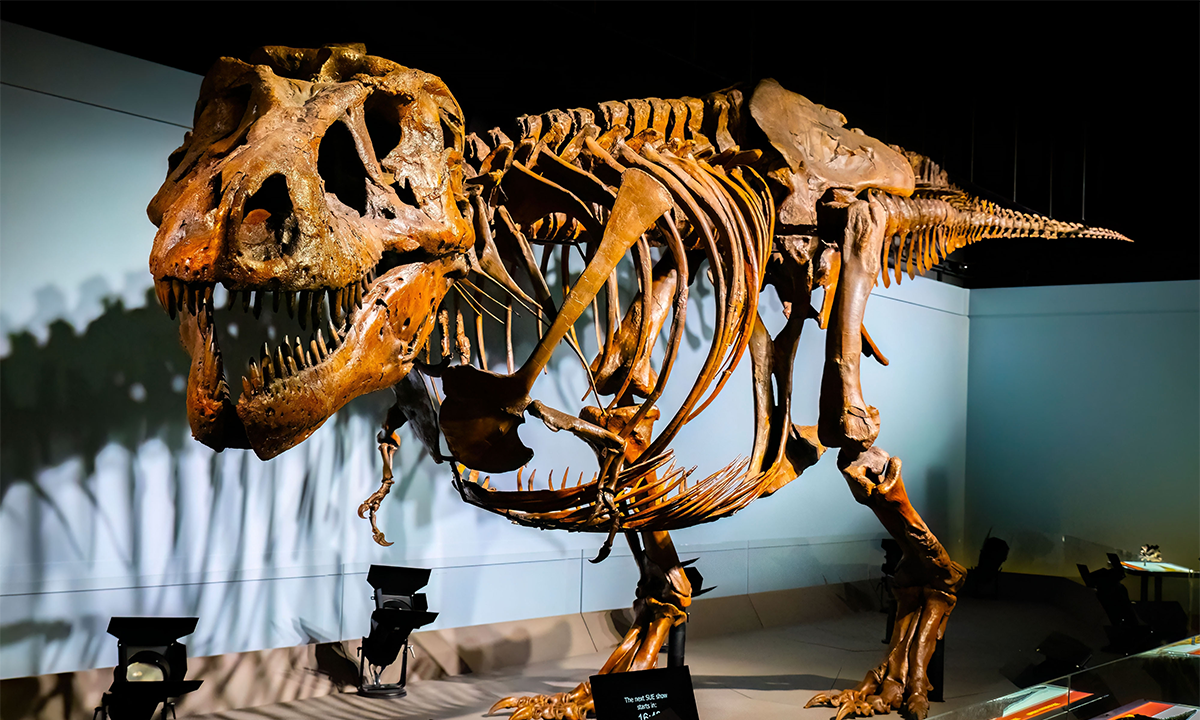
How long did it take for a Tyrannosaurus rex to grow to its maximum size of more than 17,000 pounds?
Growth often levels off at adulthood, so assessing annual growth rates of an animal can give you an idea not only of how fast it grew, but when it reached maturity. Like you’d do for a tree, you count and measure growth rings in slices of T. rex leg bones, with wider rings indicating faster growth.
In a study published yesterday in Peer J, researchers examined growth rings in 17 Tyrannosaurus fossils to plot their pattern of growth.
“Examining the growth rings preserved in the fossilized bones allowed us to reconstruct the animals’ year-by-year growth histories,” explained lead study author and Oklahoma State paleontologist Holly Woodward Ballard in a statement.
Read more: “T. Rex Was a Slacker”
In the most complete analysis of Tyrannosaurus internal bone structure to date, the researchers examined femurs and tibias from young juvenile specimens to older adults. The use of polarized light facilitated analysis of growth rings that would otherwise be missed. A statistical algorithm led by mathematician Nathan Myhrvold combined data across specimens to come up with a growth trajectory for the species.
Previous studies had estimated time to max size for T. rex at about 25 years, but the new data indicates that it grew more slowly, reaching its maximum size at 35 to 40 years of age. That’s a really long sub-adulthood.
“A four-decade growth phase may have allowed younger tyrannosaurs to fill a variety of ecological roles within their environments,” hypothesizes co-author and Chapman University paleontologist Jack Horner. “That could be one factor that allowed them to dominate the end of the Cretaceous Period as apex carnivores.”
The new data also adds fuel to an ongoing debate about whether smaller specimens of T. rex are unique species—members of a hypothetical genus dubbed Nanotyrannus. Two of the 17 specimens, colloquially called “Jane” and “Petey,” proved to be outliers on these new growth curves. Thus, they may be species other than T. rex, as proposed in a recent related study published in Nature.
The inclusion of additional tyrannosaurid specimens into the statistical models would continue to beef up our understanding of how these animals became the giants of the Cretaceous. 
Enjoying Nautilus? Subscribe to our free newsletter.
Lead image: Photo Spirit / Shutterstock