The Ediacaran Period marked the first time something on Earth became recognizable as life. During this era, which lasted from around 635 to 535 million years ago, microscopic single-cell life transitioned to macroscopic multicellular organisms and animals started to develop rudimentary sensory organs and began moving around for the first time. Now, according to a new paper published in Scientific Reports, we can add another Ediacaran first to the list: handedness.
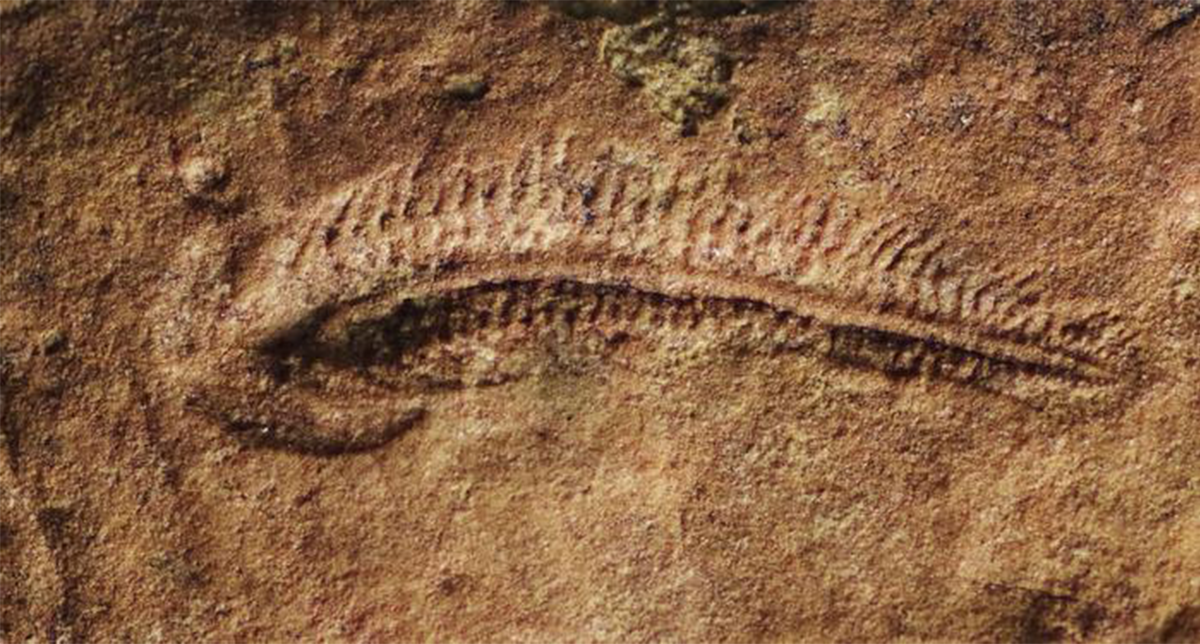
One of the first movers and shakers of the Ediacaran was Spriggina floundersi, an organism with bilateral symmetry, a segmented body, and an identifiable head that got around in part by bending its two-inch body. Although S. floundersi bears more than a passing resemblance to a trilobite, paleontologists are still divided on just which group it belongs to—possibilities range from worms to an extinct group of fern-like animals.
Southern Australia is littered with fossils of the little critter (in fact, S. floundersi is the region’s official fossil), and paleontologists studying them noticed something interesting—they tend to favor one side. Around twice as many of the S. floundersi they examined were preserved curled to the left instead of the right. Because the fossils record the mirror image of S. floundersi, this means that the living organisms preferred their right side.
Read more: “How Life Made Our Earth”
In other words, S. floundersi seems to be right-handed.
“When we talk about being right- or left-handed, most people likely think about how they hold a pencil or kick a soccer ball,” study author Scott Evans of the American Museum of Natural History explained in a statement. “But our research shows that an animal without hands or feet, living over 500 million years ago, may have had its own version of handedness.”
It’s a striking finding because such lateralized behavior, present in existing animals ranging from cats to cuttlefish, is a sign of a more sophisticated nervous system (or similar system) than was previously thought to exist during the period. “We know that living animals with this sort of handedness, from insects to octopi to birds and mammals, have complex sensory abilities,” Evans added. “So this may be telling us that the nervous system of Spriggina was relatively complex and more similar to those of animals that we know today.” 
Enjoying Nautilus? Subscribe to our free newsletter.
Lead image: Scott Evans / ©AMNH