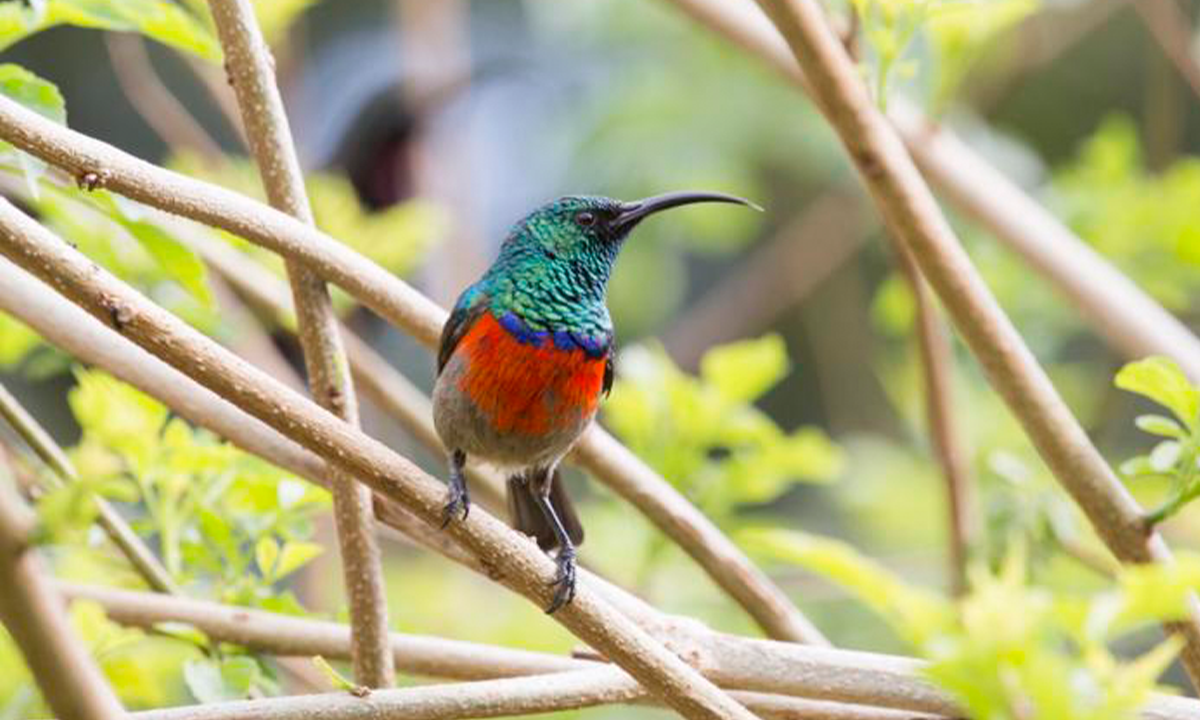
Sunbirds suck—literally.
New research published in Current Biology reveals they use their long tongues as a kind of makeshift straw to hoover up nectar in flowers—the first vertebrates known to do so.
Surely other animals must employ this technique. You might think, hummingbirds, for example, also feed from the nectar nestled within flower blossoms. That’s true, but research from a decade ago revealed the hummingbird tongue is more like a sponge than a straw.
Evolutionary biologist Alejandro Rico-Guevara of the University of Washington, an author on this latest paper as well, demonstrated that hummingbirds compress their tongues before plunging them into the sugary liquid. As they expand inside the flower, they soak up the nectar. Once retracted, the hummingbird squeezes them within their bill to wring out the bounty.
Read more: “Chasing James Bond’s Hummingbird”
Sunbirds, which resemble hummingbirds despite being only distantly related, have developed an entirely different mechanism for feeding on nectar. To get a close-up view of the process, study author David Cuban, formerly of the University of California, Berkeley, traveled to Africa and Asia to watch the birds in the wild.
Using 3-D-printed flowers and high-speed cameras, he was able to record the feeding process in action. He noticed bubbles forming along the surface of the sugar water, indicating the birds weren’t relying on capillary action to move liquids (as previously thought) because the interruptions of the surface tension would halt the flow.
How exactly do they do it?
Sunbirds have a unique V-shaped groove in their tongues that form a kind of trough for the nectar to travel up. By pressing the base of their extended tongue against their bills they can form an airtight seal. Retracting their tongues suctions the nectar along for the ride and treats the hungry birds to a sip. It’s a striking example of convergent evolution.
“I am fascinated by the phenomena of convergent evolution,” Cuban said in a statement. “Hummingbirds and sunbirds—and some other nectar-feeding birds—have similar morphology, coloration, behavior, and ecological niches, but once we zoom in on something specific, in this case their feeding mechanism, we find that they use completely distinct mechanisms.”
It just goes to show, evolution can come up with as many ways to solve a problem as there are animals that need to solve it. 
Enjoying Nautilus? Subscribe to our free newsletter.
Lead photo by Keith Barnes