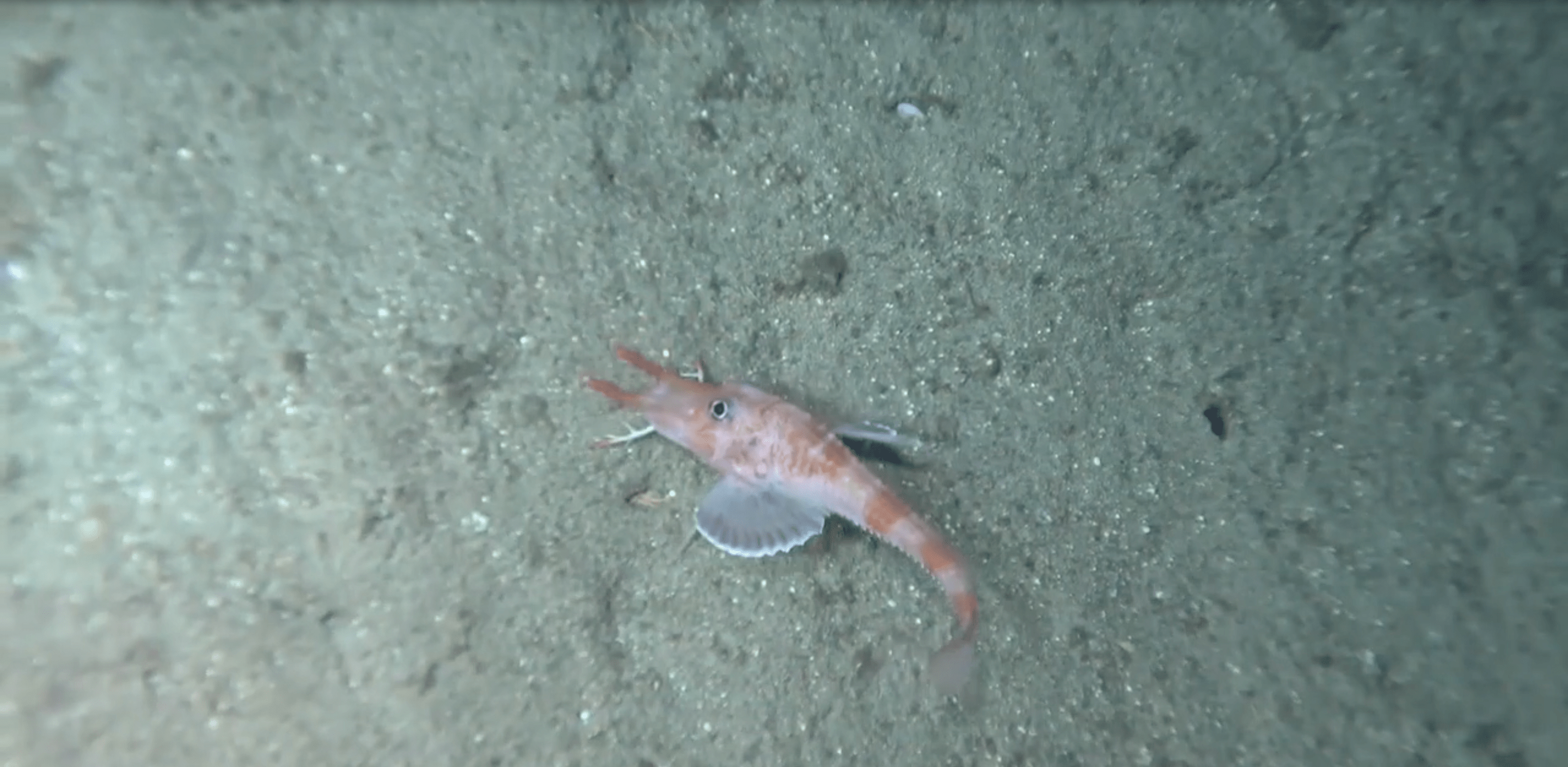
What looks like a shrimp, walks like a crab, and swims like a fish? The armored sea robin (obviously).
This mysterious deep-sea dweller likes to hang out on the ocean floor, which makes it tough to study in its natural environment—unless you have a submersible. Marine biologists from Sun Yat-sen University in China got a hold of one, and managed to capture videos of three different sea robin species in the South China Sea. They recently published their findings in the journal Ocean-Land-Atmosphere Research.
Read more: “Mysterious Deep Sea Habitats Reveal New Species”
Among other things, the team was able to confirm that sea robins use their fin rays for walking. These highly specialized appendages emerge from the fish’s pectoral region and can be operated independently of one another, acting like stiff “legs” that allow it to scuttle around on the ocean floor. In a first, the team captured one species (Scalicus engyceros) scurrying sideways and even backwards.
And the peculiarities don’t stop there. The armored sea robin’s pectoral fins have evolved into rounded plates that fan out like a skirt, offering much-needed balance while it’s foraging for food. They also possess unique snouts consisting of two paired protrusions, like tuning-fork prongs and rake-like appendages that extend outward. According to the team, these structures help them sense and probe prey in the sediment.
The expedition shed light as well on the sea robin’s eyes (literally). While they appeared undisturbed by the approaching deep-sea vehicles, they did take notice when the team shined a light on them. The researchers say this response indicates their eyes have retained some light-sensing activity, despite its inky black environment.
“These walking fish harbor far more novel behavioral and evolutionary adaptations than previously assumed,” study author Han Tian said in a statement. “Ultimately, this research will reshape scientific perceptions of deep-sea biodiversity and reveal how extreme marine environments drive the emergence of one-of-a-kind biological structures and behaviors unseen in any other aquatic organism on Earth.” 
Enjoying Nautilus? Subscribe to our free newsletter.
Lead Image and Video Credit: Kedong Yin