
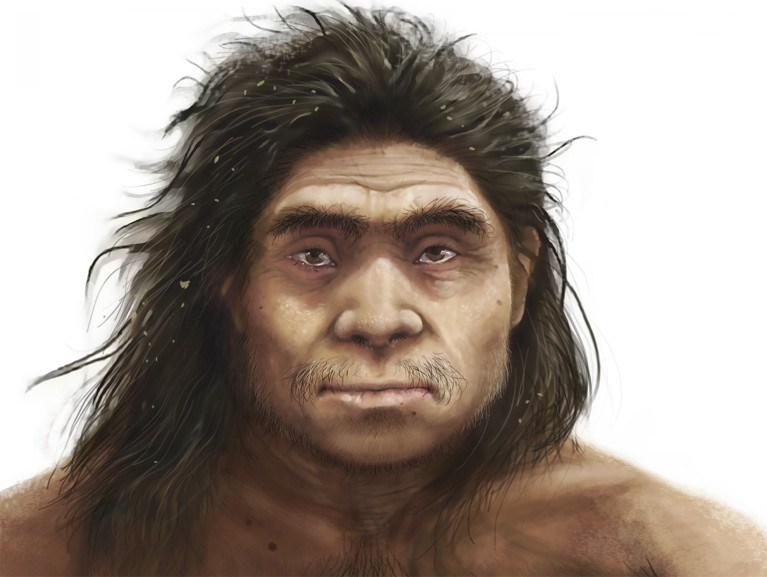
Of all our ancient relatives, the Denisovans might be the most mysterious. While fossils from these archaic hominins were unearthed nearly half a century ago, they were only determined to be a genetically distinct hominin line in the past 15 years. The name Denisovans comes from the Denisova cave in Russia where some of the first specimens were found. Now a new study published in Nature is putting a face to that name.
A team of paleoanthropologists and geneticists from the Chinese Academy of Sciences investigated a cache of 20 fossils dating to around 130,000 years old that were discovered in Xujiayao alongside tools and various animal remains. When the fossils were excavated in the 1970s, it was unclear which hominin group they belonged to. The team’s proteomic sequencing of collagen peptides revealed a key amino acid substitution unique to Denisovans and not found in humans or Neanderthals.
Read more: “Archaic Hominin Species Buried Only Their Women”
The researchers also performed an extensive morphological analysis of the Xujiayao skulls and jaws as well as the Harbin cranium, a near-complete Denisovan skull. According to the team, the Denisovan’s thick, wide skull cap is reminiscent of Homo erectus, the cavity that houses their inner ears resembled Neanderthals’, and the tall sides of their vaulted skulls were akin to those of modern humans.
Prior research has revealed that early hominins were rather promiscuous. Denisovans in particular interbred with Homo erectus, Neanderthals, and even modern humans. So it’s no surprise these hominins shared similar features. The overall shape of Denisovan skulls, however, were somewhat unique. According to their analysis, Denisovans have a relatively long, shallow skull with a low, sloping forehead, massive brow ridges, and flat cheekbones.
Of course, much of what we know about these enigmatic hominins is still new. As we uncover more fossils and technology and molecular techniques improve, the face of Denisovans may change further. Until then, this is our best glimpse into the past. 
Enjoying Nautilus? Subscribe to our free newsletter.
Lead Image: Institute of Vertebrate Paleontology and Paleoanthropology/Chinese Academy of Sciences