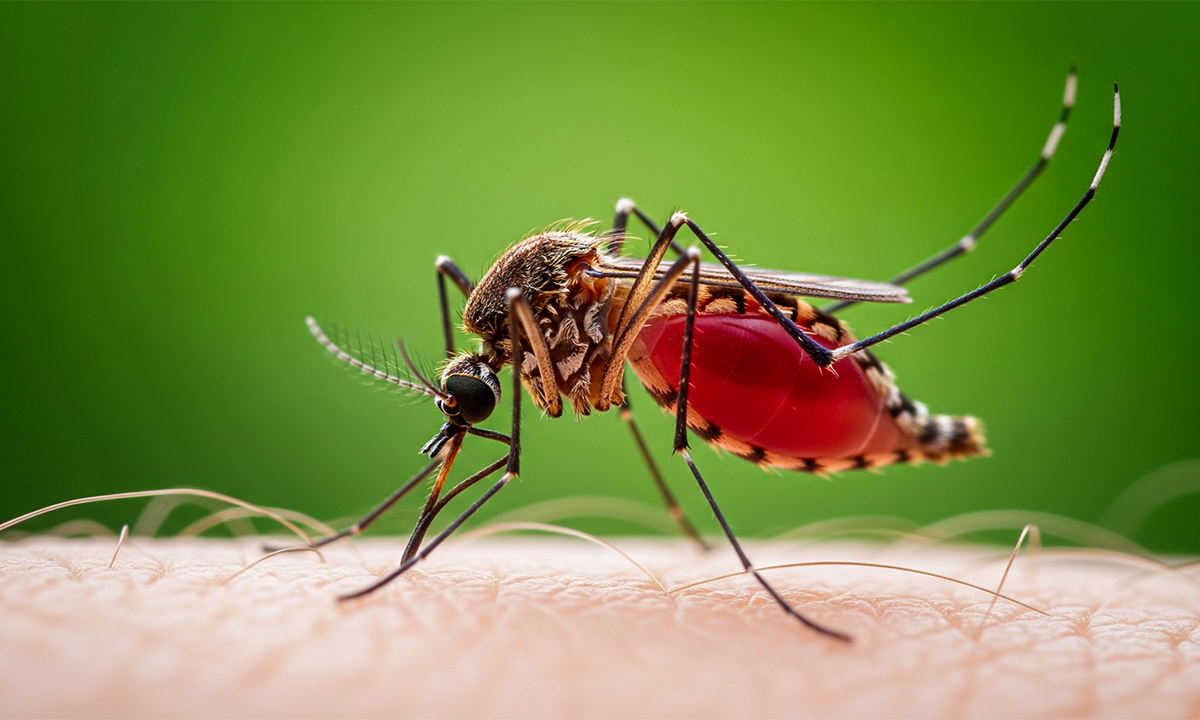
Traditional animal surveys are cumbersome—days and weeks of tromping around in the field looking for animals and signs of their presence in tracks, scrapes, and scats. But entomologists at the University of Florida have found a way to survey vertebrate animals from just a few drops of mosquito blood.
A paper published in Scientific Reports describes how analysis of mosquito blood can yield an estimate of vertebrate species assemblages that rivals traditional sampling methods. A companion paper, also in Scientific Reports, provided the results of using the technique in Central Florida’s Deluca Preserve. “They say Jurassic Park inspired a new generation of paleontologists, but it inspired me to study mosquitoes,” explained study author Lawrence Reeves in a statement.
Recalling the Jurassic Park trope of recovering dinosaur DNA from fossilized mosquitoes, he wondered whether mosquitoes could really yield information about the vertebrates in their ecosystems.
Read more: “Parasites Are Us”
Over eight months, Reeves and his University of Florida colleagues, led by graduate student Hanna Atsma, collected tens of thousands of mosquitoes, including 21 species, from the DeLuca Preserve. Using DNA barcoding, a sample of 2,051 mosquito meals were analyzed. The results brought to light a whopping 86 vertebrate species that had been bitten by mosquitoes—from bald eagles to coyotes to toads to gopher tortoises. Not many vertebrates appeared to have escaped the mosquitoes, although Florida panthers, which are extremely rare, didn’t show up in the sample.
In evaluating the mosquito blood analysis (MBA) results, the researchers led by postdoc Sebastian Botero-Cañola found that they outperformed conventional sampling methods, depending on the season. During the dry season, when mosquitoes are absent or at low densities, conventional sampling methods were superior. But during the wet season when mosquitoes come out in force, the MBA technique was as good as surveys in assessing total vertebrate diversity.
“I am acutely aware of the disdain humans have for mosquitoes,” explained Reeves, “but in their ecosystems, they play important roles, and we show here they can help monitor other animals to help conserve them or to inform how we manage ecosystems.” 
Enjoying Nautilus? Subscribe to our free newsletter.
Lead image: SILVIA MAQQ / Shutterstock