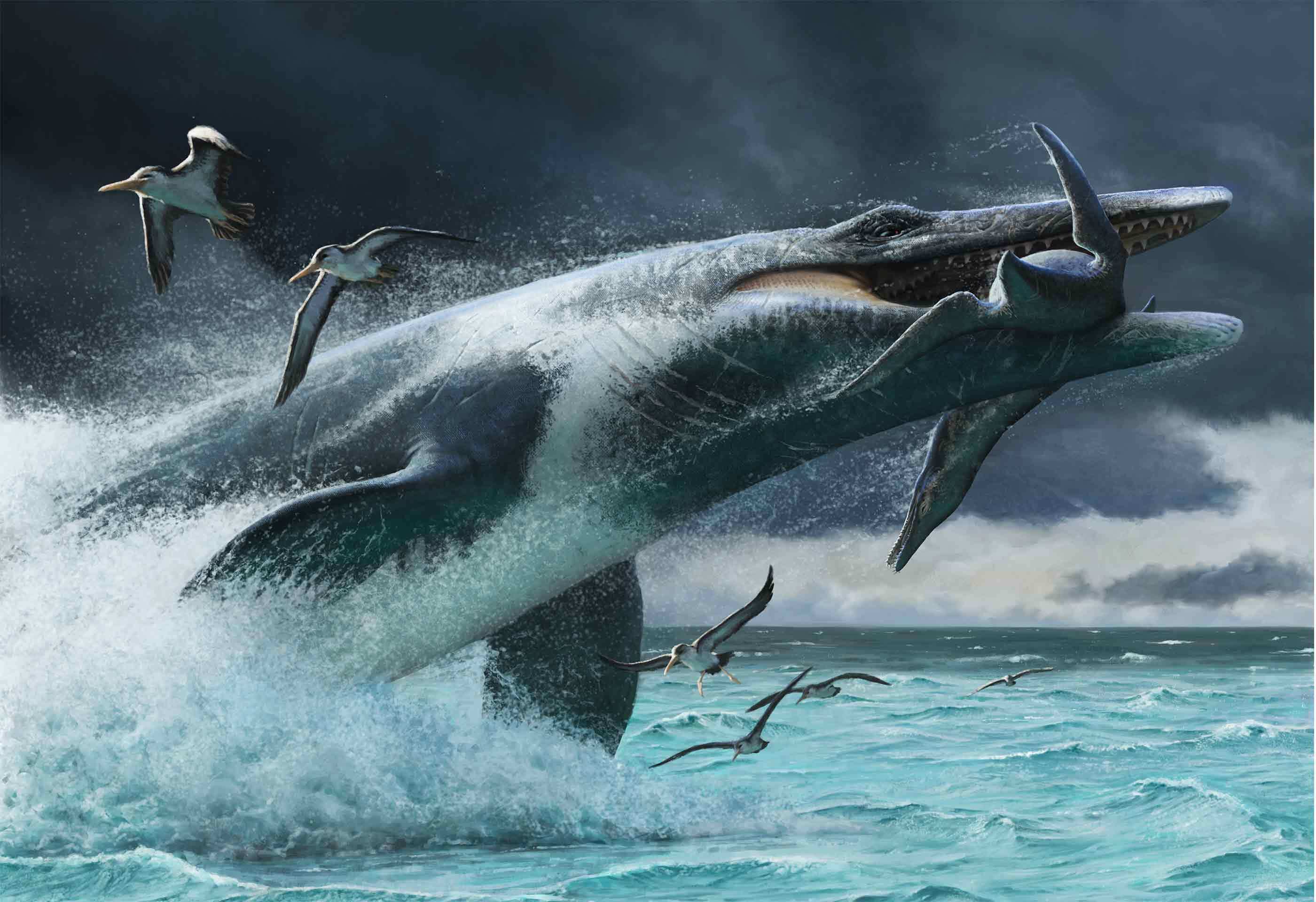
The megalodon shark is popular quarry of cryptozoologists, who speculate about the legendary creature’s persistence in our oceans. Now scientists have given the extinct shark new life with revelations about its own ancient quarries. The largest fish to ever live, Otodus megalodon (which, yes, did go extinct 3.6 million years ago) was “a transoceanic super-predator” that could grow to some 80 feet long—and swim faster than many of the fastest fish today. To fuel its tremendous growth and vigorous activity, it likely needed to eat about 50 times as much as an average adult human does each day.
One way it could have done that, scientists have suggested, is to specialize in calorie-rich whale blubber. What better way to sustain massive body size than to use other massive animals for fuel. But a new analysis of fossilized megalodon teeth suggest the shark was a far less discerning eater.
Fossilized teeth store traces of the minerals that helped to build them. And scientists have recently discovered that different isotope forms of the mineral zinc can reveal how much an animal might have been feeding on fellow fish-eaters. Analyzing these zinc isotope ratios reveals that “megalodon was by all means flexible enough to feed on marine mammals and large fish, from the top of the food pyramid as well as lower levels—depending on availability,” said Jeremy McCormack, a geosciences researcher at Goethe University Frankfurt, in a statement. He and his colleagues propose in a new paper published in Earth and Planetary Science Letters that this feeding behavior made the meg an “opportunistic supercarnivore.”
The megalodon teeth they studied came from 17 million- to 19 million-year-old fossils unearthed in current-day Germany, where the giants once swam in shallow seas. The zinc profiling, which has also been used to study prehistoric land animal diets, allows researchers to track changes in dietary patterns over time. The new findings support the notion that, although some of the megalodon’s largest prey was declining in parallel, competition from a new, smaller upstart known as Carcharodon carcharias (or the great white shark), was likely a large contributor to the megalodon’s ultimate demise.
Teeth have been the primary way scientists have gotten to know megalodon—whose name means “big tooth.” Their striking size and the knowledge that they once roamed the vast, under-explored oceans continues to whet the appetite of speculation about whether they persist to this day in deep ocean trenches, a lore that is fueled by science-fiction stories from the 1950s and “ecogothic” feature films of this millennium. But, as the author of a 2023 paper about megalodons reassures readers: “There is no conceivable way that O. megalodon could be living while utterly evading detection.” Or evidence for it in the oceanic food web. Something to chew over. 
Lead image: Antonio Viesa / Shutterstock