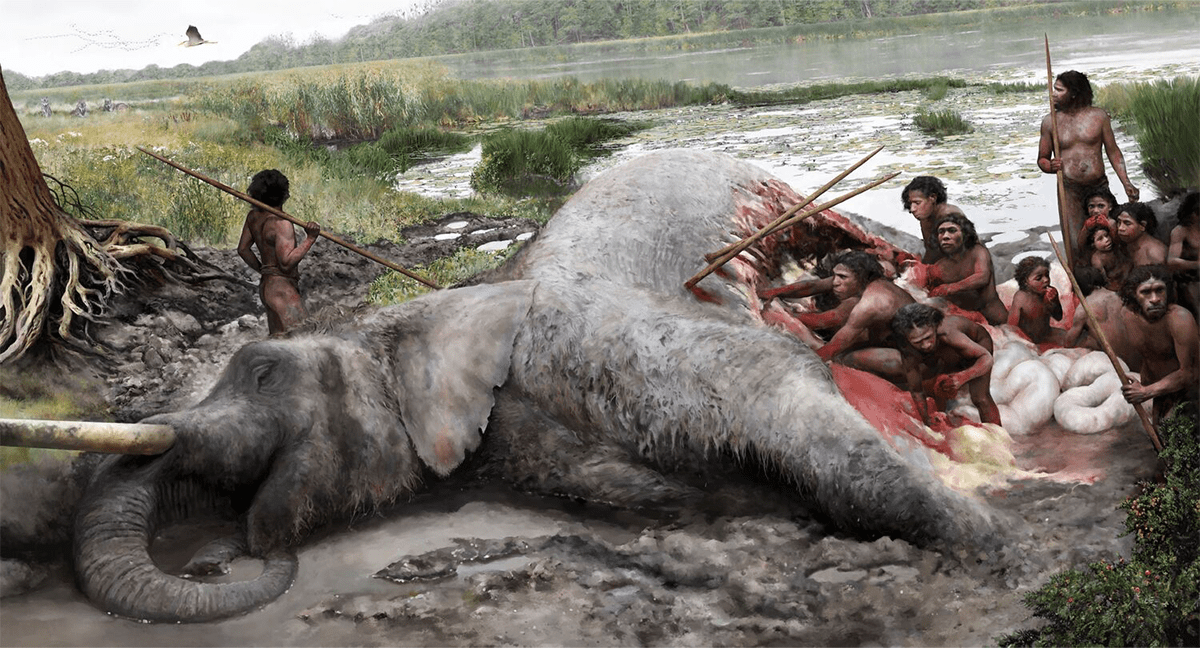
Straight-tusked elephants roamed the landscape of Stone Age Europe 125,000 years ago. Thirteen feet tall and weighing in at 14 tons, these prehistoric behemoths were the largest animals on the continent at the time. Now, new research published in Scientific Reports reveals they were stalked by predators: the Neanderthals.
In 1948, amateur archaeologists unearthed the skeleton of a straight-tusked elephant near the village of Lehringen in Germany. Between its ribs they found a spear almost eight feet long, fashioned from the wood of a yew tree. It was unclear at the time whether the spear washed into the carcass coincidentally or if it had been thrust there by hunters, but this new analysis reveals it was almost certainly the latter.
“The finds, which were recovered under difficult conditions in 1948, provide a crucial building block for an up-to-date understanding of Neanderthals, who were already hunting strategically with the same level of skill as anatomically modern humans were 125,000 years ago,” study co-author Thomas Terberger explained in a statement.
Conducting a detailed review of the site, which was an ancient lakeshore during the Pleistocene, zooarchaeologists from University of Göttingen and the Lower Saxony State Office for Heritage determined that Neanderthals not only killed the elephant, but butchered it there as well.
Read more: “Our Neanderthal Complex”
The team discovered cut marks on the interior side of the elephant’s ribs, indicating that the chest cavity had been opened and eviscerated. The elephant would have yielded quite a bounty, too—over 7,500 pounds of meat, fat, and organs that could have kept a large population fed for a considerable amount of time.
The elephant wasn’t the only animal Neanderthals processed at the site either. Bones from 16 different species—including fish, birds, and turtles—were discovered littered around as well. The team found cut marks on vertebrae from an aurochs, a massive, six-foot-tall ancestor of modern cattle, and signs marrow was harvested from bear bones. Additionally, beaver jawbones displayed tool marks indicating they had been skinned.
“It appears that Neanderthals in Lehringen repeatedly spent a long period of time at the lake and pursued diverse hunting strategies,” study co-author Ivo Verheijen said. “Large quantities of meat were important to them of course, but they needed bone marrow and fur as well.”
While lakeside barbecues have come a long way since then, our distant cousins had the core idea in place 125,000 years ago. 
Enjoying Nautilus? Subscribe to our free newsletter.
Lead image: Tom Björklund, Lower Saxony State Office for Heritage (NLD)