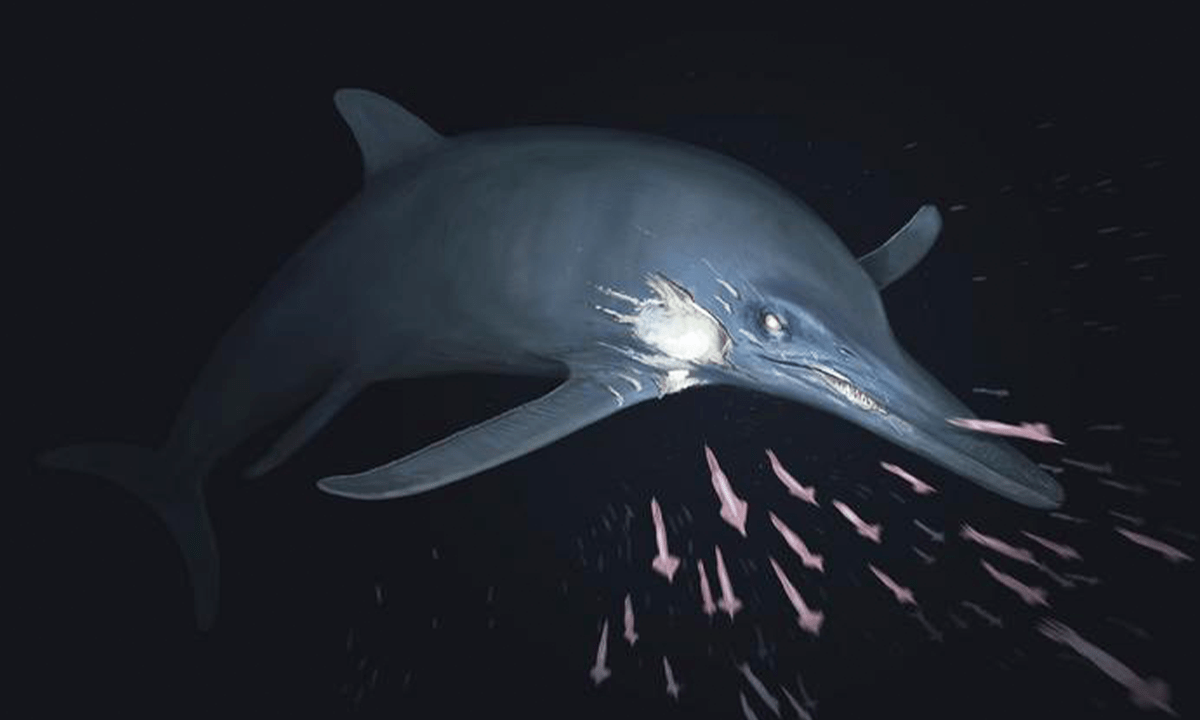
The oceans of the Early Jurassic period wouldn’t have been entirely alien to those of us living today. They were home to some familiar faces, like sharks, as well as plenty of bizarre-looking creatures, like the long-necked plesiosaurs. Then there were the ichthyosaurs, which were a little of both. Although they had a familiar dolphin-like silhouette, these fearsome marine predators were actually reptiles. Researchers recently unearthed the fossilized remains of one such ichthyosaur—and the find is a testament to the species’ survival skills.
Paleontologists from the Bavarian State Collections of Natural History made the find while excavating a fossil-rich clay pit near Bayreuth, Germany. The remarkably well-preserved skeleton consisted of the skull and upper torso, including the spine and more than 100 teeth. Notably, they were able to describe in detail rarely discovered structures like the eye sockets and fins. The team’s analysis, which they published in the journal Zitteliana, determined the species belonged to the genus Temnodontosaurus.
Read more: “These Gory, Rare Fossils Unravel Ancient Marine Rivalries”
“Our Temnodontosaurus fossil is one of the youngest finds of this ichthyosaur genus to date,” study co-author Ulrike Albert said in a statement. “The discovery now shows that these large marine reptiles survived longer in the Southwest German Basin than previously documented.”
And they were definitely survivors. The team discovered deformations in the shoulder and jaw joints, likely caused by old injuries. “The injuries likely significantly limited the animal’s ability to catch prey,” study co-author Stefan Eggmaier explained. “The fact that it nevertheless survived is evidenced, among other things, by its heavily worn teeth and gastroliths, which we were able to identify in the abdominal region.”
Gastroliths are pebbles that several species of animals ingest and retain in their gastrointestinal tracts to help grind their food, especially if they lack the teeth to get the job done. Still, they’re not commonly found in ichthyosaur fossils. Eggmaier believes the presence of these gastroliths suggests this particular predator’s injuries forced it to adapt to new food sources.
It certainly puts a new spin on the paleo diet. 
Enjoying Nautilus? Subscribe to our free newsletter.
Lead image: Paleoartist: Joschua Knüppe