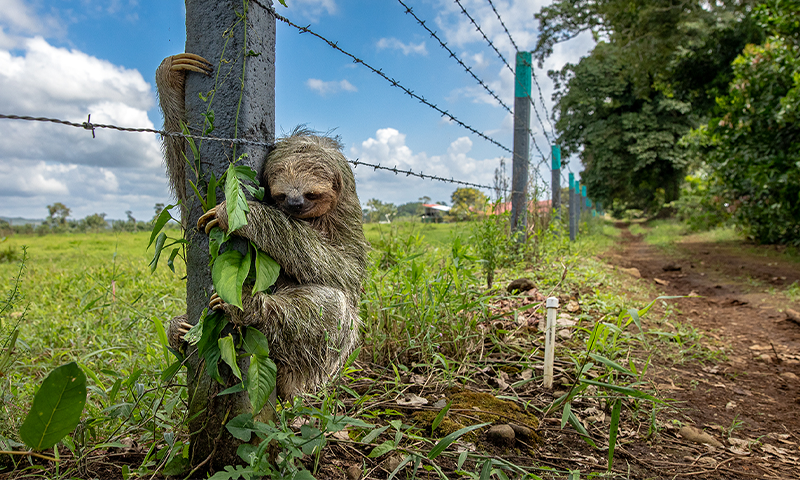
A brown-throated three-toed sloth strikes a familiar pose, clinging onto a fencepost as it slowly, very slowly, traverses the grasslands and forests of Costa Rica. Photographer Emmanuel Tardy said he watched the mammal cross the road and waited for a crowd of people to disperse before capturing this shot. The image starkly depicts the challenges sloths face as humans increasingly encroach on their habitat.
All five species of three-toed sloths are well known for their lethargy, moving an average of 125 feet on a given day. In spite of their perceived slowness and awkwardness, scientists note that sloths are remarkably adapted to survive in arboreal habitats. Their protruding, inches-long claws help them tightly grasp onto branches and trunks, and sloths expend very little energy daily, meaning they’re content to survive on a simple, low-calorie diet of leaves scavenged from the canopy.
Three-toed sloths move an average of 125 feet on a given day.
Yet the sloth’s reliance upon arboreal habitats is likely the underlying cause for their population decline across Costa Rica and South America, according to ongoing studies. As development creeps into natural spaces and humans introduce infrastructure like the fences shown above, sloths suffer. Ill-adapted to living on land, sloths are especially vulnerable to predators if removed from their arboreal niche and are unable to traverse across landscapes without the aid of continuous forest canopy.
The latter factor is particularly important to sloth reproduction—and by extension, their species’ genetic diversity and survival. Highly specialized, sedentary creatures like three-toed sloths struggle to navigate landscapes without adequate trees, isolating them from possible mates and limiting their access to breeding areas. Already, rescue nonprofits in Costa Rica report higher levels of birth defects among orphaned baby sloths, and subsequent research indicates that the cause may be inbreeding in urban areas where sloths can’t move beyond narrow pockets of forest cover.
As trees continue to vanish, the sloths are left with nowhere to go. 
This photograph won a commendation from the 2025 Wildlife Photographer of the Year competition.