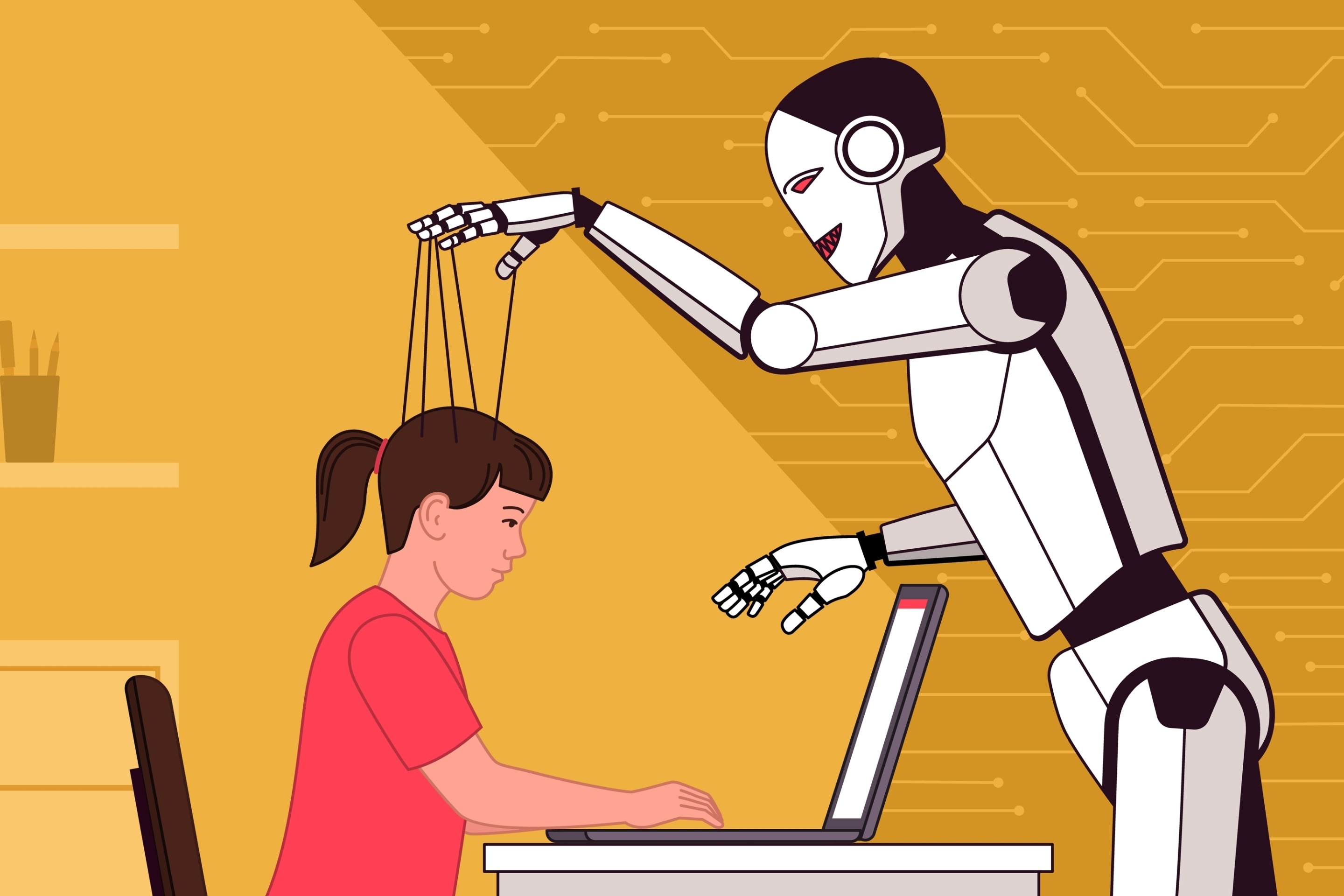
The post-pandemic rise in remote work led to an explosion of employee-monitoring technology, as bosses sought to keep tabs on workers’ activity, locations, and messages. Now, in the latest glimpse into our dystopian future, computer engineers at Rice University have previewed a new nightmare scenario for workers: constant biometric surveillance via hidden devices built into our work computers.
In a new study published in Computer Communications, researchers explain that the ubiquity of biometric devices like radar-based facial-recognition systems in our phones, and heart and breathing monitoring systems in wearable devices comes with some pretty significant privacy trade-offs. For example, it’s now possible to build devices—using off-the-shelf components—that can eavesdrop on phone conversations, track our movements, and monitor our heart and breathing rates to determine our emotional state.
To prove it, the team built a heart-rate monitor utilizing millimeter-wave technology and demonstrated that it could be used to detect when someone was present in the room, potentially providing a record of employee breaks and work activity. The team said the spy device could even be used to get a rough idea of whether someone was stressed, fatigued, asleep, and so on.
“We used this scenario to stage a technologically possible use case for a radar-based heart rate monitoring system,” study co-author Dora Zivanovic, a graduate student in the lab of Edward Knightly, the Sheafor-Lindsay Professor of Electrical and Computer Engineering at Rice University, said in a statement.
Oh, good.
Read more: “Darwin Was a Slacker and You Should Be Too”
If you’re wondering why researchers at Rice would give potentially malicious bosses a technological tool to tighten their grip on unsuspecting workers, never fear. They also built a device capable of fooling the spy tech.
Called the MetaHeart, this device proved to be capable of not just camouflaging the user’s heartbeat, but sending a false signal out to spoof the intrusive heart-rate monitor. Anyone using such a device would be free to have a panic attack in the next room, all while appearing to be steadily working away at their laptop.
“We fool the radar on the level of the electromagnetic signal itself,” Zivanovic explained. “You can program the device with any heartbeat pattern you like.”
While this study focused on biometric spying in the same room, future research could expand to potential long-range biometric surveillance from outside offices or domiciles.
“Sensing technologies are becoming higher resolution and more pervasive, and concerns around what that means for privacy should be taken seriously,” study co-author Knightly said. “It is important to explore potential vulnerabilities and think about how we might address them.”
Technology continues marching forward, but hopefully not over our backs. 
Enjoying Nautilus? Subscribe to our free newsletter.
Lead image: Alphavector / Shutterstock