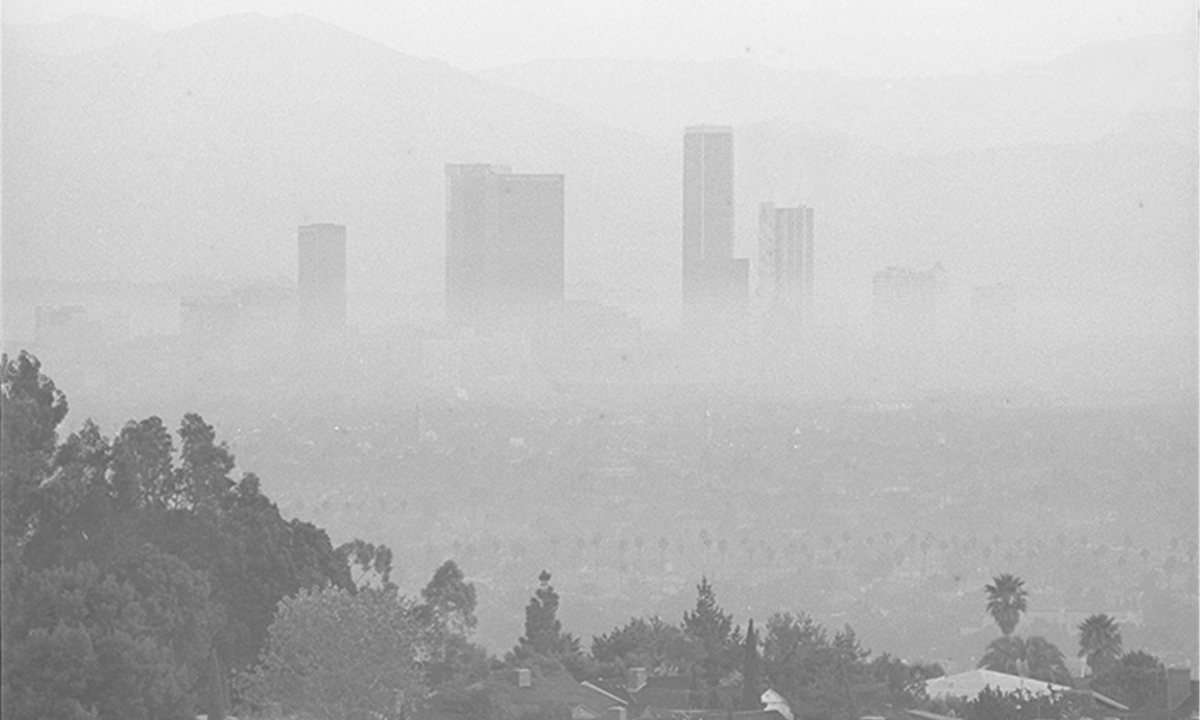
This week marks the 83rd anniversary of the first major smog incident in Los Angeles, when reports described a “hellish cloud” of pollution descending on the city. There had been complaints about industrial smoke in the area for a decade prior, but it took some time for L.A. authorities to work out why the problem was getting worse.
The big new contributor was one we’re all now well familiar with: automobile exhaust.
In the midst of a heat wave, the 1943 smog suffocation of L.A. seriously reduced visibility and led to burning eyes and throats. In fact, with World War II still raging, there was some initial concern that the city was under a chemical warfare attack.
While conditions have improved since that summer nearly a century ago, the smog problem hasn’t entirely gone away—and there’s a trail of photo evidence showing how it’s affected Angelenos over the years.
SETTLED SMOG: A smoggy L.A. skyline, viewed from Mulholland Drive looking out on the 101 Freeway toward downtown, in 1984. Credit: Los Angeles Daily News Negatives, UCLA Library Special Collections.SMOG WALK: The view from the sidewalk on a smog-filled day in 1953. Credit: Los Angeles Times Photographic Archive, UCLA Library Special Collections.CLEAR THE AIR: An experimental smog-control device being tested on a smokestack in 1948. Credit: Los Angeles Times Photographic Archive, UCLA Library Special Collections.
SMOGGY CITY: The L.A. Civic Center shrouded by “eye-smarting” smog in 1948. Credit: Los Angeles Times Photographic Archive, UCLA Library Special Collections.VOLTS-WAGON: An electric-powered L.A. Department of Water and Power truck driving down the street on a smoggy day in 1967. Credit: Los Angeles Daily News Negatives, UCLA Library Special Collections.NOT SO PARK-ISH PARKWAY: Looking down from the hills of Arroyo Seco Parkway at the L.A. City Hall and Civic Center surrounded by smog in 1948. Credit: Los Angeles Times Photographic Archive, UCLA Library Special Collections.HELPING HANDS: Boy Scout Jeffrey La France helps Nancy Rayder, 11, dry her eyes during a four-hour smog alert in Reseda. Credit: Los Angeles Times Photographic Archive, UCLA Library Special Collections.
SHROUDED IN SMOG: Century City towers appearing through the smog with the Santa Monica Mountains in the background, in 1980. Credit: Los Angeles Times Photographic Archive, UCLA Library Special Collections.UNDERCOVER: Some Angelenos, like this Manhattan Beach resident, built their own “smog-alert” chambers. Credit: Los Angeles Daily News Negatives, UCLA Library Special Collections.HIDDEN CITY: Downtown high-rise buildings surrounded by blanket smog in 1973. Credit: Los Angeles Daily News Negatives, UCLA Library Special Collections.
David Nield has written about science and technology for more than 20 years. His work has appeared in a wide range of publications, including Wired, Popular Science, The Guardian, and Gizmodo.
The world is full of tiny things that live off more charismatic hosts. Parasite ecologists say that these critters, too, are finally starting to get the conservation attention they deserve