
Every year the World Meteorological Organization (WMO) puts out a Dust Bulletin—a record of how many sand and dust storms hit our planet over a 12-month period which notes how dangerous those storms might be for air quality, health, and the environment.
The July 2026 bulletin has now arrived, covering the year 2025, and while the overall dust surface concentrations were comparable to 2024, there were certain areas that were significantly impacted by dust and sand storms—to a record-breaking level, in some cases.
Every year about 2,000 million tons of dust gets kicked up into the atmosphere, and it can travel for thousands of miles, given the right conditions. Its spread isn’t hemmed in by borders or oceans, and while much of this cycle isn’t affected by human activity, enough of it is: by water and land management, by environmental degradation, or by drought caused by a warming world, for example.
“Sand and dust storms affect air quality and human health,” said WMO Secretary-General Celeste Saulo in a statement. “They reduce agricultural productivity, disrupt transport and aviation, strain water and energy systems, and damage ecosystems. No country is immune to their impacts.”
Read more: “What Can We Do with Moon Dust?”
Dust concentrations remained centered on the Bodélé Depression in Chad in 2025, while North Africa and the Middle East were hit by major dust intrusions—both long-standing patterns seen in previous years.
China experienced its worst sand and dust storm in a decade, after large volumes of material were swept down from Mongolia to the north. In some spots, concentrations of inhalable particles reached 4,000 μg/m³ (micrograms per cubic meter of air), which is many times higher than the official World Health Organization recommended 24-hour exposure level of 45 µg/m³.
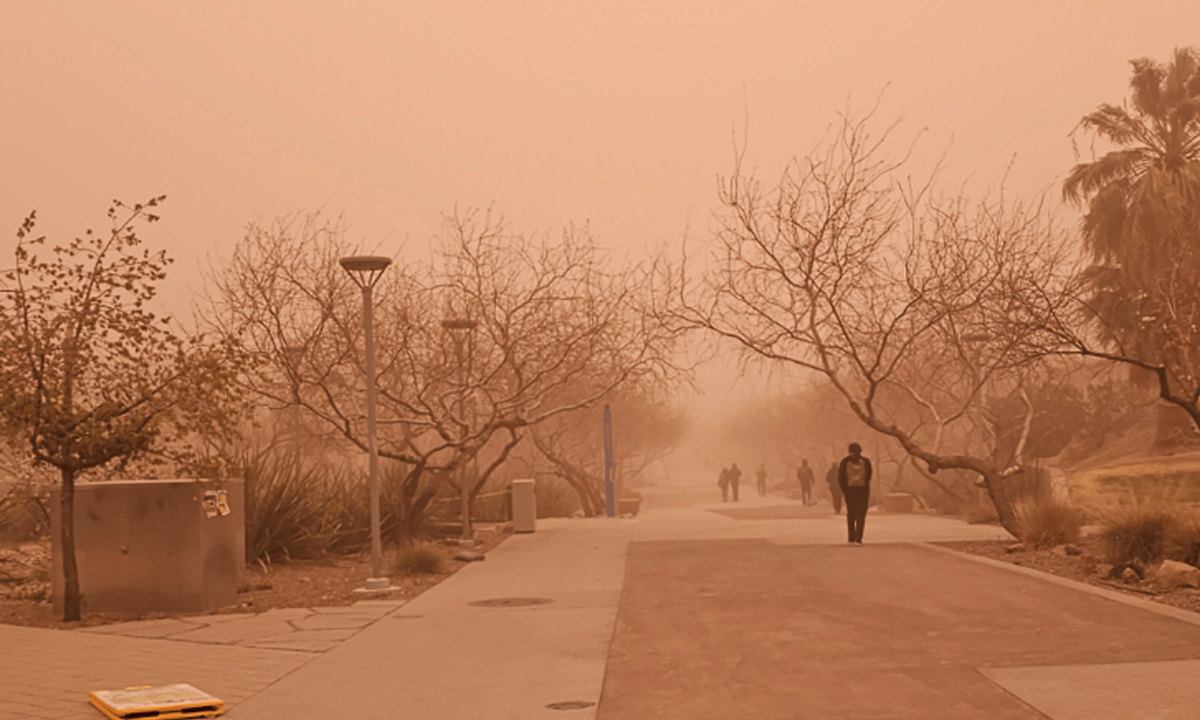
Along the Mexico-United States border, there was a significant uptick in dust and sand storm activity as well. El Paso had 50 “dust weather” days in 2025, double the annual average, and the highest since the Dust Bowl catastrophe of the 1930s.
This activity peaked on March 18, with six hours of continuous sand and dust storms, and an hourly reported level of inhalable particles of 8,142 μg/m³. That’s the highest level since records began. Conditions were bad enough that schools, highways, and airports were closed, and there were multiple fatal crashes on the roads.
The link between dust storms and poor health is clear: A study published last year reviewed the evidence and found strong associations with increased mortality risk, respiratory and cardiovascular diseases, eye diseases, children’s neurodevelopment, and risk of suicide.
But there is some good news. The WMO believes improving AI models will lead to improved forecasting that’s quicker and cheaper to implement, helping to focus resources and interventions.
“Because sand and dust storms and droughts do not respect borders, international cooperation is essential,” said Saulo. “Strengthening shared observations, data exchange, and regional forecasting capacity allows all countries—especially the most vulnerable—to benefit from advances in science and early warning.” 
Enjoying Nautilus? Subscribe to our free newsletter.
Lead image: Katalina Salas