Does it smell like something’s burning? That would be the more than 800 active wildfires in Canada.
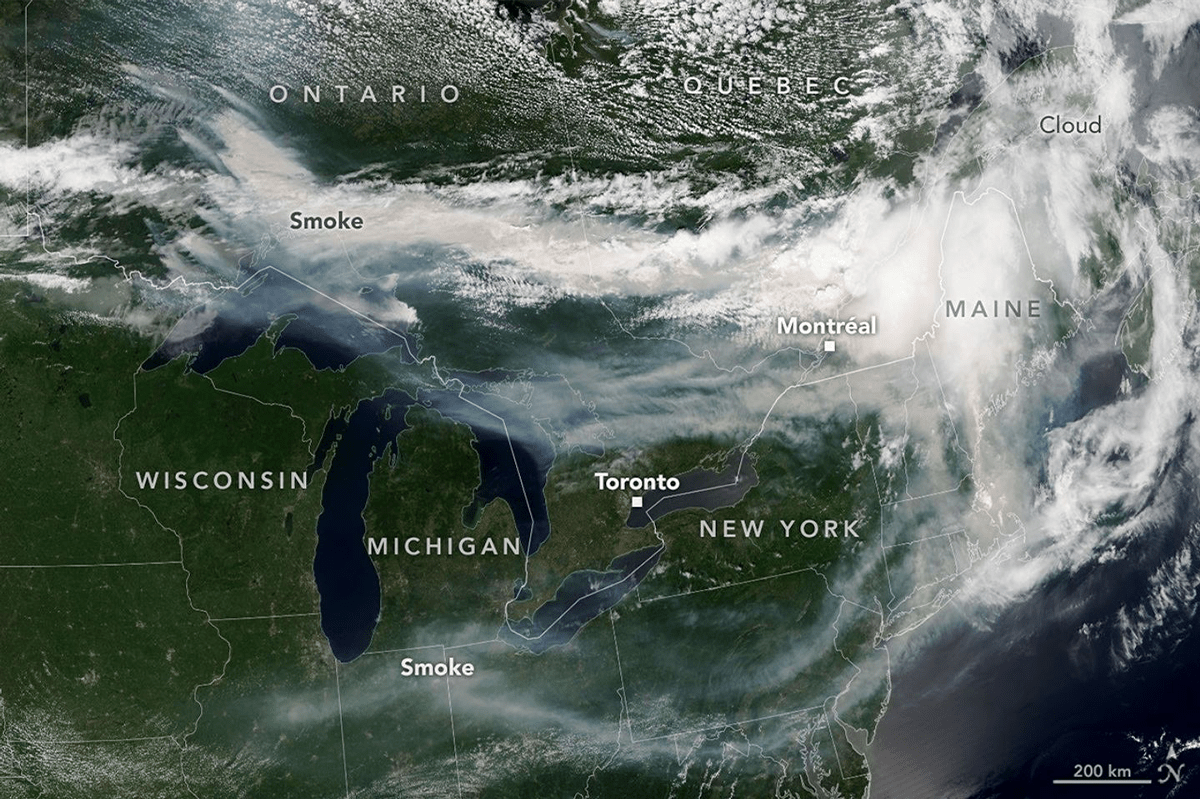
An image posted to X (formerly Twitter) by the United States National Weather Service (NWS) shows the vast extent of the wildfire smoke continuing to billow across northeastern states, coming from wildfires in southern central Canada and northern Minnesota.
As per the Canadian Wildland Fire Information System, close to 900 wildfires are now burning across the Great White North, though it’s the ones closest to the U.S. border that are having the most impact on air quality for more than 100 million U.S. residents in the Midwest and Northeast.
The change in air quality has led the NWS to issue purple-level alerts (that is, an air quality index of above 200) across affected states like Pennsylvania and Maryland—that’s the second-most severe level.
“Everyone should limit outdoor strenuous activity and exercise due to poor air quality,” warns the NWS in an air quality alert. “Sensitive groups should avoid all outdoor activity. Sensitive groups include children, the elderly, and people suffering from heart disease, asthma, or other lung diseases.” (You can check the official advice for your region here.)
More photos posted to social media show how the smoky haze is reducing visibility and casting a brown and orange hue across vast stretches of the country.
Wildfires produce particulate matter less than 2.5 μm (micrometers) in diameter, small enough to get into the lungs and cause inflammation. The main health threat comes from exacerbating existing conditions in the lungs, heart, brain and nervous system, skin, gut, kidney, eyes, nose, and liver, according to the World Health Organization.
Read more: “What’s Fueling Today’s Extreme Fires”
In a study published in Nature last year, researchers estimated that 5,400 acute (short-term) deaths in North America could be attributed to wildfire smoke from Canada, a number that balloons to 64,300 deaths across both North America and Europe for chronic (long-term) deaths.
As big emitters of carbon dioxide, wildfires also contribute significantly to global warming and climate change, while being a consequence of the planet’s steady temperature rise as well. It’s a vicious cycle that’s challenging to break.
According to forecasters, the smoggy conditions are likely to extend into the weekend, though changes in weather systems and wind patterns should mean the northeastern states start to get some relief going into next week—though the wildfires themselves will continue to burn (last year’s wildfire season, for example, stretched into November). 
Enjoying Nautilus? Subscribe to our free newsletter.
Lead image: NASA Earth Observatory/Lauren Dauphin