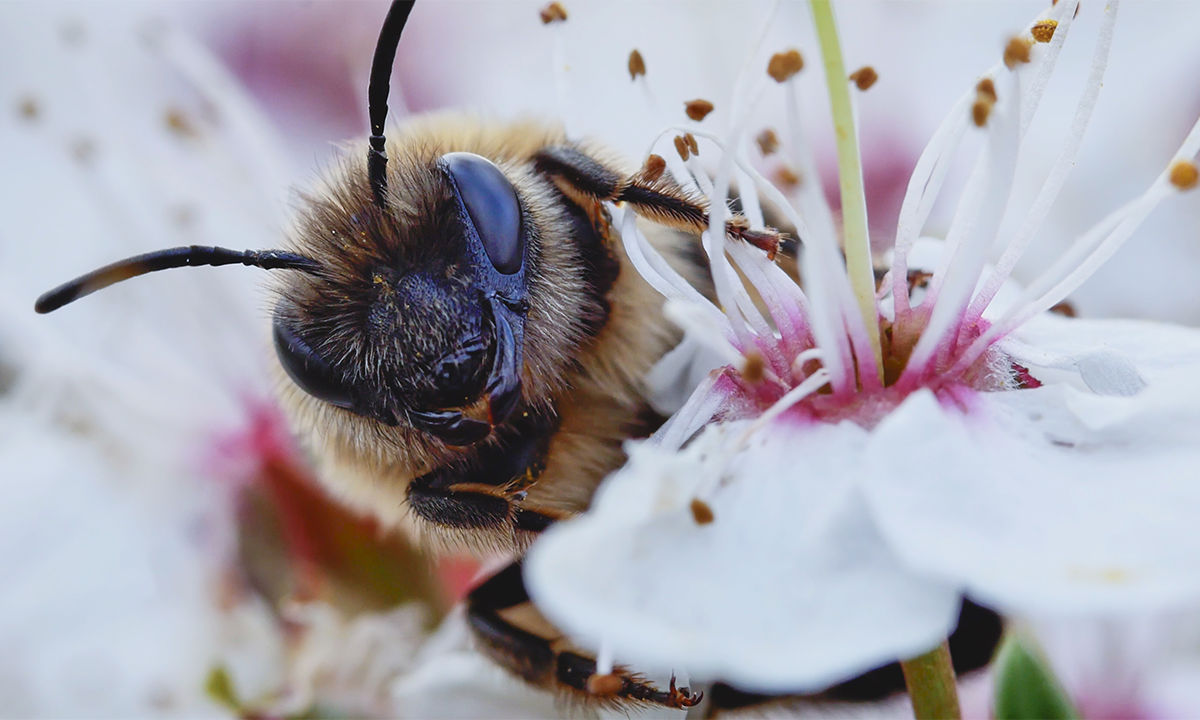
Ever wonder what goes on in the mind of a honeybee?
According to new research published yesterday in Science Advances by neuroscientists Brian Smith of Arizona State University and Read Montague of Virginia Tech, it might not be that different from what goes on in our own minds.
With a lifespan that can last only a few weeks, bees don’t have a lot of time to figure out how to locate flowers, harvest nectar, and bring it back to the hive for processing. And so, to accomplish such a big job in a short time period, they have to be primed to learn quickly.
“That bee has to be a learning machine,” Smith explained in a statement. “You have to be prepared to forget what you learned yesterday and learn something new today. And if they can’t do that, they’ll never be able to perform their task within the colony.”
It’s what makes bees such an attractive model organism for scientists studying the learning process. As master foragers, honeybees are adept at quickly forming connections between odors and rewards—when blasted with a scent and given a sugary treat, they’ll mentally link the two. They also send a clear signal they’ve made the connection by extending their proboscis when they encounter the odor on its own, just like Pavlov’s dog salivating at the ring of a bell.
Read more: “The Dreams of a Bumblebee in Autumn”
To get a better understanding of the neurochemical cocktail produced during learning, Smith and Montague slipped tiny electrodes into the bees’ antennal lobes, allowing them to measure neurotransmitter activity in real-time while conditioning them with certain odors.
They found that some bees were quick learners, thrusting out their proboscises after only a few odor-reward pairings. Others took longer to make the connection—somtimes as many as eight pairings. This variation, they discovered, was closely tied to the activity of the neurotransmitters octopamine and tyramine, the invertebrate equivalents of epinephrine and norepinephrine in mammals.
Bees that showed a stronger signal during their introduction to the odor and reward tended to learn more quickly. As learning progressed, the non-learning bees showed little variation in their neurochemical response. For bees that learned quickly, octopamine and tyramine levels changed after the behavior was mastered, while dopamine and serotonin levels gradually declined.
Because these basic neural pathways evolved 130 million years ago in bees, researchers hope they’ll help them uncover how other species learn—including humans. Or as Montague put it, “These are evolutionarily very, very old systems that we still have in our brains.” 
Enjoying Nautilus? Subscribe to our free newsletter.
Lead image: Andreiii77 / Shutterstock