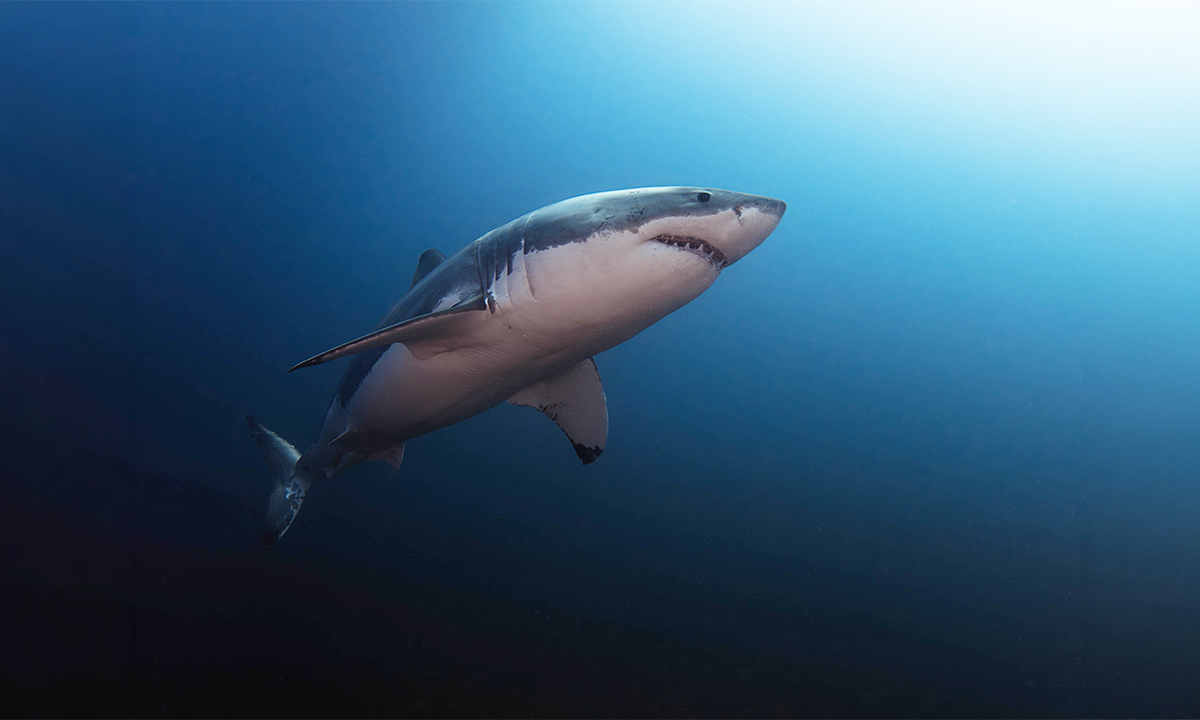
On April 20, 2023, a juvenile great white shark measuring about 83 inches long and weighing about 187 pounds was caught off the coast of Spain. It made a splash in the news since great white sharks (Carcharodon carcharias), which were common in the Mediterranean during the Pleistocene, are scarce there today.
This unusual encounter prompted researchers from the Spanish Institute of Oceanography, in collaboration with the University of Cádiz, to explore great white shark records from 1862 to 2023. Most were direct encounters with sharks, but a handful consisted of interpretations of bite marks on stranded marine animal carcasses. The review study, recently published in Acta Ichthyologica et Piscatoria, showed a minimal but continued presence of great white sharks in Spanish coastal waters.
Swimmers in the area may balk at the news, but researchers are excited, given the important role of great white sharks in their ecosystems. “As highly migratory pelagic species, they redistribute energy and nutrients across vast distances,” said lead study author and Spanish Institute of Oceanography biologist José Carlos Báez in a statement. “Even in death, their descent to the seafloor provides a critical pulse of nourishment for deep-sea communities.”
Read more: “Lessons for the Return of Great White Sharks”
Great white shark populations are categorized as vulnerable and declining on the IUCN Red List. The main threats to their survival are bycatches in long lines, gillnets, trawls, and other inshore fishing equipment. Case in point: The recently captured shark was caught by local fishermen targeting bluefin tuna in an area with deep canyons about 11 nautical miles off the coast of Spain’s eastern peninsula, Cabo de San Antonio.
According to the review, it was one of 62 great white shark sightings noted during the 160 years of record-keeping. The other most recent one was in 2018 during a scientific expedition. The study authors conclude that, while Mediterranean great white sharks comprise an elusive “ghost” population, they still do maintain a presence in these waters. Indeed, “the occurrence of juvenile specimens raises the question whether active reproduction may be occurring in the region,” said Báez.
It’s also possible that the young shark was born elsewhere in known central Mediterranean breeding spots, after which it migrated to Spain. Regardless, it’s a rare example of a heartwarming marine ghost story. 
Enjoying Nautilus? Subscribe to our free newsletter.
Lead image: Balazs Fodor / Ocean Image Bank