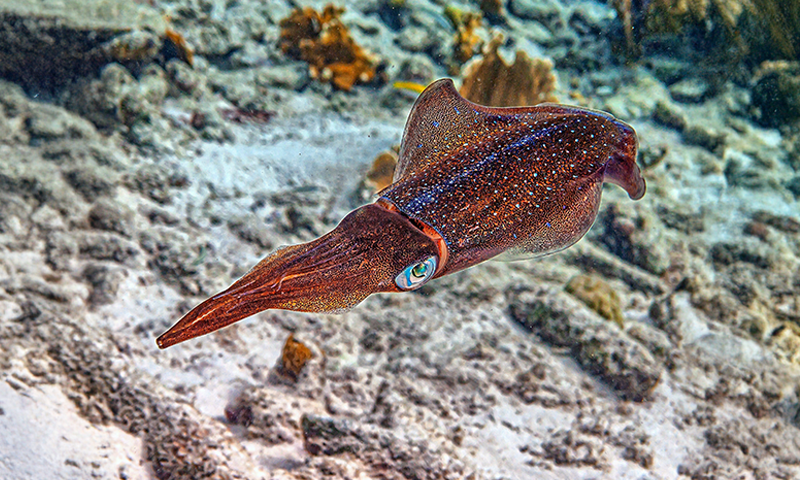
One hundred million years ago, there were plenty of fish in the sea. But you know what there were more of? Squids.
A team of scientists in Japan suggests that ancient oceans were writhing with the crafty cephalopods, a finding that could help rewrite the paleoecology of marine environments. Squids likely even outnumbered bony fish and ammonites, extinct, shelled relatives of squid that researchers have long thought to be the most numerous swimming animals in seas of the Mesozoic Era, a geologic period stretching from 252 to 66 million years ago.
The researchers, from Hokkaido University, uncovered the unexpected abundance of ancient squid species using a new fossil discovery method they developed called grinding tomography. By grinding Late Cretaceous (100- to 66-million-year-old) rocks from Japan, photographing each cross section, and digitizing the embedded fossils within, they found fossilized beaks from 263 squid specimens, about 40 of which belonged to species that had not been known to science. Their results appear today in Science.
“These findings change everything we thought we knew about marine ecosystems in the past,” said Yasuhiro Iba Hokkaido University researcher and senior author on the study, in a statement. “Squids were probably the pioneers of fast and intelligent swimmers that dominate the modern ocean.”
“In both number and size, these ancient squids clearly prevailed in the seas,” agreed Hokkaido University’s Shin Ikegami, the study’s first author. “Their body sizes were as large as fish and even bigger than the ammonites we found alongside them. This shows us that squids were thriving as the most abundant swimmers in the ancient ocean.” 
Lead image: John A. Anderson / Shutterstock