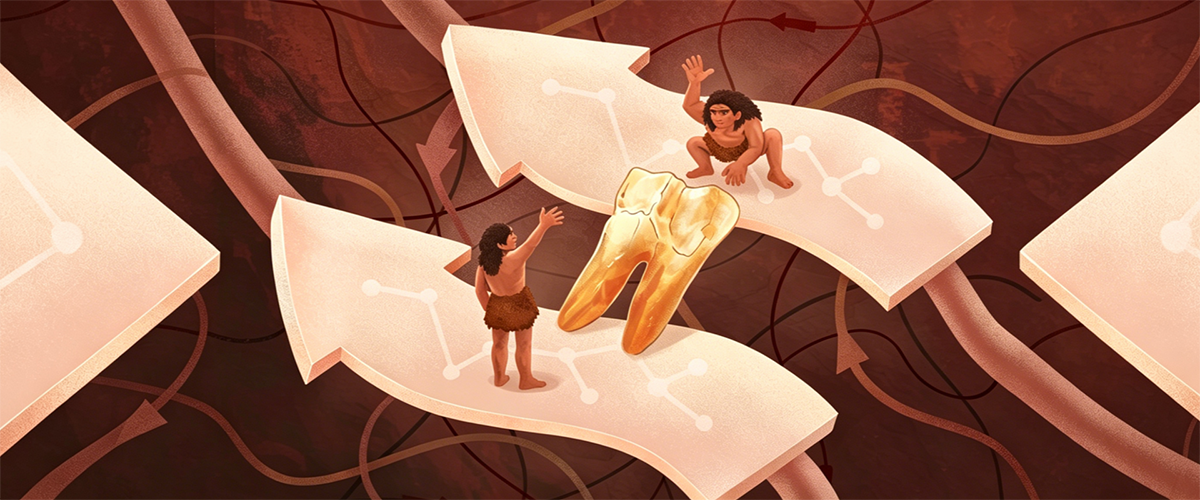
Of all the early hominins in the human family tree, Homo erectus might be the first that we recognized as “one of us.” That’s because, as the species name suggests, Homo erectus was the first hominin to primarily walk upright, almost 2 million years ago. And once they evolved this ability, members of the species ventured out of Africa and deep into Asia. There, they overlapped with a later human relative, the mysterious Denisovans, and new research published in Nature reveals the two may have interbred.
A team of paleogeneticists from the Chinese Academy of Sciences carefully extracted proteins from 400,000-year-old Homo erectus teeth found at three sites in China. By sequencing the peptide chains from the enamel protein ameloblastin, they were able to tease out two interesting variants. The first, a substitution of the amino acid glycine for alanine, wasn’t present in any modern human variants, meaning it’s likely unique to Homo erectus. The second, a substitution of valine for methionine (M273V), was also found in Denisovans. According to the researchers this suggests the two groups interbred.
Read more: “The Last Hominin Standing”
And this is where things get really interesting. Past research has shown that Homo sapiens interbred with a number of our archaic relatives, including Denisovans, Neanderthals, and an unknown “ghost” group. The M273V variant has also been found in a small subsection of modern humans in the Philippines. It’s possible then that Homo erectus interbred with Denisovans who later passed Homo erectus DNA on to us. It’s also possible that Homo erectus is this mysterious ghost hominin.
Unfortunately, Homo erectus bones are so ancient they haven’t given us any usable DNA to work with, so we may be haunted by speculation for a long time. 
Enjoying Nautilus? Subscribe to our free newsletter.
Lead image: IVPP