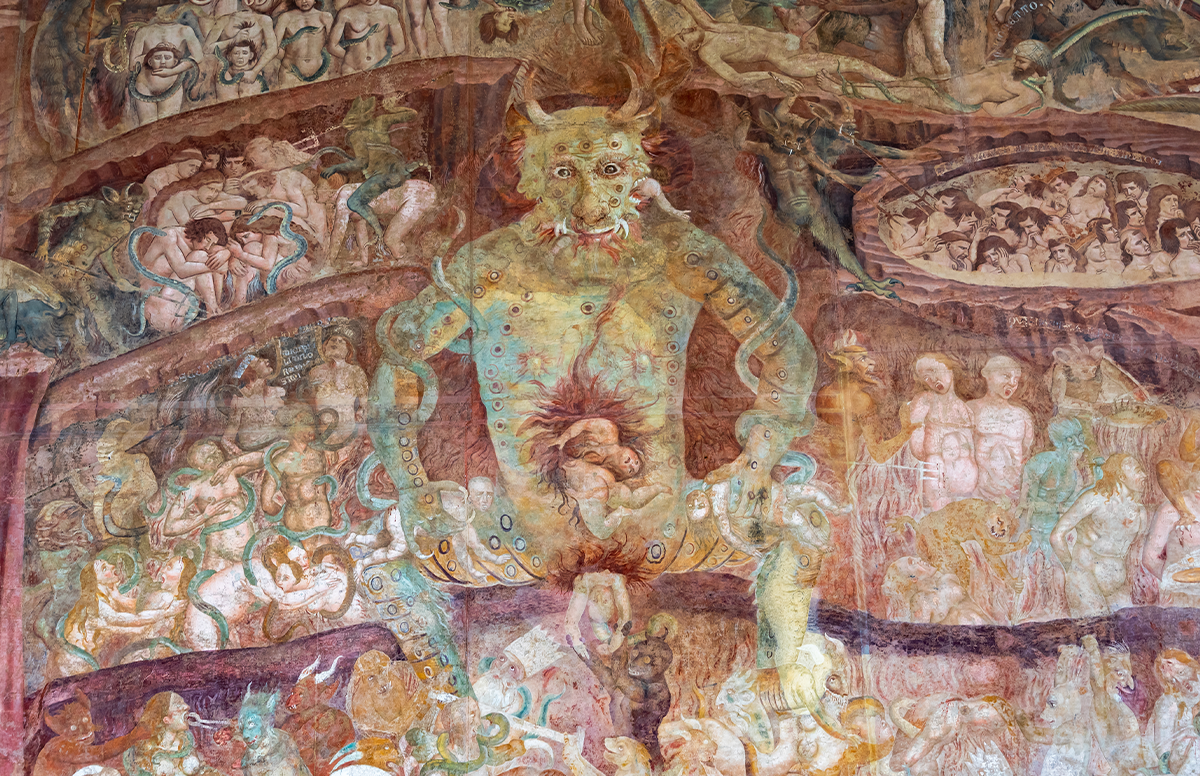
An interloper recently crashed a European Geosciences Union conference: Timothy Burbery of Marshall University was the lone English professor among 18,000 geoscientists. He is also an expert in geomythology, or the study of how pre-scientific cultures used legends and myths to explain mysterious geological events, such as volcanoes, tsunamis, and fossils. Burbery came to the conference with a wild idea: Dante Alighieri’s The Inferno wasn’t just a 14th-century epic poem and literary masterwork. It presaged the modern science of falling space rocks by 500 years.
Dante’s story of Satan’s fall has long been read as an allegory of spiritual collapse, a long, hard descent from grace. Burbery doesn’t dispute that this spiritual slide is the central metaphor the Florentine master was working with, but he suggests that Dante may have been connecting spiritual processes to physical ones—the heavens to the cosmos, the Devil to a meteorite, and that perhaps he was the first to intuit what happens when a cosmic rock strikes the Earth.
Dante was a student of geology in his time, Burbery points out, and The Inferno features many real-world geological events, such as landslides and earthquakes. Dante may have imagined the Prince of Darkness as an oblong asteroid that tunneled to the center of the Earth, kicking up the Mountain of Purgatory, creating a multi-tiered impact basin—the nine circles of Hell—and setting off a chain reaction.
The idea has some tough critics. Burbery himself pointed me to a takedown of his argument by science writer Jason Colavito, who called it, “to put it mildly, insane.” Colavito points out that the actual physics of asteroid impacts is inconsistent with what Dante describes, and the details he offers about the devil’s trip to the center of the Earth are, anyway, too slim. Any object large enough and moving fast enough to penetrate to the Earth’s core would destroy the entire planet, for example. “The atmosphere would likely be blown off, the oceans boiled away, and the planet would become a molten ball being reshaped around the impact. This is not what Dante described,” Colavito writes. But Burbery counters that he didn’t intend to present Dante as a literal prophet, but rather someone who “was among the first to consider the geophysics of a big mass crashing to earth.”
I spoke with Burbery about the uses of geomythology, the power of the literary imagination, and what Dante may have gotten right.
Read more: “The Real Landscapes of the Great Flood Myths”
What inspired you to take this approach to Dante’s Inferno?
I’ve been teaching Dante for a long time. I’m a literature professor, but I’m also very interested in science. I don’t remember exactly when it was, but a number of years ago, the idea just came to me. I thought, “Gosh, it really does seem like Satan could be seen as an asteroid or a meteorite, coming down from the heavens, since Dante treats him as something physical.” Not literally, of course. It would’ve been a spiritual event too, for Dante was a faithful Catholic. But to say that the angels have physical bodies and can have some sort of impact in the physical world, Dante does that in The Inferno, as well, with the souls that are departed. They have physical bodies, and they’re put through all kinds of physical tortures. It just got me thinking.
What were you hoping to leave your readers with? You mention geo-education in the paper. Was your main aim to show that literature could be used as a tool for astronomical and geological prediction?
I think it would work well for geo-education. I’m not a geologist, so I haven’t taught geology, and I could be wrong. But I’ve published in the area of geomythology, and I’ve touched on the possibility of using not just this, but other Earth-related myths, to help explain concepts from geology and geophysics.
What is geomythology?
It’s looking at old myths, stories, legends, and tales to try to find if there are any proto-scientific observations embedded in them. One of the icons of geomythology is the Cyclops. He’s got one eye in the middle of his head, and that’s what he’s famous for. Geomythologists speculate that pre-literate people living in places like Sicily and Greece, where a lot of bones were being dug up, might have found an elephant skull, which looks sort of humanoid, but not exactly, and it’s got a hole in the middle. Of course, we know now that’s where the trunk came out. But if you didn’t exactly know what you were looking at, you might think you had stumbled on a one-eyed creature. The eye sockets are around the sides with a lot of elephant species. So it would be kind of easy to miss them.
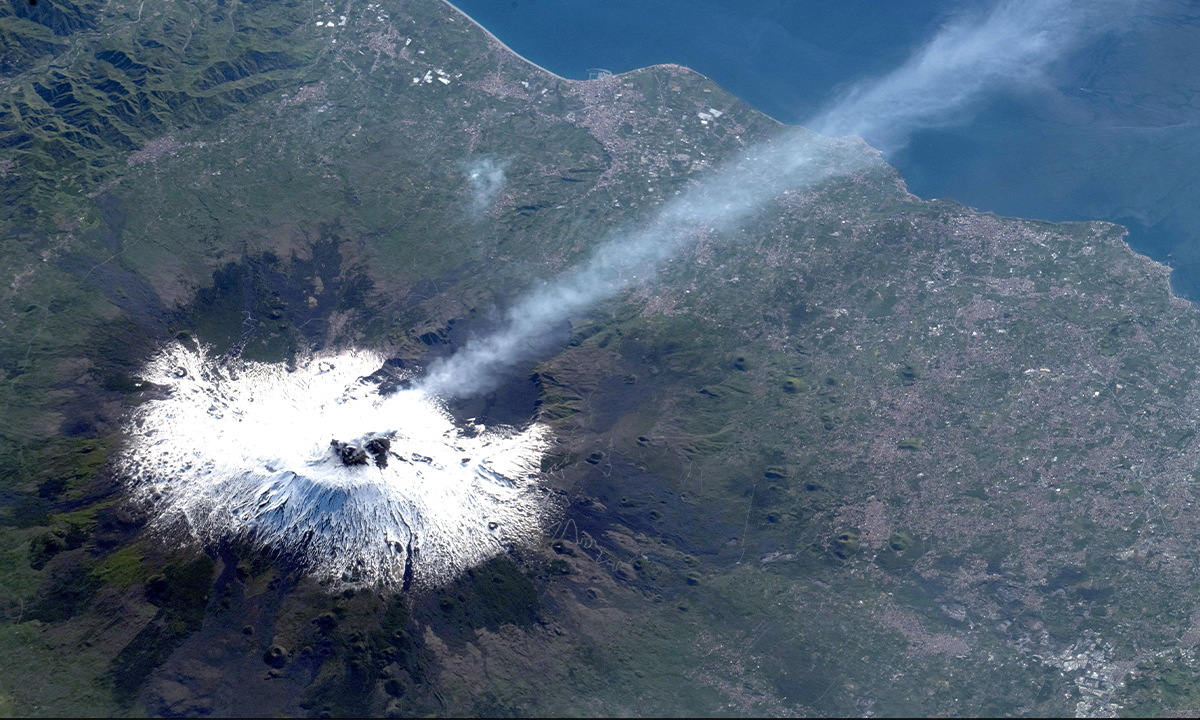
What I’m doing with Dante is a little bit different. As far as we know, Dante probably didn’t see any craters firsthand. On the other hand, he could have heard about craters, like in Mount Etna or Vesuvius, and maybe he imagined some connection with the fall of Satan. Although even that’s kind of tricky—whether his text suggests that Satan actually caused the crater in hell or not. Anyway, geomythology causes me to go back and look at these old stories and ask myself, “What’s going on here?” Especially if it’s before the scientific revolution.
Dante was writing in the 1300s, before Galileo, Copernicus, Kepler, and so on. He’s mainly just using his imagination. He’s observing; he’s looking at things. He’s very interested in geology. He talks about earthquakes. He has those in The Inferno, and in The Purgatorio, the second book, he talks about landslides. One of the landslide descriptions is probably based on a real landslide that he could have observed. To me, it’s not a huge stretch to make that next step and say, “Well, what would it be like if something big hit Earth?” So he does get a number of things wrong in his speculation. I’m not trying to say that The Inferno is some completely accurate account, but he does get some things right.
My understanding is that Dante primarily drew on Aristotelian cosmology, which rejected rocks falling from the sky. Is the idea that he was deliberately departing from Aristotle here?
That’s a really good point. In The Paradiso, the third book, and I think it’s in Canto 15, Dante does go with the orthodox view following Aristotle that meteors are local events. They fall down from within the confines of the Earth—not too high up. But what I’m arguing is that actually, unbeknownst to him, without even realizing it, he was breaking with Aristotle a little bit when he thinks about Satan’s fall. He’s saying, “Here’s this huge mass coming down, slamming into the Earth,” and he’s actually anticipating, thinking about asteroids and meteorites hitting Earth at that point.
Are there other ancient texts that would support such speculation?
There are the biblical texts that talk about the fall of Lucifer, both in the Old and New Testaments. Dante would’ve known those texts. He knew the Bible very well. But he’s mainly working with Aristotle in terms of falling objects. No one before him, to my knowledge, really thought through what it would be like if this thing actually hit the Earth. The science of meteoritics didn’t even happen until about the 1800s. Before then, people couldn’t quite connect the dots. Everybody’s seen a falling star, right? That’s been going on for thousands of years. But to connect that with this big rock that landed in the yard is different. Usually, when you see a falling star off in the distance, you don’t see where it lands. That seems so simple to us now, like, “Gosh, yeah, of course, it was a rock hitting the ground.” But Dante, I’m arguing, anticipated that by about 500 years.
You could look at Greek stories where there are similar falls from the heavens. Icarus is probably the other one people are most familiar with. He puts the wings on with his father Daedalus. But of course, they fly too close to the sun, and he plunges down. As far as I know, there’s not a lot of discussion about what actually happens to him when he hits. There’s Bellerophon, not as well-known, who is riding his horse Pegasus, and he gets knocked off his horse and falls. And there’s another guy named Phaethon, son of Helios, who takes Helios’ chariot up in the sky and tries to drive it and can’t really handle the horses, so he plunges down.
These are very dramatic falls. But no one gave consideration as far as I know to what happens when they fall. You also have the titans and the giants, going even further back, really ancient Greek mythology. They do have some pretty spectacular descents, but these myths don’t say much about what happens when they hit the planet.
One pretty pointed critique of your model, which you shared with me yourself, comes from science journalist Jason Colavito. He pointed out a lot of places where the actual science of meteors and craters conflicts dramatically with what Dante describes. What’s your response to that critique?
I ended up being grateful for it. He was very tough on me, and he went after a number of things. His critique and the critiques of a number of other folks have caused me to refine the theory, and I think it’s in better shape now. I might have been a little misleading when I talked about some of these meteors that we’re familiar with today. One possible link I mentioned was the Chicxulub crater. Everybody loves to talk about both the Chicxulub crater and the asteroid that created it—the one that wiped out the dinosaurs. That one is interesting because it had a global impact. It was sizable, but it wasn’t ginormous. But the way that it hit and the timing and everything, it spun up all this dust around the globe. It lowered the temperature globally. It kicked up the tsunami. All kinds of effects, somewhat similar to what Satan does when he hits the planet. In Dante’s vision, he too reconfigures the geography of our planet.
So again, it’s a very limited analogy. I’m not saying the Chicxulub asteroid was the devil, although interestingly, in the Mayan language, apparently Chicxulub can be translated as the “devil's tail” or the “devil’s fall.” But that name is something that was added later by scientists, when they were describing it. [Chicxulub is the name of a Maya village near the impact site, and the scientists decided to name the crater after the town.]
Read more: “The Comet Year”
You said that after receiving critiques you were making some revisions to your model or account. What are some of those revisions?
It’s possible the analogies with the real craters were overblown, so I’m dialing those in a bit and trying to be more accurate. I’m not an official Dante scholar. I teach him a lot. I really enjoy his work, but I haven’t published anything on him. A number of scholars have said that the crater in The Inferno wasn’t actually formed when Satan smacks into the other side of the Earth. God put it there from the very beginning. They go back and forth on this. So that has caused me to pause a little bit.
Another thing, and this is brand new, Dante may have anticipated the theory of continental drift or continental movement. Dante does mention that when Satan hits the Earth, he hits the Southern Hemisphere, tunnels into the center of the Earth, and it kicks up all the dirt and so on. And the continents actually move away from him. In Dante’s time, he didn’t know about Australia or South America. He thought all the continents were in the Northern Hemisphere. But is there a little bit of a sense of Pangea, the notion at all that the continents might be moving? When Alfred Wegener proposed this about a century ago, people laughed. But Dante actually wrote an essay titled, A Question of the Water and the Land, which attempts to investigate why dry land rises above sea level.
You mentioned earlier that Dante gets some things right about meteors in his account in The Inferno. What are those things?
Yes, and again, this is a work in progress. But one thing that happens when Satan hits the Earth, in Dante’s Inferno, he doesn’t create a big crater. That doesn’t happen. Instead, he tunnels right down to the middle of the Earth, but in the process, he excavates dirt. And that forms the Mountain of Purgatory. My understanding is that when a large asteroid or meteorite hits Earth, sometimes it will create a crater, but it will also create a central peak—a little mountain or a little hill. The Earth gets smooshed down, temporarily sort of compressed, and then it bounces back. And that idea of bouncing back, that motion, was something that Dante did seem to anticipate. These were mainly lucky guesses, but he was a student of geology. He was a careful observer of the Earth. He does have geological effects throughout the inferno and somewhat in the purgatory as well, so I don’t think they’re just total shots in the dark.
The second thing would be this notion of something falling all the way from space and hitting Earth. We know about meteorites and asteroids now, but that would’ve been something new at this time. And it would’ve been unthinkable in some ways because of the domination of Aristotle. Aristotle was so well known he was just called “the philosopher.” For Dante to break with him, even without realizing it, would have been really significant.
If Dante were anticipating the emergence of those future scientific fields to some extent, what would that tell us? How would it change the way we understand the history of science?
It’s a good question. There might be sort of a science-fiction angle here. I teach a lot of science fiction, and a lot of times in science fiction, you’ll see an author just throw out an idea or try something like, “Hey, this is kind of crazy, but what if …” I believe Dante was doing that to an extent. Now, as far as we know, no one actually picked up on it. I’ve looked at some of the early pioneers of meteoritics. No one has said, “Oh, yeah, Dante gave me this idea back here.”
If your speculation is true, what would it tell us about the power of the literary imagination?
This is something I’m big on as a literary scholar because I love literature. I teach it. But I really enjoy science, too, and I try to bridge the gap wherever I can. We talk about the two cultures, right? There’s science here and humanities over there, and unfortunately they don’t always talk to each other. But the third culture can bridge the gap, and say, “Gosh, we can get really good insights from both sides.”
This is what happens when you read a poet like Dante, who’s scientifically astute—he’s kind of ahead of his time. He’s not a trained scientist. He lives before the scientific revolution, but he makes some pretty good guesses. Is there something about the way our minds work that with certain truths, we need poetry or we need fiction, or we need things that aren’t necessarily quantitative to wrap our minds around the concept?
J.R.R. Tolkien, the author of The Lord of the Rings, talks about this. He says that there may be certain truths that simply can’t be apprehended, apart from a poetic or intuitive way of understanding. 
Enjoying Nautilus? Subscribe to our free newsletter.
Lead image: Giorgio G / Adobe Stock