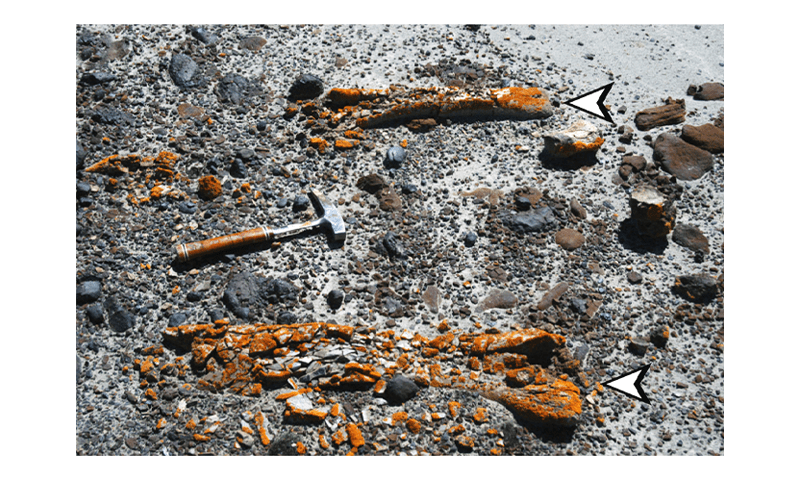
For decades, dinosaur seekers have anecdotally noted the presence of distinctive orange growth on fossil bones. It turns out that vibrant orange lichens—crusty little colonies that can comprise algae or cyanobacteria locked in symbiosis with fungus—do indeed have a preference for growing on exposed dinosaur bones. And researchers working in western North America are suggesting that the colorful growths could serve as homing beacons leading paleontologists directly to their fossilized quarry.
Working at a known dinosaur fossil site in Alberta, Canada, the scientists measured lichen colonization in three microfossil bonebeds, which contained high proportions of ironstone. They found that two species of lichen preferentially grew where fossil bone density was greatest. “The exponential increase in lichen colonisation with increasing fossil density that we observed,” they wrote in a recent Current Biology paper, “... reinforces the potential for using lichens as indicators of productive bonebeds.”
Read more: “The Dinos’ Demise Gave Rivers Their Shape”
This means that instead of manual digging for fossils, or relying on the odd serendipitous find, paleontologists might employ aircraft or even satellites to scan the ground and zero in on the lichen color spectrum that indicates a high likelihood of ancient bones.
Such a methodological shift could take fossil hunting to the skies and beyond, something that might prove invaluable in the types of rugged and remote locales where some dino fossils are unearthed. 
Enjoying Nautilus? Subscribe to our free newsletter.
Lead image: Pickles, B.J., et al. Current Biology (2025).