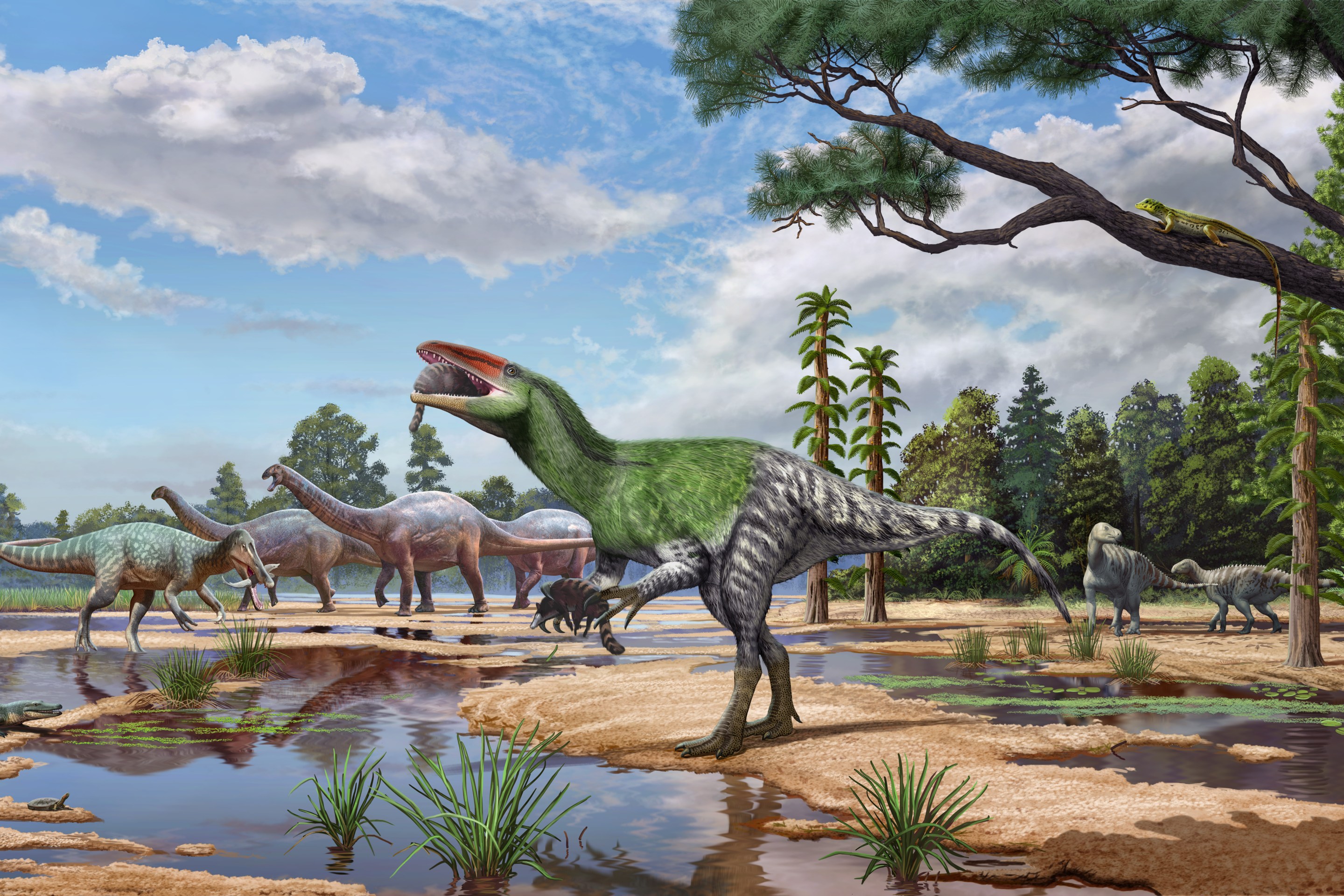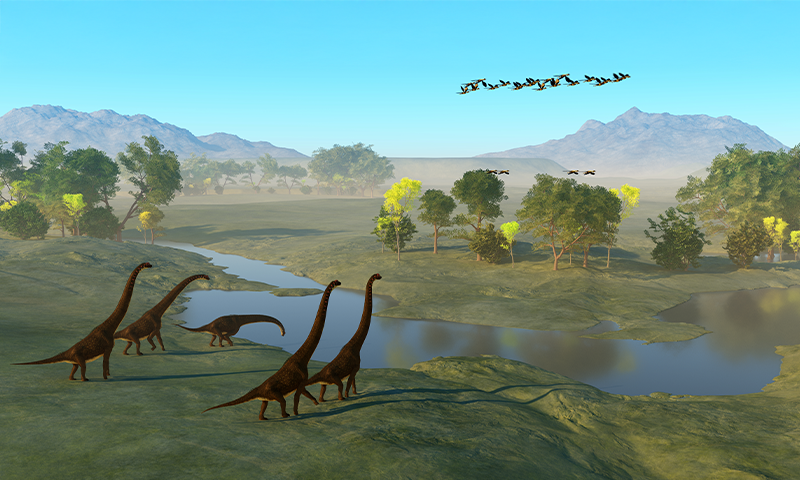
Dinosaurs were the architects of entire ecosystems on Earth. Leaf-munching, ground-trampling, and soil-uprooting by herds of large herbivores like Tricerotops and Edmontosaurus kept Cretaceous forests in check, helping to maintain open savannas that would otherwise have been thick with trees. This in turn likely had a profound effect on how rivers flowed across landscapes, both while the dinosaurs were alive and after they went extinct in an asteroid apocalypse.
When the giant reptiles were alive, rivers tended to flow straight, overflow their banks, and spread across the landscape. After their demise, forests grew back, and rivers established meandering paths. These are among the findings of a new study, published this week in Nature Communications Earth & Environment by a team of scientists from the University of Michigan.
“The disappearance of these dinosaur megafauna fundamentally rearranged and reconfigured landscapes and ecosystems as we know them today,” says Luke Weaver, a paleontologist at the University of Michigan and the study’s lead author. “An extinction event, which is biological, can have dramatic consequences for the non-biotic aspects of the landscape.”
After the dino’s demise, forests grew thick, and rivers established meandering paths.
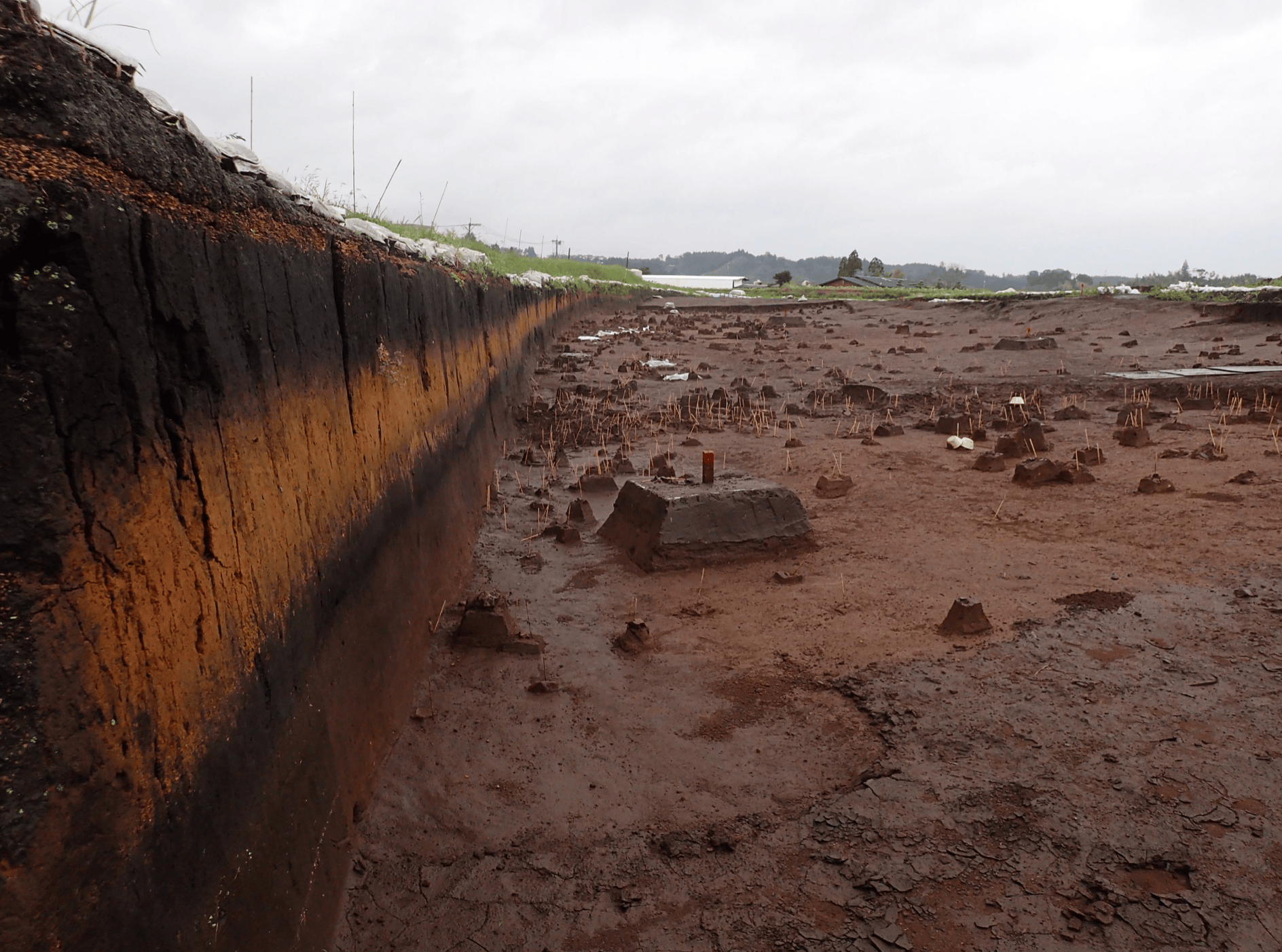
The newly proposed link between dinosaurs and rivers was the result of close scrutiny of layers of sediment laid down before and after the dino-killing Chicxulub meteorite hit Earth 66 million years ago. The best-known marker for this boundary between the age of dinosaurs and the age of mammals—known as the Cretaceous-Paleogene boundary—is a thin layer of sediment enriched in iridium that was delivered by the meteorite and scattered around the globe. But the strata on either side of this boundary also register an abrupt shift at many rocky outcrops found in ancient floodplains.
Below the boundary, sediment tends to be thick with silt and sand, says Weaver. This is indicative of rivers that regularly overflowed their banks and delivered sediment across the floodplain. Above the boundary, there’s much less silt and sand and a lot more coal—the carbonized detritus of ancient plants. This pattern suggests that the riverbanks began to stabilize, corralling sediment into wide and established meandering channels.
Geologists had already proposed explanations for this shift, none of which had to do with dinosaurs. One idea is that in the early Paleogene, Earth was simply wetter in general, due to more precipitation or rising seas, which raised the water table. Fires ignited by the meteorite impact could also have changed what sediment was flowing through the rivers. But Weaver and his colleagues suspected these explanations were missing an important part of the story: dinosaurs. “These things are an absolutely enormous presence on the landscape,” he says.
The disappearance of dinosaurs fundamentally rearranged landscapes as we know them today.
To get a better view, the researchers looked at outcrops across western North America that clearly show strata before and after the Cretaceous-Paleogene boundary, including five newly identified boundary sites in Montana and Wyoming. They found a change in the sediment record from sand and silt to coal is consistent across western North America and persists for more than a million years after the impact. In their study, they argue a shift of this scale is best explained by an abrupt and dramatic regrowth of forests, which were previously kept in check by hungry dinosaurs.
“With that hot and humid landscape there is no reason you shouldn’t have dense forests being formed, unless you have something preventing them from coming in,” says Weaver. Within just decades to a few centuries after the devastation incited by the meteorite, he says the forests would have grown back to form closed canopies not unlike today’s temperate rainforests of the Pacific Northwest. These forests would then have rooted soil in place and stabilized rivers anywhere such trees could grow. “This is a first step toward testing a really big idea,” says Weaver, adding that more paleobotanical evidence for how forests changed would help strengthen the story.
Other research does support the idea that forests rapidly grew back after the dinosaurs disappeared, says Scott Wing at the Smithsonian National Museum of Natural History, who was not involved in the research. For instance, he has found an increase in the size of seeds found in sediment after the dino-mammal era boundary. These larger seeds suggest plants were adapting to a denser forest environment, because larger seeds can survive longer without sunlight before germinating. The link with rivers “is a new line of evidence. It’s a different way of looking at the problem,” he says.
The new theory also brings the dinosaurs into the much larger story of how plants have shaped the flow of rivers since they emerged on land 450 million years ago, says Mathieu Lapôtre at Stanford University, who also did not participate in the study. “Once plants evolved there were a bunch of things that changed the distribution of vegetation on Earth.”
In the new dinosaur-free forests, small mammals began their rise. Eventually the primates came along, a few of whom would come to reshape the planet’s rivers on an even grander scale. “It’s a story that is important for all of Earth’s history from the first land plants to today,” says Lapôtre. 
Lead image: Catmando / Shutterstock