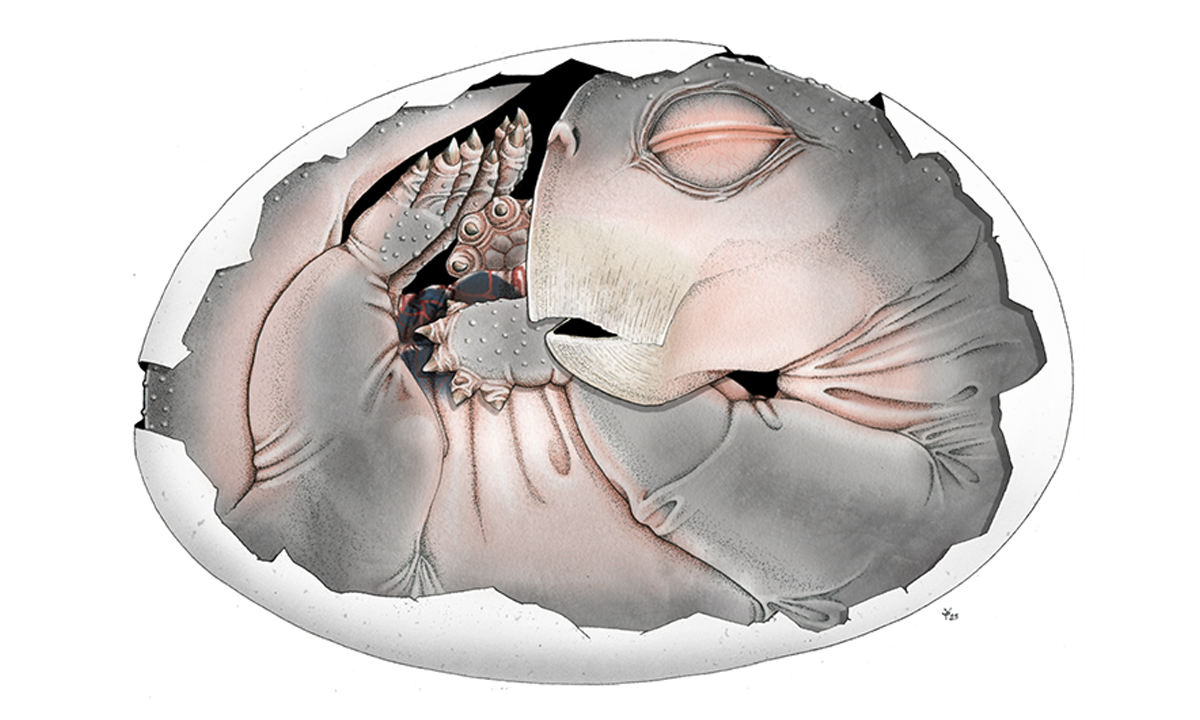
In 2008, an oblong fossil was recovered from South Africa’s Karoo Basin, a site famous for its Triassic mammal precursors—therapsids. Once the fossil was cleaned and prepped, it revealed a curled-up therapsid. With a skull just 1.7 inches long, it appeared to be an embryo of Lystrosaurus, a therapsid that was common 250 million years ago.
Now, nearly two decades later, this fossil has become central in the story of mammal evolution. Paleontologists had long wondered whether the therapsid ancestors of mammals were egg-layers. It seemed plausible, since dinosaurs laid eggs, but no direct evidence had ever surfaced. A new paper, however, describes the evidence that the embryonic Lystrosaurus and two other fossilized animals died enclosed in eggshells.
Researchers from the University of the Witwatersrand in South Africa and the European Synchrotron Radiation Facility collaborated to examine the specimens using high-resolution CT and synchrotron scanning.
Read more: “Egg Laying or Live Birth: How Evolution Chooses”
Lystrosaurus eggshells didn’t fossilize, so they must have been soft, in contrast to the mineralized shells of dinosaurs. But certain features of the embryos gave away their origins as animals developing in eggs like turtles or birds. “When I saw the incomplete mandibular symphysis, I was genuinely excited,” explained study author and University of the Witwatersrand paleontologist Julien Benoit in a press release. “The mandible, the lower jaw, is made up of two halves that must fuse before the animal can feed.”
The unfused jaw bones proved that the individual wasn’t yet fully formed but was rather curled in an egg as it completed its development.
The eggs were large relative to Lystrosaurus body size, which suggests that they were well-supplied with nutrients so that hatchlings emerged mature and ready to feed on their own. The researchers hypothesized that “by producing large, yolk-rich eggs and precocial young, Lystrosaurus was able to thrive in the harsh, unpredictable conditions following the end-Permian mass extinction.”
So, a successful reproductive strategy of laying large eggs may have conferred resilience to the pre-mammal Lystrosaurus, allowing it to survive in conditions of intense heat and drought at the start of the Triassic. Along the way, it hatched a whole new way of thinking about how our mammal ancestors evolved. 
Enjoying Nautilus? Subscribe to our free newsletter.
Lead image: From Benoit, J., et al. PLOS One (2026).