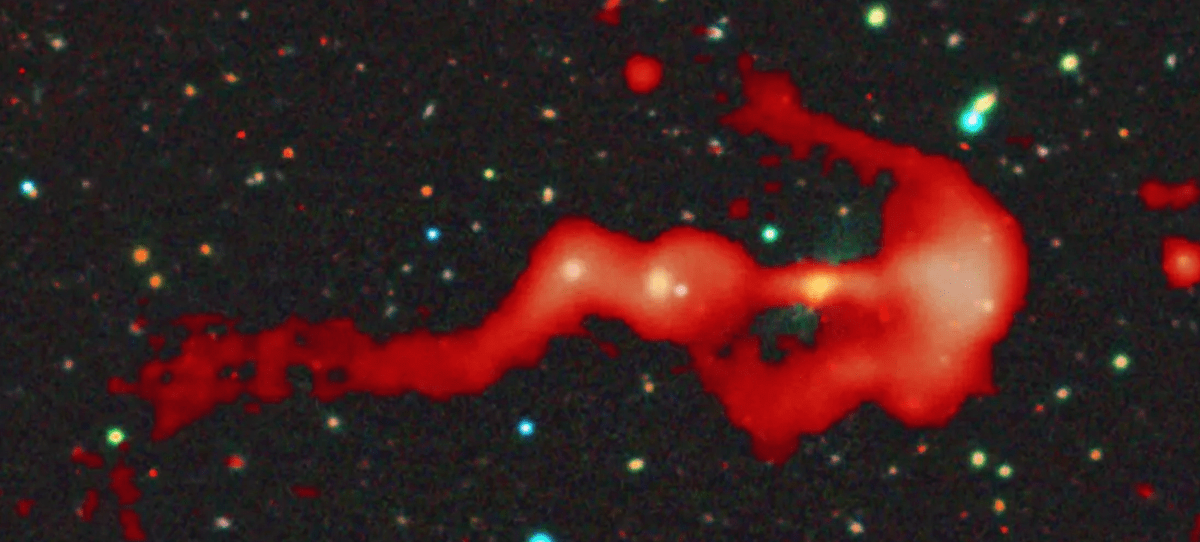
A citizen astronomer examining radio telescope data recently flagged something unusual: massive streams of radio emissions shaped like a cosmic bow and arrow. The source of the emissions was a galaxy, dubbed the Radio Bow-And-Arrow Radio Galaxy (or RAD-BAARG for short), and it’s unlike anything astronomers have seen before.
Most galaxies are fairly symmetric. When viewed through a radio telescope, the radio waves emanating from ionized particles jetting out of the supermassive black holes in the galactic nuclei stream outward like the beams of klieg lights. RAD-BAARG is puzzlingly different. One of its lopsided “beams” curves backward, forming a massive arc, while the other twists into a snake-like tail. In total, its cosmic structure is 1.8 million light-years across, nearly 18 times larger than the Milky Way.
“The structure of this source is unlike that of any radio galaxy I’ve seen in the last 25 years,” Ananda Hota, author of a study on the galaxy published in Monthly Notices of the Royal Astronomical Society said in a statement.
According to the astronomers, RAD-BAARG likely gets its unique shape from its interactions with a dense cluster of galaxies. “Its remarkable morphology appears to display signatures of interaction between relativistic radio plasma and a large-scale shock generated during the galaxy’s infall into a nearby cluster environment,” Hota explained.
Read more: “There’s A Dwarf Galaxy Hidden Inside the Milky Way”
Basically, as it “falls” deeper into the center of the galactic cluster, a bow-shaped shockwave develops (similar to the shockwave in front of supersonic jets). This bow shock distorts the stream of radio-wave-emitting particles, forming a curved shape.
A radio galaxy like RAD-BAARG experiencing a close encounter with a galactic cluster is a unique scenario. If further research confirms their understanding of the situation, researchers say it could offer insights into how the relativistic jets streaming from black holes interact with other celestial matter.
All of which is to say, it’s a big win for citizen scientists, and anyone else who likes strange cosmic phenomena. 
Enjoying Nautilus? Subscribe to our free newsletter.
Lead image: Hota et al. (2026) and the RAD@home Collaboratory.