Chimpanzees and humans share 98 percent of their genomes, so what’s in that 2 percent that makes us uniquely human? According to a new study published in Science Advances, a tiny portion of these genes play an outsized role in our language skills—and Neanderthals had the same sequences.
These segments of the human genome, known as Human Ancestor Quickly Evolved Regions (HAQERs) are non-coding sequences that showed accelerated evolution after humans split from the ancestor they shared with apes. Even though they represent only 0.1 percent of our genes, they’re responsible for the neural “hardware” for language.
“What we’re seeing is how a very small part of the genome can have an outsized influence, not just on who we were as a species, but on who we are as individuals,” study author Jacob Michaelson of the University of Iowa said in a statement. “These aren’t genes we’re talking about. They’re regulatory regions that act like the volume knob on genes.”
The HAQERs also interact with another vital speech gene: FOXP2. Identified in 1998, FOXP2 is a transcription factor active in the development of the neural circuitry of language use, and mutations in the gene can cause speech problems. “So, if the HAQERs are like volume knobs that can be turned, FOXP2 is one of the hands that is turning these volume knobs,” Michaelson said.
Read more: “The Last Hominin Standing”
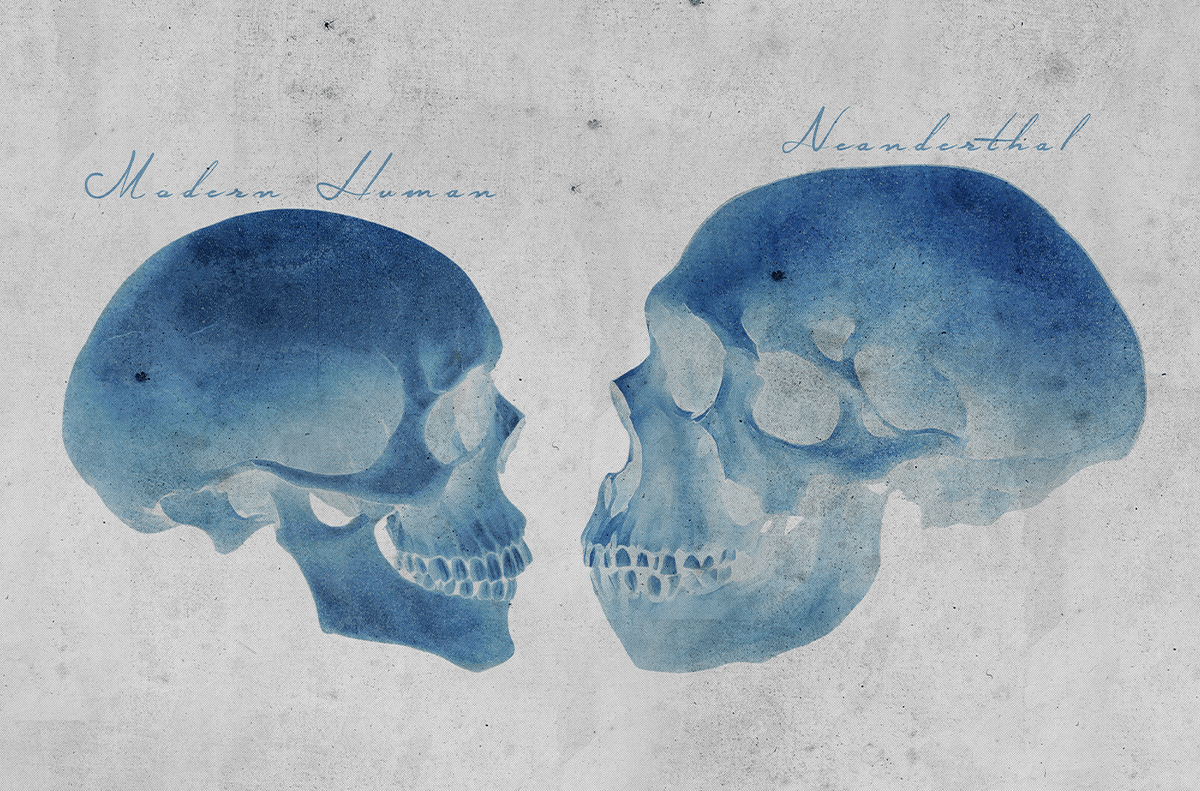
The accelerated evolution of these “volume knobs” predates the split between modern humans and Neanderthals, which means they were also present in our distant cousins. Intriguingly, they may have been cranked up even higher in Neanderthals than they are in humans. In other words, it’s highly likely Neanderthals had a similar—or better—cognitive capacity for language.
The researchers also discovered that even though the regions showed strong signs of positive selection in the past, the pace has since plateaued, demonstrating signs of balancing selection. According to the team, the reason our language hardware genes seem to be stalled is because of evolutionary trade-offs related to another unique human characteristic—our bipedal locomotion.
Individuals with HAQERs that conferred greater language skills were also more likely to have larger heads, but in order to walk upright, humans need narrower pelvises. The evolutionary conflict between the two traits is why HAQER variants associated with stronger language skills seem to have stalled out, researchers say. This obstetric dilemma could also explain why Neanderthals seem to have HAQER variants more strongly associated with language skills than humans, but the team says further research is needed to say for sure.
With every study that comes out, our distant cousins seem to get more and more human. 
Enjoying Nautilus? Subscribe to our free newsletter.
Lead image: Winters860 / Adobe Stock