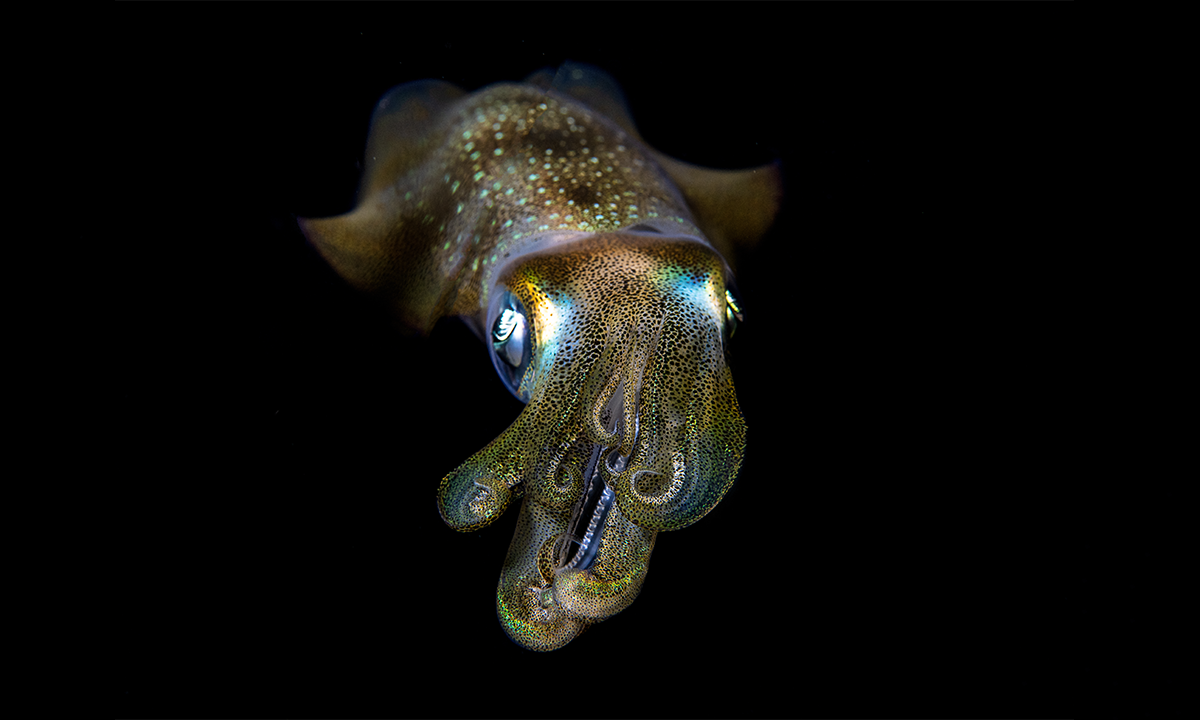
With 10 arms, color-changing skin, and an internal shell, squids are unique organisms. They’re also incredibly diverse. The squid’s superorder, decapodiformes, contains six different orders that live in a wide range of ecosystems from the cold, deep sea to warm, shallow coastlines. Why are there so many different kinds of squid? New research published in Nature Ecology & Evolution reconstructs their evolutionary history, showing squid diversification was a slow burn followed by a big bang.
To create the first evolutionary tree for squids, researchers from the Okinawa Institute of Science and Technology relied on genome sequences from nearly all living squids, in addition to data from newly discovered fossils. Together they paint a dramatic picture of squid evolution.
Their analysis revealed squids originated around 100 million years ago, during the middle of the Cretaceous period. However, the Cretaceous-Paleogene (K-Pg) mass extinction event 66 million years ago devastated life both on land and in the oceans, famously wiping out the dinosaurs.
So how did these squishy, vulnerable squids survive the cataclysm? Researchers believe they retreated to refuges deep beneath the ocean where they continued to slowly diversify.
Read more: “The Light Magic of Squid”
“The sea surface would have been a very harsh environment for cephalopods,” study author Gustavo Sanchez said in a statement. “Around that time, very few suitable oxygen-rich habitats would have been found near the shores. Intense ocean acidification in shallower waters would also likely have degraded their shells, so the fact that some form of this feature has been retained throughout their evolutionary history is evidence of their deeper oceanic origins.”
As other ocean ecosystems closer to the surface began to recover, squid were poised to leave the depths, adapt to new habitats, and fill a variety of niches. “Following the initial lineage splits in the Cretaceous, we don’t see much branching for many tens of millions of years,” Sanchez said. “However, in the K-Pg recovery period, we suddenly see rapid diversification, as species adapt and evolve to new and changing ecosystems. This is an example of a ‘long fuse’ model; a period of limited change followed by an explosion of diversity.”
This explosion of diversity is why we see so many different kinds of squids today—from the awe-inspiring giant squid to the smaller (and more adorable) pygmy squid.
The researchers say this new evolutionary tree will help them uncover the genetic changes that led to squid innovations like dynamic camouflage, bioluminescence, and even intelligence.
It’s a good time to be a squid—or at least a lot better than it was 66 million years ago. 
Enjoying Nautilus? Subscribe to our free newsletter.
Lead photo: Tracey Jennings / Ocean Image Bank