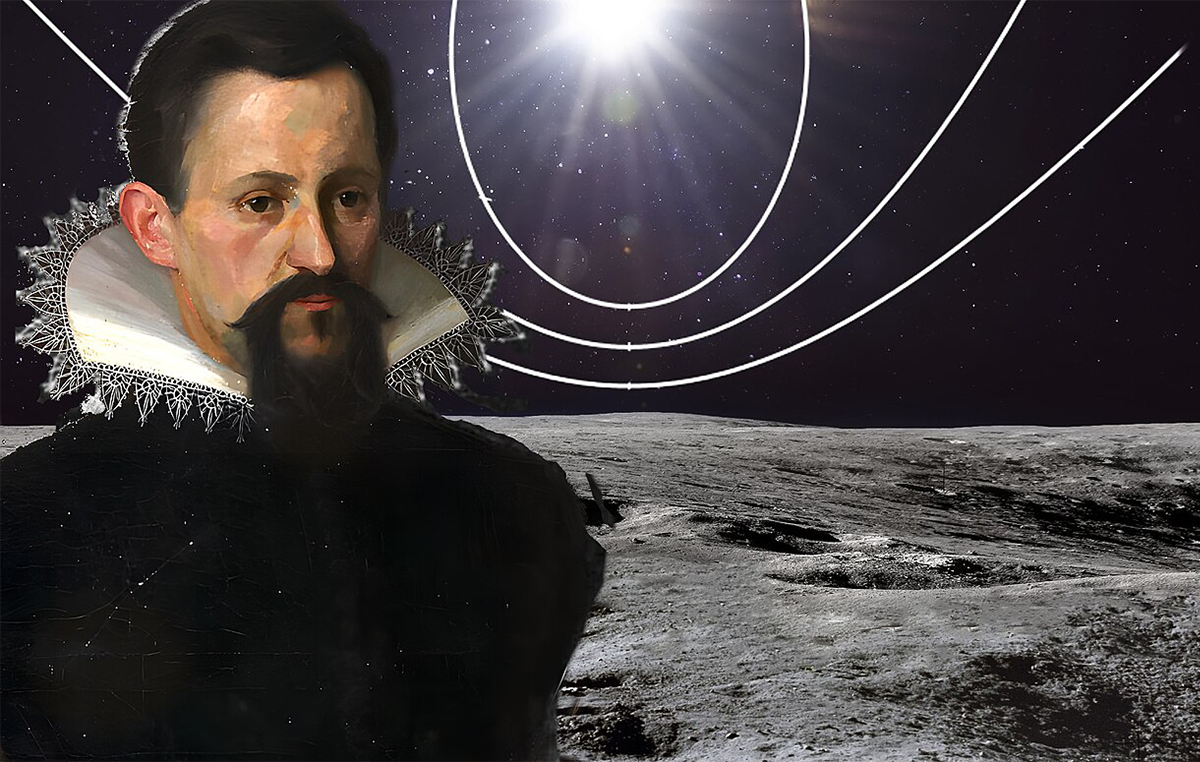
As the Artemis II astronauts near their historic slingshot around the moon, and the world awaits their communiques, a short novel from the 17th-century reminds us that great thinkers have been imagining the far side of our lunar satellite for centuries.
Published in 1634, Somnium was written in 1608 by giant of early astronomy Johannes Kepler. Widely considered to be one of the earliest works of science fiction, the book’s full title is Somnium, seu opus posthumum De astronomia lunari (translation: The Dream, or Posthumous Work on Lunar Astronomy) because it was published by his son Ludwig after Kepler’s death in 1630.
The plot of the work is pretty wild. The book opens with Kepler falling asleep and into a vivid dreamscape after reading and admiring the night sky, both frequent pastimes for the decipherer of the laws of planetary motion. Once dreaming, Kepler reads a different book that recounts the tale of Duracotus, an Icelandic youth. Duracotus tells of his witchy mother, Fiolxhilde, who inadvertently sold the 14-year-old to a ship’s captain bound for the Danish island of Hven, home to another astronomical luminary of the age, Tycho Brahe.
This is where things get weird. Brahe takes Duracotus under his wing (as he did Kepler in real life), and schools him in the emerging science of lunar observation. Upon reuniting with his mother in Denmark, the boy is introduced to a daemon (neither devil nor demon, more like a spirit or an extraterrestrial) who promises to escort him on a journey “fifty thousand German miles high up in the sky” to the “island of Levania,” aka Earth’s moon. (A “German mile” was a unit of measurement used until the late 19th century that equaled about 4.6 Imperial miles. The moon floats an average of about 238,855 miles above Earth. So Kepler’s fictional distance of about 230,000 miles wasn’t too far off from reality!)
Read more: “The Carouser and the Great Astronomer”
While Kepler’s Earth-moon distance was remarkably accurate, the speed of Duracotus’s journey was not. Traveling at daemon speed, “The whole journey, although far, is completed in a time of four hours at the most.” The Artemis II astronauts, like spacefarers before them, took about four days to get to the moon. As fantastical as the speed of Duracotus’s moonshot, the daemon’s warnings regarding the rigors of space travel ring remarkably similar to rocketeering. “First of all he experiences a strong pressure, not unlike an explosion of gunpowder, as he is hurled above the mountains and the seas,” Kepler writes. “For this reason, drugs and opium are consumed at the start, so that he falls asleep, and each of his limbs disentangled, so that his body is not torn from his legs, nor his head driven from his body, but so the shock will be distributed across all his limbs.” OK, so maybe not that last part.
The rest of the book is similarly dualistic, peppered with alternating instances of science and fancy: An equation for moment or driving force to get the acceleration just right to leave Earth and touch down lightly on Levania here, and a description of the bizarre creatures that inhabit the moon’s strangely watery surface there.
Kepler accurately relays the fact that the moon is tidally locked to Earth (called “Volva” in the story), meaning that one lunar hemisphere is perpetually facing away from our planet. This hidden face of Levania, he terms the “Privolvan hemisphere.” And it’s not necessarily a welcoming place.
“The Privolvans’ night lasts 15 or 16 of our days, terrible with never-ending shadows, as are our moonless nights. The rays of the Volva never light upon them,” the astronomer writes. “For this reason everything becomes stiff from the ice, the frost and from the sagest and most powerful winds.”
The days on Privolva aren’t much better. “The Sun is slow under fixed stars and there are no winds. Then, it becomes intolerable hot. Thus for the space of one of our months or of one Levanian day and in one and the same place, the heat becomes 15 times hotter than our Africa, and the cold, unbearable.”
Especially strange are the creatures that inhabit the moon. “Whatever springs from the land or walks upon the land is of a monstrous size,” writes Kepler. “Increases in size are very rapid. Life is of short duration because all living things grow to such an enormous bodily mass.” On the far side, the moon’s inhabitants mainly stick to the shadows. “The Privolvans have no fixed dwelling place. In the space of a single day, they traverse the whole of their world in hordes, following the receding waters either on legs that are longer than those of our camels, on wings, or in boats. If a delay of very many days is necessary, they crawl through the caves according to each one’s nature.”
Botanical life on the moon has it even tougher. “Plants in the earth, and there are a few on the mountain tops, spring up and die on the same day, daily making room for new growing things.”
Such a great reminder that so many imaginations, past and present, have been ignited by a heavenly hemisphere obscured to us Earthbound stargazers. And it’s fascinating to revisit Kepler’s scientifically-informed fantasy about traveling to the moon as humans actually approach the far side of our storied satellite at the closest distance yet. While I don’t expect to be getting snapshots of long-legged creatures migrating across that rarely glimpsed lunar surface, I eagerly await the latest news from the moon. 
Enjoying Nautilus? Subscribe to our free newsletter.
Lead image: Serendipodous / Wikimedia Commons