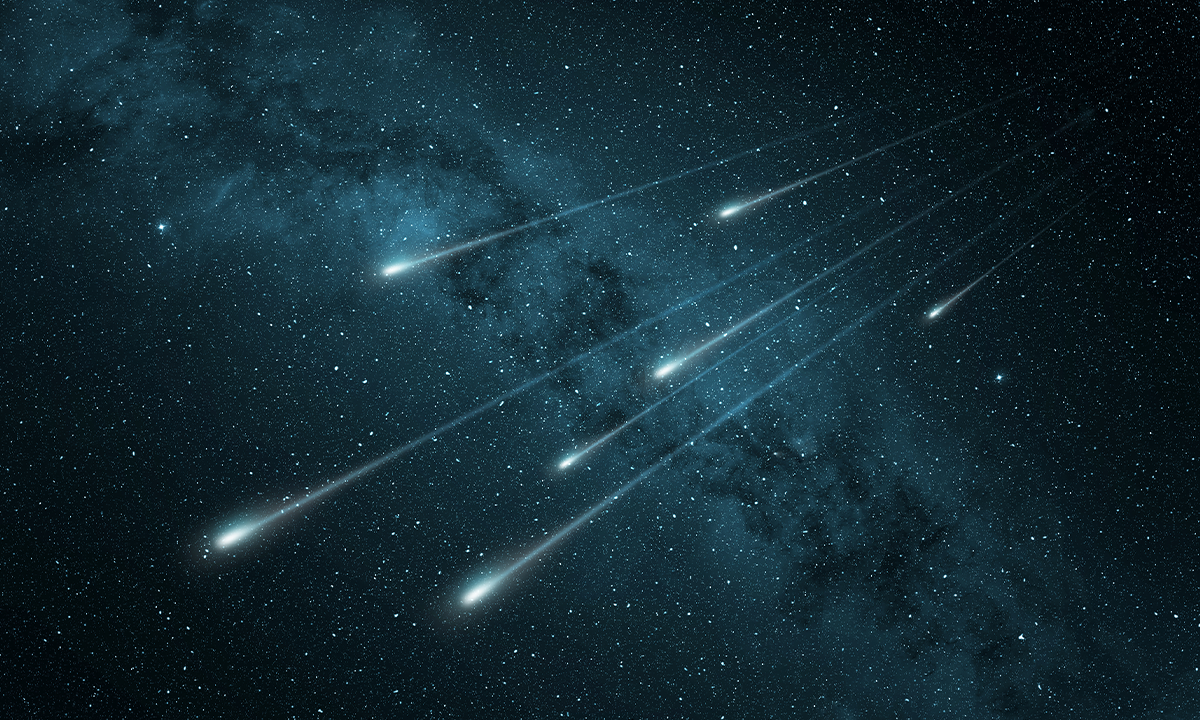
To say our solar system had a chaotic childhood would be putting it lightly. After the planets coalesced around 4.5 billion years ago, there was still plenty of leftover rocky material swirling out in the ether. As the outer gas giants settled into their orbits, the shifting gravitational forces sent this debris screaming toward the inner planets. Both the moon and Earth were pummeled by an unrelenting cosmic barrage, and this bombardment had profound effects on the development of our planet.
Researchers from Curtin University in Australia modeled the heat dynamics of early Earth during the Hadean period around 4 billion years ago, taking into account the energy from asteroid strikes, and recently published their analysis in Science. They determined the intense period of impacts delivered so much heat to the mantle of our young planet that solid crust had a difficult time forming.
Read more: “The Violent Birth of the Moon”
“Those impacts carried enormous amounts of energy, and that energy had to go somewhere,” study author Tim Johnson said in a statement. “The extra heat from impacts would have kept much of the early crust weak and partially molten, making it difficult for rocks to survive.”
Most previous models of the Earth’s geodynamics during this period only take into account the heat from within the planet, but the researchers say the heat from outside impacts dwarfed this internally generated energy. The result was a thin, unstable crust less than two miles thick that was constantly in flux.
Around 3.9 billion years ago, the impacts subsided, and the Earth’s surface stabilized enough to allow continents to form. “It’s apparent from the moon that, by around 3.9 billion years ago, the global effect of impact heating becomes much less important, which is also around the time Earth begins to preserve continental crust,” Johnson said. “That seems unlikely to be a coincidence.”
One hundred million years after that, the oceans formed, setting the stage for the evolution of life. The rest, as they say, is history. 
Enjoying Nautilus? Subscribe to our free newsletter.
Lead image: Paulista / Adobe Stock