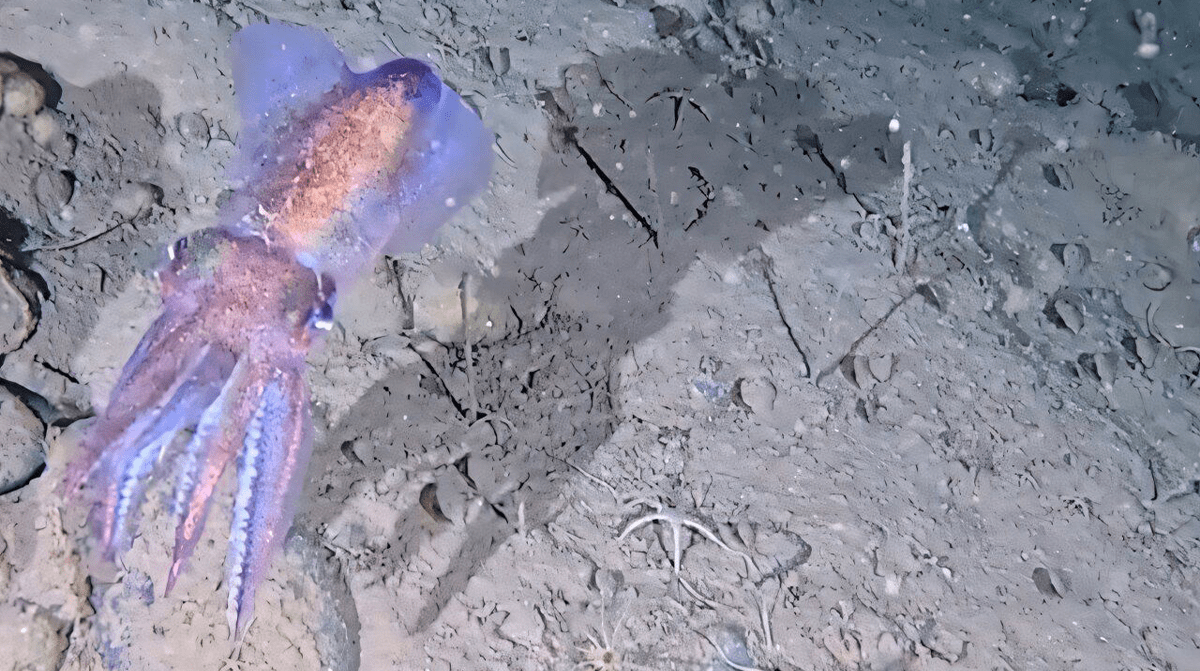
This mesmerizing deep sea creature is the Arctic bobtail squid (Rossia moelleri), and the photo you’re looking at—snapped by researchers using a remote camera—is the first image ever captured of it in its natural habitat.
As an extra bonus, egg clusters from the squid were also photographed, giving experts an unprecedented look at the life and reproduction of this cephalopod. The photo was captured in the Kong Oscar Fjord in Northeast Greenland National Park, and an account of the recording has been published in Polar Biology.
A number of signals were used to identify the species, including its morphology and the placement of the eggs on a hard substrate—in this case, a sheltered fjord wall.
Read more: “The Mystery of the Largest Light in the Sea”
The female measures around 3.9 inches, but these squids can grow up to five times that size. They’re resilient too: The squid was snapped at a depth of 164 feet, in water that was about 29 degrees Fahrenheit. It’s a harsh environment, but R. moelleri makes it work.
It’s also an environment that’s changing as the world warms up. Northeast Greenland is experiencing some of the most dramatic ecological changes in the Arctic, with the loss of glaciers likely to have profound effects on habitats and wildlife.
That’s why sightings such as this one—made from a roving video camera launched from a smaller tourism vessel, rather than a large research ship—are so important. Cephalopods including squid and octopus are known to be especially vulnerable to climate change and have roles as both predator and prey.
Northeast Greenland National Park is the largest national park on Earth, stretching across some 375,291 square miles—more than twice the size of California. And yet, it’s also one of the areas of the ocean we know the least about in terms of its marine biology.
“Establishing knowledge of the biodiversity in this region is crucial for understanding ecosystem function and resilience under accelerating climate change,” biologist Paige Maroni, one of the study authors, said in a statement. “This study provides a valuable new baseline for tracking ecological change in the rapidly warming Arctic.” 
Enjoying Nautilus? Subscribe to our free newsletter.
Lead image: University of Western Australia