Beneath our feet lies a vast living network.
Across the planet, the microscopic threadlike hyphae of arbuscular mycorrhizal fungi (AM fungi) snake through the soil, connecting and supporting the roots of plants. This mutually beneficial relationship, which dates as far back as the Devonian period 400 million years ago, fosters the growth of an estimated 70 percent of plant species on Earth. Now, the first global atlas documenting this vital network has been published in Science, and the scale is staggering.
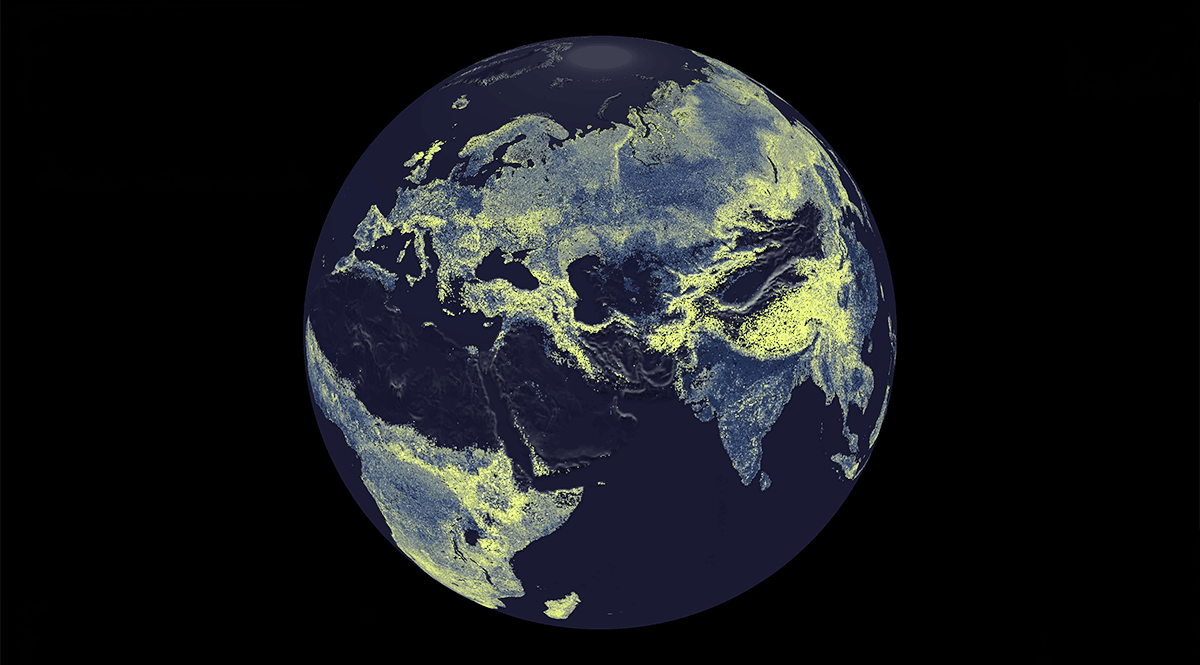
To make the map, an international team of researchers from the Society for the Protection of Underground Networks (SPUN) used data from more than 16,000 soil core samples taken from sites across the globe. They then relied on custom machine-learning models (calibrated with robotic imaging of lab-grown hyphae) that allowed them to predict AM fungi growth in unsampled areas.
Read more: “Never Underestimate the Intelligence of Trees”
The results, which you can peruse here, are almost unfathomable. The team estimates there are more than 68.35 quadrillion miles of microscopic hyphae threaded through the topsoil—enough to stretch from the Earth to the sun a billion times over. “It’s hard to overstate the importance and enormity of these fungi,” study co-author Justin Stewart, said in a statement. “There could be up to 10 meters (32 feet) of mycorrhizal network in just a teaspoon of soil.”
They’re performing an essential job, too. They make plants more resilient, protecting their roots from heavy metals and pathogens and increasing their foraging area, while providing nutrients and water. In exchange, they draw carbon from the plants and traffick it throughout the soil, acting as a vital carbon sink. That’s why they’re sometimes called the planet’s “circulatory system.”
According to the researchers, this circulatory system is under threat. Wild grasslands, for example, are estimated to contain roughly 40 percent of AM fungi biomass, yet most of them aren’t protected under law. As a result, they’re being converted to farmland at a much faster pace than forests. In fact, a previous study by the SPUN team found that more than 90 percent of AM fungus biodiversity hotspots are unprotected.
“Fungi have been ignored in climate and conservation for too long,” study co-author Toby Kiers said. “Now is the time to change that trajectory.” 
Enjoying Nautilus? Subscribe to our free newsletter.
Lead image: Truth & Beauty / Moritz Stefaner Justin Stewart - SPUN