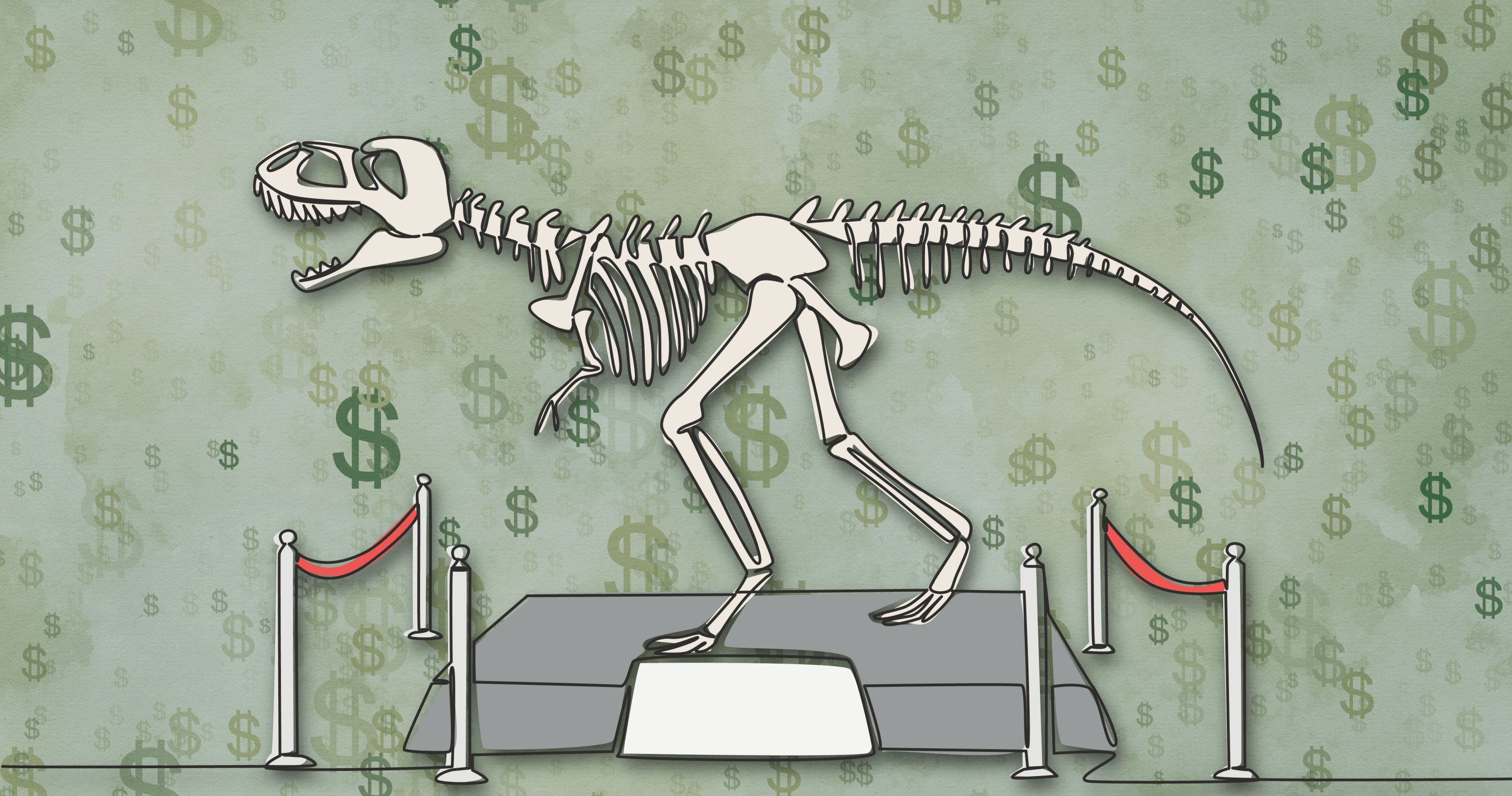
Have you ever wanted to own a Tyrannosaurus rex skeleton?
The going rate is now over $50 million after Sotheby’s auction house sold “Gus,” a 38-foot long T. rex, for that eye-watering sum this morning. It’s part of a growing trend of wealthy collectors lining up to own a piece of prehistory, and one that has paleontologists crying foul.
But how do precious dinosaur skeletons wind up in the hands of auction houses in the first place? Gus’s journey started when he was discovered by commercial fossil-hunting group Theropoda Expeditions on private land in Harding County, South Dakota. Unlike countries such as Brazil and Mongolia with laws on the books designating fossils the property of the state, dinosaur bones found in the United States belong to the landowners. Those landowners can enter into agreements with outfits like Theropoda Expeditions to excavate their land for valuable fossils, split the profits, and make a tidy sum—cutting paleontologists out of the equation.
Of course, the question of who owns dinosaur bones wasn’t always so cut-and-dried. It was settled by a flurry of lawsuits surrounding the sale of another T. rex skeleton, Sue, which was auctioned by Sotheby’s in 1997 for $8.3 million (around $17 million today). Now on display at Chicago’s Field Museum, Sue held the title of the priciest fossil ever sold for decades, until the government of Abu Dhabi forked over $32 million for yet another T. rex skeleton (Stan) in 2020.
It wasn’t long before Stan’s record was smashed by hedge fund billionaire Ken Griffin, who bought the most complete Stegosaurus skeleton ever discovered, Apex, for $45 million in 2024. Now with today’s whopping $50.1 million sale, the crown has returned to the king: Tyrannosaurus rex.
Read more: “How Tycoons Created the Dinosaur”
However, Apex still remains the most expensive herbivore ever sold, and the record could stand for some time. Meat-eaters tend to fetch more on the private market. Only a few plant-eating dinos, like the iconic triceratops, are prized by collectors to the tune of millions. Big John—the largest triceratops skeleton ever discovered—went for more than $7.7 million in 2021, but an 80-percent-complete Camptosaurus skeleton failed to fetch even $1 million in 2023.
Still, with the market for dinosaur skeletons heating up, relying on the biases of collectors to leave enough fossils for public research is cold comfort for priced-out paleontologists. As long as our laws allow private land owners to rake in cash hawking fossils to wealthy collectors, there’s a massive financial incentive to keep them out of the public trust. And with the Trump administration shrinking the fossil-rich national monuments of Bears Ears and Grand-Staircase Escalante by 90 percent yesterday, today’s record-setting sale is definitely cause for concern. 
Enjoying Nautilus? Subscribe to our free newsletter.
Lead image: Simple Line and vlntn / Adobe Stock