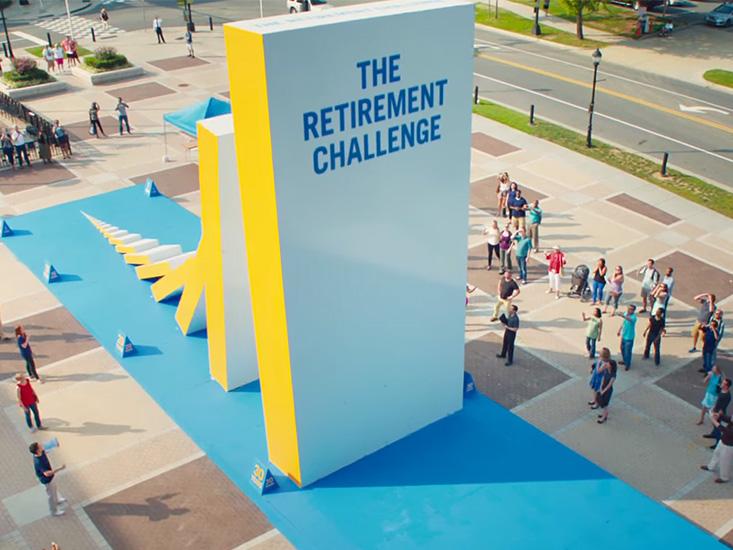
It’s a clear warm day in early August, and the Harvard psychologist Dan Gilbert is lucky it isn’t windy. Towering right behind him stands a 30-foot tall domino. It’s 15 feet wide, four feet long, and weighs two tons. Gilbert, who is bald and has a thick white goatee and oval spectacles, looks puny by comparison. Passersby, noticing the humungous rectangle resting atop a long raised platform on the plaza of the NASCAR Hall of Fame, in Charlotte, North Carolina, start to gather around him, and he begins to lecture.
In 2009, Gilbert wrote a bestselling book called Stumbling on Happiness. “We think about the future in a way that no animal can, does, or ever has,” Gilbert argued in his book, “and this simple, ubiquitous, ordinary act is a defining feature of our humanity.” But the point of Gilbert’s demonstration was to help people think about the future in a way that evolution hasn’t programmed them to do: He was trying to help this audience understand compound interest.
Before the 1980s, Americans could largely rely on Social Security or pension plans sponsored by their employers for their retirement. But much more is expected now—both financially and cognitively. Employees today have “a greater responsibility to save, invest, and decumulate retirement wealth sensibly,” writes Annamaria Lusardi, a professor of financial literacy at George Washington University. She says that people depend for their retirement security “ever more on their own decisions and behavior.”
While this can sound empowering, Lusardi has shown that people approaching retirement age aren’t so skilled in the basic calculations involved. Even though they could work well with percentages, grasping compound interest was a bust. In a 2007 survey that tasked Baby Boomers with financial word problems, she found that only 18 percent could correctly solve ones involving compound interest.
“The level of numeracy in the adult population gives reasons to worry,” she writes in the academic journal Numeracy. What’s more, she notes, “It is very difficult to improve numeracy among the adult population.”
To delay gratification isn’t something we can easily commit to if we haven’t already been habituated to it.
This is where Gilbert’s domino comes in. Behind that massive one were 30 other dominoes, each smaller than the one behind it. The smallest dominoes had dollar amounts scribbled on them, corresponding to how much money certain members of the audience had in their wallet. He walks the 56 feet past the row of dominoes, and gingerly kneels down to place the very first domino into position. The slightest misplacement could ruin the demonstration.
Pointer finger extended, he tilts the first domino over and, in an instant, a dozen dominoes fall down, each releasing more energy than the last. As the dominoes grow in size, the action begins to slow. It takes 11 seconds to reach the last, behemoth domino, whose fall prompts the crowd to erupt in cheers and fist-pumps. A new Guinness World Record has been set, for the largest domino to ever be toppled.
Gilbert’s demonstration, called “The Retirement Challenge,” was set up for the financial services firm Prudential. Ray Del Savio, a group creative director at Droga5, who’s been partnering with Prudential on their advertising vision, says the connection between dominoes and interest is obvious. “If you Google ‘compound interest bar chart,’ you can’t help but see dominoes.” Gilbert said he hopes “this demonstration helps people realize that little things that they can do today—over time—add up, and can topple their biggest challenges.”
Is that likely? Recent studies in behavioral economics have shown that when it comes to saving money, we remain wedded to saving habits we cultivated in adolescence. To delay gratification, in other words, isn’t something we can easily commit to if we haven’t already been habituated to it. So it makes sense for people who’ve made a habit of saving to continue to “cut back” even when they don’t have to. But despite the fact that that our consumption behavior seems to remain relatively unchanged as we age, perhaps the spectacle of crashing dominoes can shock us out of old habits.
James, one spectator present that day, says it made him resolve to start saving. “It made me want to take the $45 in my pocket and put it into an account,” he said. Another spectator, Jennifer, seemed powerfully affected by the dominoes crashing. “It was nice to come here today,” she said, “and have a rather grand reminder of something that’s super important.”
Brian Gallagher is an editorial intern at Nautilus. @brianscottg
Lead image courtesy of Prudential