Giraffes are best known for their elegant necks, stretching high over the savannah like periscopes. We have some pretty good ideas about why evolution granted them these long necks: access to the growing tops of trees, where some of the most nutritious leaves sprout, plus the longer the neck, the better a male giraffe is able to head bang his male competitors during mating season, a winning advantage with opposite sex. (These battles can get quite fierce.)
But what about the giraffe’s exceptionally long legs?
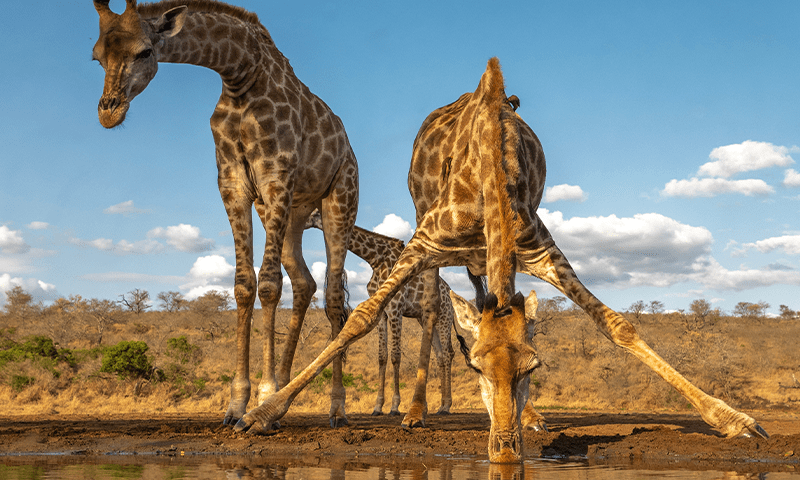
Less thought has been devoted to this other remarkable feature of the creature, but giraffe legs generally extend to some 6 feet in adults, almost as long as their 6-to-9-foot necks. Their legs are so spindly that to drink water from a pond giraffes must splay them out awkwardly like the poles of a large tent, making it difficult for them to quickly run from lions or other predators.
Read more: “How Necking Shaped the Giraffe”
To try to solve the mystery of giraffe legs, scientists from Australia and South Africa invented a hypothetical chimera: The elaffe. A combination of giraffe and a much shorter creature called the common eland, the elaffe featured an elongated giraffe’s neck atop the squat body and stubby legs of the eland. When the scientists did the math on this fictitious creature, they found that the unusual arrangement of limbs and head would have been much too hard on its heart, potentially deadly even.
The elaffe would have to spend 21 percent of its energy powering its heart, versus 16 percent in the giraffe and about 7 percent in humans. The longer legs, they found, save the giraffe a net 5 percent in terms of energy, which translates to more than 3,300 pounds of food over the course of a year. They published their results in the Journal of Experimental Biology.
Giraffes may have actually had long legs before they had long necks. Either way, both features create trouble for the heart. While gravity can do much of the work of pumping blood from the heart to the lower extremities, there is the risk of blood pooling in the feet. Meanwhile, getting blood to the brain requires an exceptionally high blood pressure, as much as three times human systolic level, and the giraffe risks passing out when it lifts its head.
To solve these problems, giraffes have specially designed blood vessels, which are the equivalent of compression socks, writes evolutionary biologist and psychology professor David Barash for Nautilus, in a story about how “necking” shaped one of the most bizarre creatures on Earth. “The giraffe’s hack consists of highly elastic blood vessel walls.”
These towering animals apparently needed more than long necks to gain an evolutionary leg up. 
Enjoying Nautilus? Subscribe to our free newsletter.
Lead image: Tony Campbell / Shutterstock