When whales die and sink to the ocean floor, their carcasses become buffets for a whole web of ocean organisms. To date, such “whale falls” have been documented as deep as about 4,000 meters, with the deepest known found by a manned submersible in the southwest Atlantic Ocean at a depth of about 13,200 feet. Yesterday, though, a new study announced the discovery of a vast area of whale falls on even deeper seafloor in the southeastern Indian Ocean.
A team of researchers from the Chinese Academy of Sciences, in collaboration with the University of Pisa in Italy and Earth Sciences New Zealand, conducted 32 dives in a human-occupied vehicle in the Diamantina Zone, a system of seafloor ridges and trenches that ranges from 2,021 to almost 23,000 feet in depth. The dives occurred over a period of about five weeks, mapping remains of both baleen and beaked whales, including several now-extinct genera.
Read more: “The Unseen Deep-Sea Legacy of Whaling”
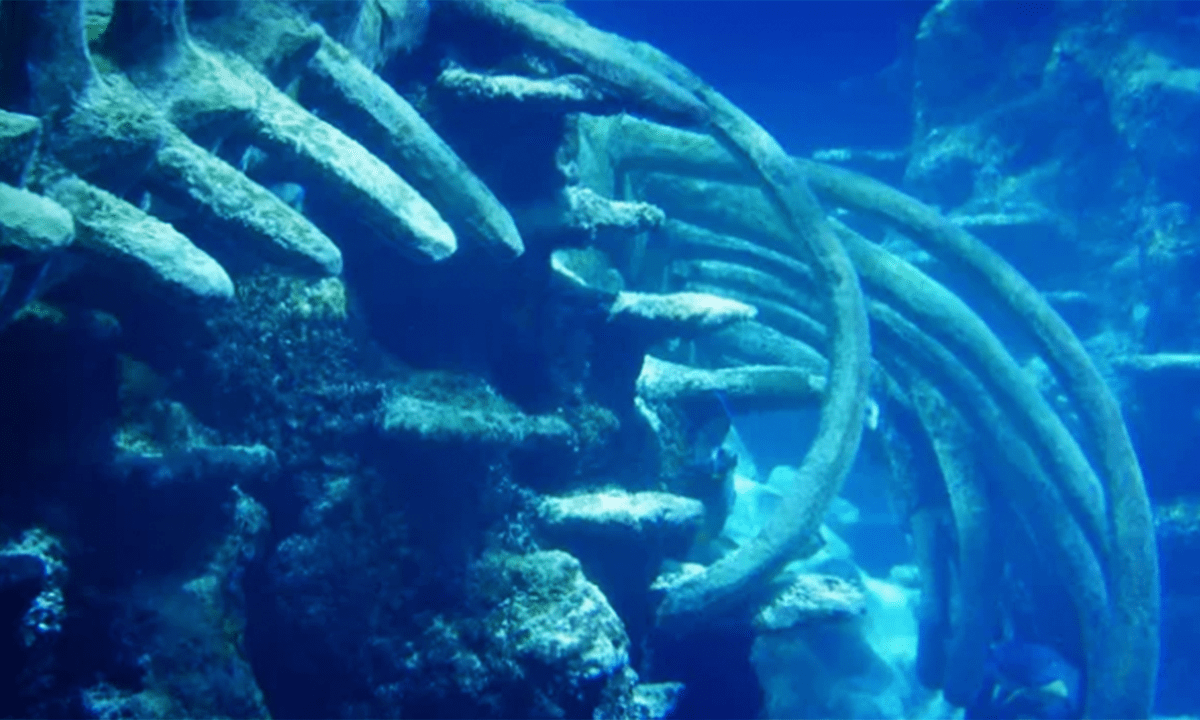
Five active whale falls were found alongside a staggering array of 476 whale fossils, making this site the most extensive whale graveyard ever known. Given the lofty name of “whale necropolis,” the density of whales in spots was nearly 2,000 individuals per square mile. For comparison’s sake, there are only several living whales per square mile, according to satellite estimates. The difference derives from the long period of time over which whales have been accumulating in the Diamantina Zone.
The age of fossilized whale skeletons was determined via isotopic dating of 33 bone samples. By matching the isotopic signal of the bones to the known record of seawater isotopes, researchers tracked the whale falls to between 0.12 million and 5.26 million years ago, the oldest remains belonging to the extinct whale Pterocetus bengulae. Essentially, whales have been sinking to the Diamantina Zone seafloor since at least the Early Pliocene, when the Indian Ocean was a very different place, including housing vertebrates no longer on Earth today like the massive megalodon sharks.
With a study estimate of 10 million whale carcasses, the whale falls of the Diamantina Zone are an ecosystem unto themselves, hosting a community of invertebrates from annelids, crustaceans, and mollusks to cnidarians and nematodes. As such, this whale necropolis “help(s) scientists understand the evolution and dispersal of deep-sea life,” wrote the study authors.
Death definitely becomes it. 
Enjoying Nautilus? Subscribe to our free newsletter.
Lead image: fyrestock / Adobe Stock