Last night was another summer evening disrupted by the specter of destructive storms in my neck of the Midwestern woods. Severe thunderstorms and tornadoes were forecast in the St. Louis area, where a deadly storm displaced hundreds of people and caused billions of dollars of damage just last year. Plans were cancelled. Reservations rescheduled.
Tornadoes did touch down across the Midwest last night, with reports coming in from Wisconsin and Illinois. And the dangerous system is now moving east, threatening Indiana, Kentucky, Ohio, and parts of West Virginia as I write. But thankfully nothing, excerpt for a brief shower in the wee hours, swept by my home.
The patchwork of watches and warnings did get me thinking about how and when tornado forecasting started.
According to the United States National Weather Service, the first tornado forecaster was one Lieutenant John Finley, a meteorologist with the Army Signal Corps. In 1878, Finely started studying the rapacious storms, his research bearing the fruit of the world’s first experimental tornado prediction on March 10, 1884, and routine tornado forecasts for 18 regions of the U.S. the same year.
But in 1887, Finley’s superior General William Hazen ordered the lieutenant to cease issuing forecasts because he “believed that the harm done by such a prediction would eventually be greater than that which results from the tornado itself.” This even despite Finley’s claim that his forecasts were accurate 95.6 to 98.6 percent of the time and the fact that he published Tornadoes, the first book dedicated entirely to tornadoes, that same year.
Read more: “The Strange Blissfulness of Storms”
Many decades later, tornadoes would again come knocking on the U.S. military’s door. On March 20, 1948, a twister raked across Tinker Air Force Base near Oklahoma City, OK. The storm left $10 million of damage in its wake and destroyed more than 100 aircraft. Two meteorologists, Captain Robert Miller and Major Ernest Fawbush were tasked with ensuring such destruction never arrived unannounced again. Quickly diving into the literature on the weather conditions associated with tornadoes (one can only assume that they encountered Finely’s work), the pair noted two things: that the weather on March 20 was strongly suggestive of tornado development, and that the forecast for March 25, just five days later, was eerily similar.
Taking their analysis to the base’s commanding general, they asserted, when asked, that a tornado was likely to form again. The general ordered them to issue the world’s first official tornado forecast. And Miller and Fawbush were right. On March 25, another tornado tore across Tinker Air Force Base, causing an additional $6 million in damage and destroying another 35 aircraft.
Tornado science was off and running. Advances throughout the ensuing decades would give us national systems of tornado forecasting, amateur weather watcher networks, and in 1971 the Fujita Scale, which was developed by University of Chicago meteorologist Ted Fujita and characterized twisters based on their windspeed and destructive power. Though the Fujita Scale was retired and replaced with the Enhanced Fujita Scale in the U.S. in 2007, Fujita remains a seminal figure in tornado science lore.
These days, advanced satellite and radar technology help forecasters warn people of impending tornadic danger. As with any weather predictions, there is some variability in how accurate forecasts are. But with less than 200 years of serious study, the science of tornadoes has come a long way. 
Enjoying Nautilus? Subscribe to our free newsletter.
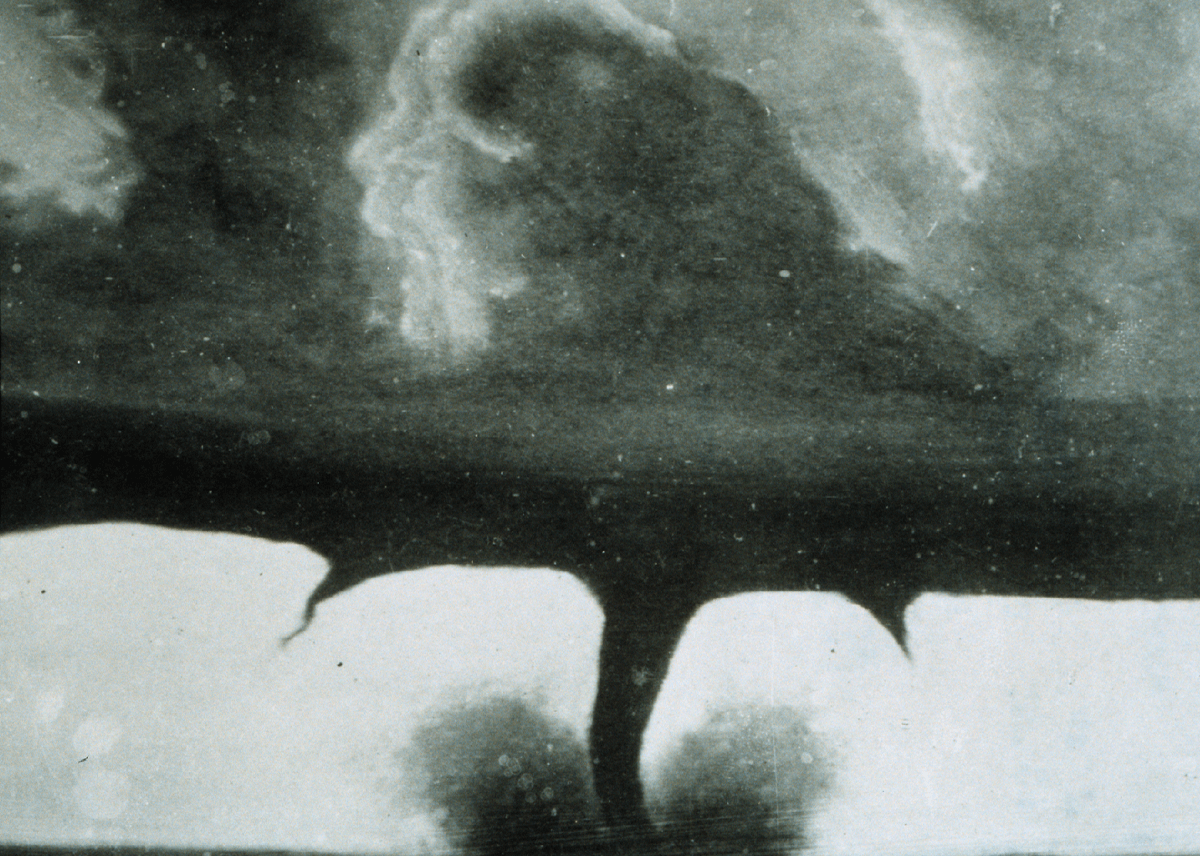
Lead image: F. N. Robinson / Wikimedia Commons