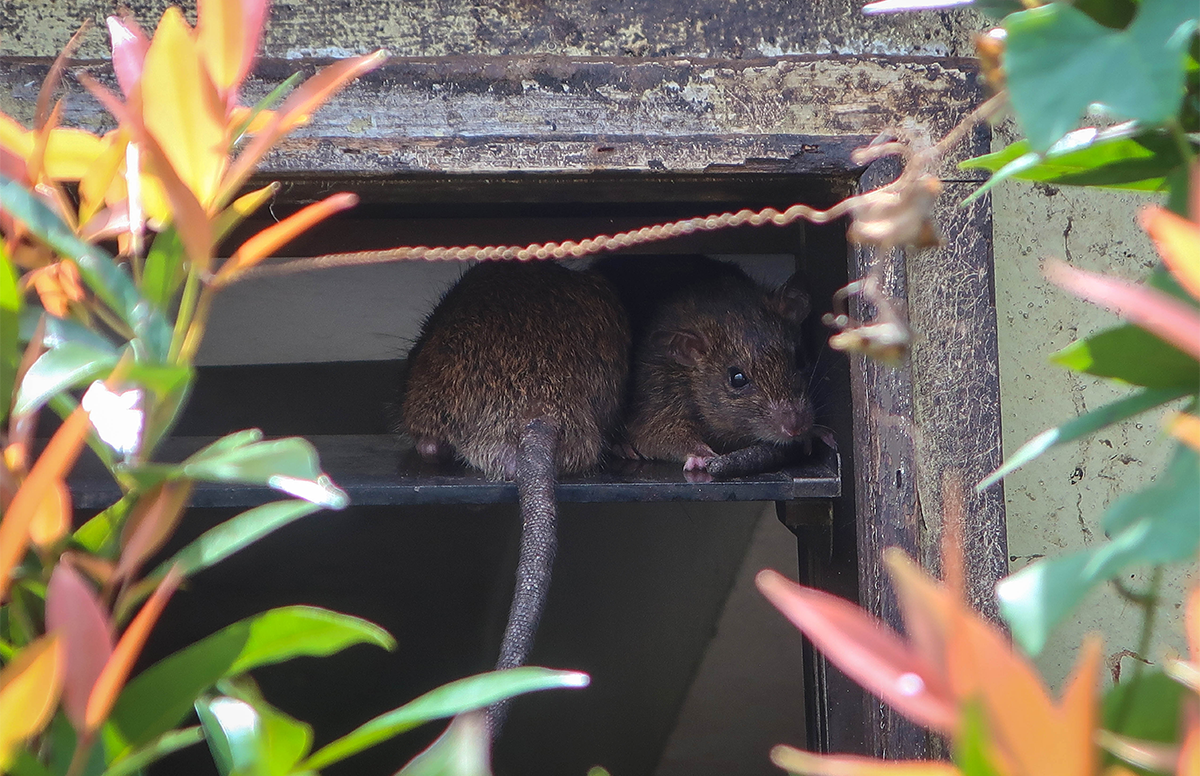
It’s well-known that invasive rats can change island ecosystems. They eat eggs and chicks of ground-nesting birds, and gobble up small animals like lizards and beetles as well. It’s only when rats are removed from islands, such as Lord Howe Island in Australia or the Caribbean island of Redonda, that biodiversity begins to rebound.
Now, a recent study in the journal Ecology reports that ecological impacts of rats on islands extend far beyond their terrestrial habitats. Led by biologists at Lancaster University in the United Kingdom and the University of Texas, the study quantified the impacts of introduced rats on coral reefs near islands in the Indian Ocean.
Black rats (Rattus rattus) were introduced several hundred years ago to these islands that otherwise have no direct human impacts. A previous study showed densities of seabirds to be about 760 times greater on rat-free islands, resulting in an influx of nutrients from bird droppings that “fertilize” the surrounding reefs. As such, the corals grew faster and supported more fish.
Read more: “From Rats to Riches”
In a natural experiment, researchers again compared marine ecosystems in the Chagos Archipelago around islands with and without rats, this time inventorying small, cryptic reef animals. These “cryptofauna” included tiny fish and invertebrates (small coral crabs, porcelain crabs, and snapping shrimps chief among them) that tuck into reef crevices. The biomass of cryptic fishes was found to be greater near nutrient-rich reefs and supported a 10-fold increase in the productivity of larger fishes.
“Cryptobenthic reef fishes are characterized by extraordinarily high rates of growth and reproduction,” said Lancaster University lead study author Laura-Li Jeannot in a statement. “This allows these fish populations to flourish and expand in favorable conditions—such as seabird-fertilized reefs.”
The cryptic invertebrates, however, showed the opposite trend. On lower-nutrient reefs that received less seabird guano, invertebrates flourished. The study authors hypothesized that invertebrates are more successful near islands with rats because there’s less competition from the fishes. Invertebrates may also benefit from lower metabolic rates that allow them to survive on fewer nutrients. These changes in cryptofauna have a direct effect on the food web because invertebrates, with their tough exoskeletons, are less nutritious and digestible than fish.
“Contrary to our expectations, the low-nutrient conditions that rats create do not negatively affect all reef organisms,” added Jeannot. “Nutrient-loss impacts are not uniform. There are winners and losers.” 
Enjoying Nautilus? Subscribe to our free newsletter.
Lead image: free2trip / Adobe Stock