If you’ve ever wondered why so many objects in the night sky are designated with an “M” followed by a number, you can thank Charles Messier. This 18th-century French astronomer had a singular obsession—finding comets—so much so that King Louis XV called him le furet des comètes or “comet ferret.”
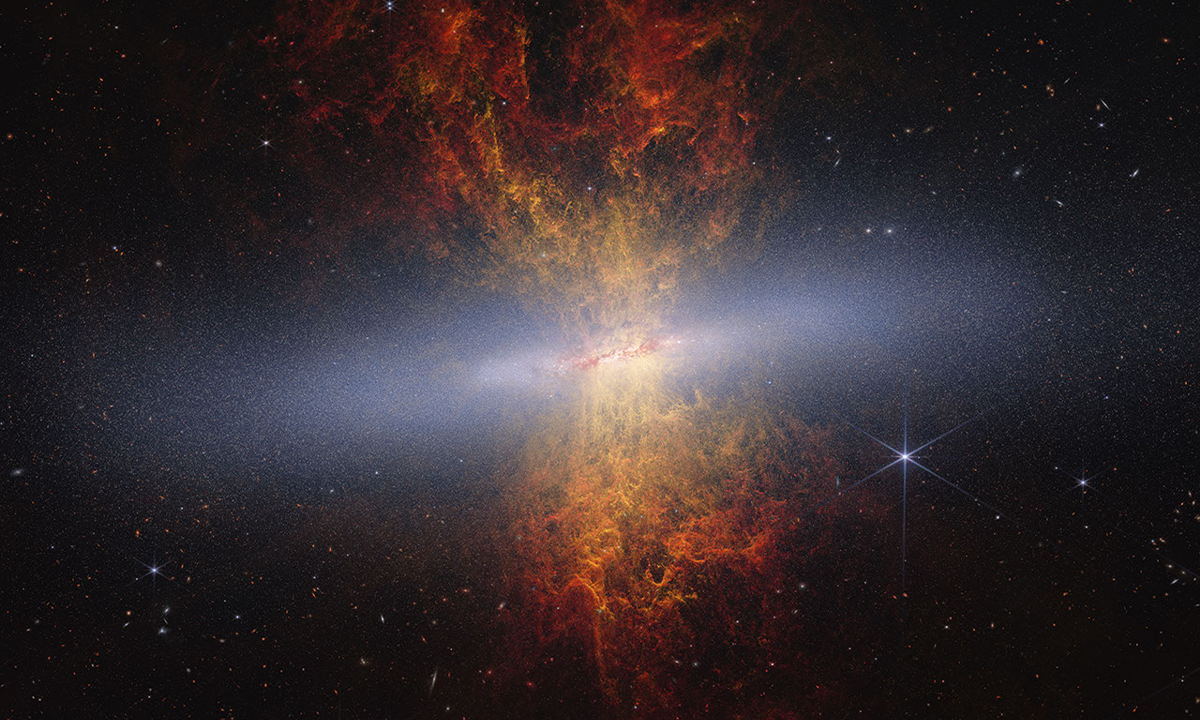
Unfortunately for Messier, most luminous phenomena fall into the category of “Not Comets” (though he did discover more than a dozen during his career). So to keep track of the eye-catching Not Comets that distracted from his search, he compiled a list of more than 100 of them, known as the Messier catalogue. Messier’s designations are still used today, and NASA just released new images of Messier Object 82, the Cigar Galaxy, captured by the James Webb Space Telescope.
Read more: “Comets Are More Dangerous Than We Thought”
This galaxy, located around 12 million light-years away, is a starburst galaxy, meaning stars are forming within it at an exceptionally high rate (10 times faster than the Milky Way). For a galaxy of its mass, it’s unusually prolific, and astronomers believe this is because the Cigar Galaxy is the result of a merger between two other galaxies. The newly released images offer astronomers a glimpse into its turbulent past.
As you may have gathered, it’s called the Cigar Galaxy because the edge-on view of it from our vantage point gives it a cylindrical shape, but it’s slightly asymmetrical. The James Webb Space Telescope’s near infrared camera offers a better look at the distended galactic disk with a bulging blob of stars on the left. Astronomers believe this asymmetry is the result of the galactic merger that formed the Cigar Galaxy.
The James Webb Space Telescope’s high-resolution cameras also were able to penetrate the thick clouds of cosmic dust surrounding the galaxy to get a better view of the nearly 16.5 million stars scattered throughout (the brilliant bluish white halo). Astronomers believe the visible stars are only a fraction of the Cigar Galaxy’s output, with the rest being too faint to observe. The plumes of yellow emanating from the center are ionized hydrogen gas terminating in reddish orange clouds of polycyclic aromatic hydrocarbons (chemical compounds made up of carbon atoms arranged in joined rings).
“The sheer number of stars that we were able to resolve with Webb is incredible,” NASA team member Benjamin Williams of the University of Washington said in a statement. “It’s a whole different world from what we’ve been able to see with other telescopes. All of these stars collectively provide a detailed fossil record of the formation and evolution of M82.”
R.I.P. Charles Messier, you would have loved the James Webb Space Telescope—despite all the distractions. 
Enjoying Nautilus? Subscribe to our free newsletter.
Lead image: NASA, ESA, CSA, Adam Smercina (STScI, Tufts), Thomas Williams (University of Manchester) Image Processing: Alyssa Pagan (STScI).