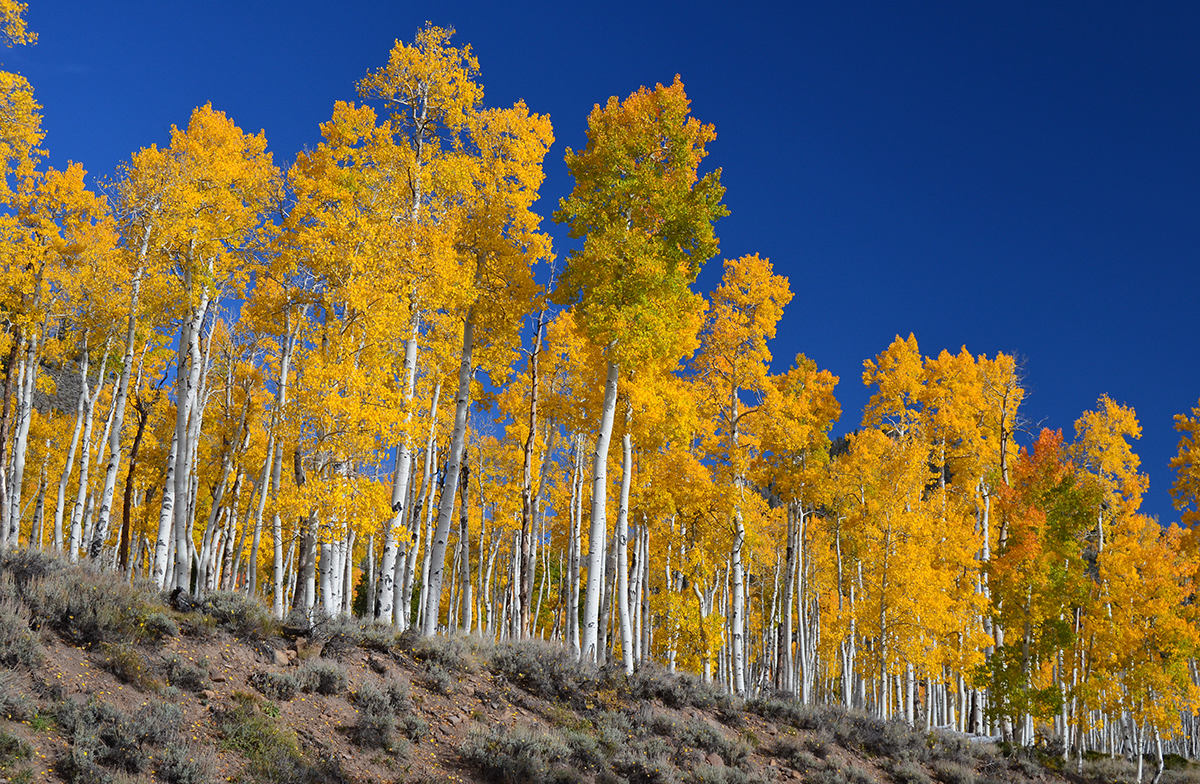
The most massive known organism on the planet covers over 100 acres in Sevier County, Utah—it’s an aspen stand named Pando (Latin for “I spread”). While the stand may appear to be made up of individual trees, they’re actually roughly 47,000 clonal stems sent out by rootlike shoots beneath the soil.
In other words, it’s an organism you can actually walk through—and thanks to experimental sound artist Jeff Rice, you can listen to it as well.
Read more: “A Revolution in Time”
Pando is a quaking aspen (Populus tremuloides) named for how its leaves and trunks shake and shudder when the wind gusts through the branches. During the run-up to a July 2022 thunderstorm, the winds were cascading through Pando to do just that. By inserting a hydrophone into a hollow at the base of one of Pando’s branches (dubbed the “Pando portal”) and lowering it to the roots below, Rice captured the incredible sound.
With the hydrophone in contact with the roots and the roots connected to one another, Rice recorded the groaning of 47,000 stems in a cacophonous concert. “It’s almost like the whole Earth is vibrating,” Rice told NPR in an interview about the project, part of an artist residency with the nonprofit group Friends of Pando. “It just emphasizes the power of all of these trembling leaves, the connectedness, I think, of this as a single organism.”
A single organism with an otherworldly voice, animated by the wind. 
Enjoying Nautilus? Subscribe to our free newsletter.
Lead image: J Zapell / Wikimedia Commons