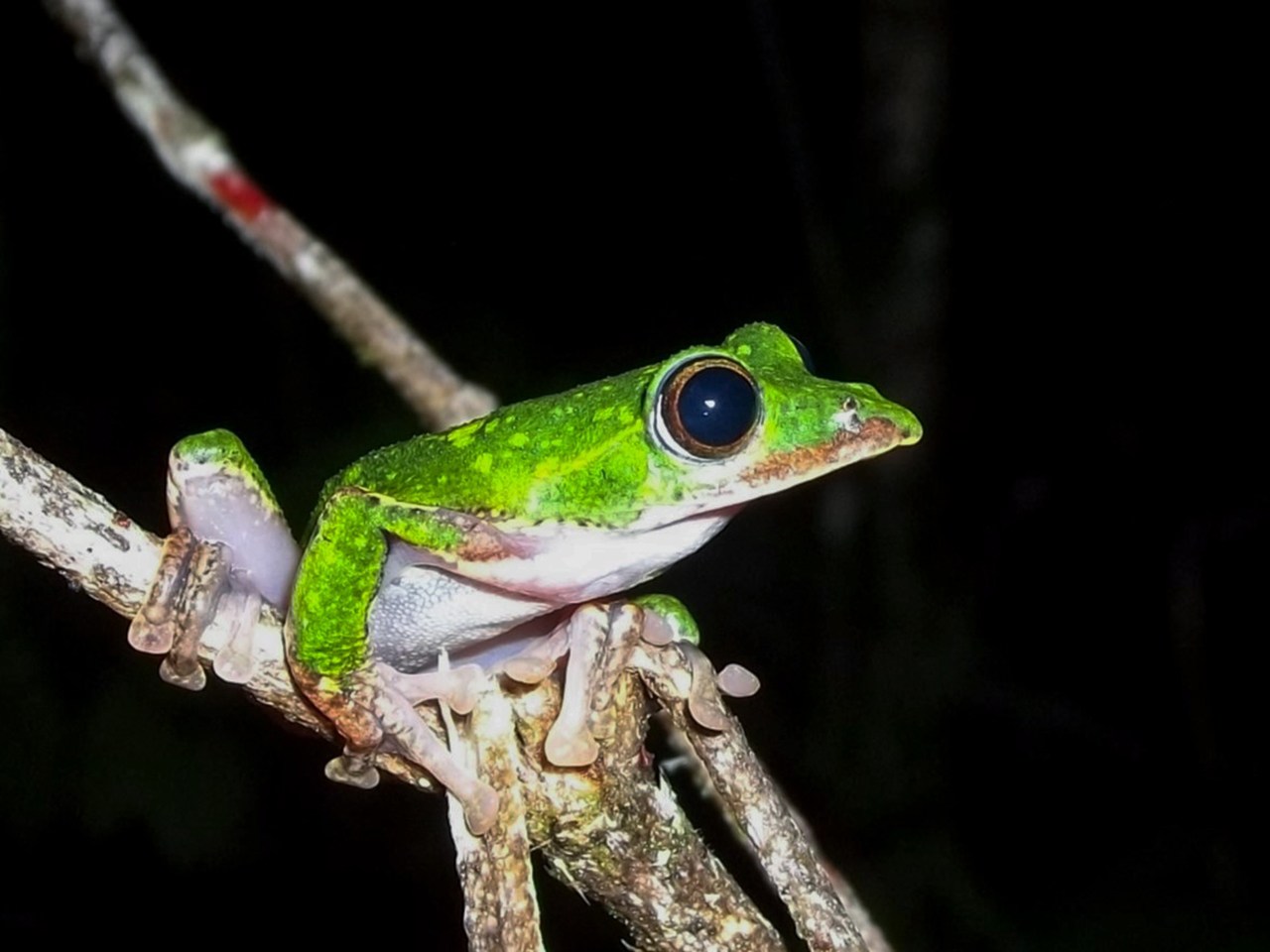
New species can be discovered in all sorts of ways. In the case of Rhacophorus kurniatia, a type of Asian flying frog that’s only just been identified, it involved a trek deep into the Mekongga Mountains in Indonesia, to a secluded lake where thousands of frogs had congregated.
“We were moving up the mountain, and we came across this big pond covered in these green frogs,” Alan Hitch, one of the authors of a new study about Rhacophorus kurniatia, explained in a statement. “They were all over. You don’t really see frogs in big congregations like that. This was something super special.”
They were quickly identified as being flying frogs, from the Rhacophorus genus. The large webbed feet, for gliding between trees, were the main giveaway. Further analysis revealed something not seen in other Rhacophorus species, though: The frogs deposit their eggs in gelatinous masses hanging above or near water, rather than in the typical foamy nests.
Distinctive, pointed snouts, as well as differences in the calls made by the frogs, confirmed that this was a species that hadn’t been observed and documented before.
“The team looked at hundreds and hundreds of specimens of frogs to describe the new species,” study author Andrew Engilis Jr. said in a statement. “Sometimes species can look the same, but their behavior is different and their genetics are different—these are called cryptic species. This frog is an example of that. It looks very similar to other Rhacophorus, but its genetics and behavior show that it’s very distinctive.”
The identification of R. kurniatia is the culmination of four years of work on the Indonesian island of Sulawesi, which is close to Borneo. Expeditions carried out by the researchers led them from sea level to the highest mountain peaks—with the new flying frog species discovered some 6,100 feet above sea level.
And there’s a bittersweet reason for the naming: The flying frog’s scientific name was chosen as a mark of respect for renowned herpetologist Hellen Kurniati, who died in 2024. She was one of the leading researchers studying amphibians and reptiles in Indonesia. She also helped to discover the new species that now shares her name. 
Enjoying Nautilus? Subscribe to our free newsletter.
Lead Image: Wahyu Trilaksono / Museum Zoologicum Bogoriense