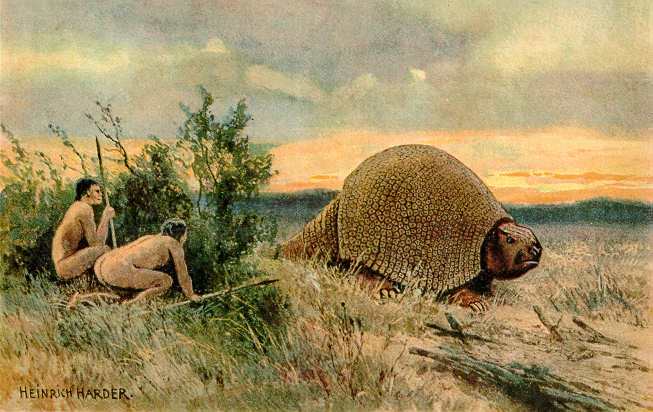
When the first humans migrated to South America, they were greeted by a menagerie of prehistoric megafauna. Among these majestic beasts were the glyptodonts—massive armored armadillos, some the size of Volkswagen Beetles. Now there’s a new species of glyptodont, and it’s got a bit of a convoluted history.
Then again, so do the rest of the glyptodonts. When remains of these prehistoric beasts were first discovered in the 19th century (including some specimens collected by Charles Darwin), it wasn’t immediately clear what animal they belonged to. The writer Garcilaso de la Vega Inga guessed they were the remains of a giant human that had been “destroyed by God for the crime of sodomy.” Danish naturalist Peter Wilhelm Lund, who spent his career spelunking through Brazilian caves, was the first to scientifically describe a member of the species in 1837.
Read more: “The Giant Sloths and Armadillos of Prehistoric Texas”
Later, Lund passed one of the glyptodont skulls he found in Brazil (dubbed NHMD 2045557) to his colleague, J. Reinhardt, who identified it as a member of the genus Hoplophorus (the same glyptodont genus Lund first described). Unfortunately, that turned out to be wrong. In 1915, a naturalist named Herluf Winge revised Reinhardt’s work, stating the skull belonged to a different genus: Glyptodon.
And so it remained—until now.
A team of paleontologists recently revisited NHMD 2045557, scanning the skull in all three dimensions and applying modern techniques 18th- and 19th-century naturalists could only dream of. The researchers determined that both Reinhardt and Winge were wrong, the skull actually belongs to not just a different genus but an entirely new species: Glyptotherium deuterophractum. They published their findings in the Journal of Mammalian Evolution.
So what happened to these majestic behemoths?
Unfortunately, all the glyptodonts died out around 12,000 years ago, shortly after humans showed up in the area. There’s at least some evidence (from bashed-in skulls) that they were hunted, although it’s not clear if that alone pushed them to the brink. It does make you wonder what giant armadillo tastes like, though. 
Enjoying Nautilus? Subscribe to our free newsletter.
Lead Image: Heinrich Harder / Wikimedia Commons