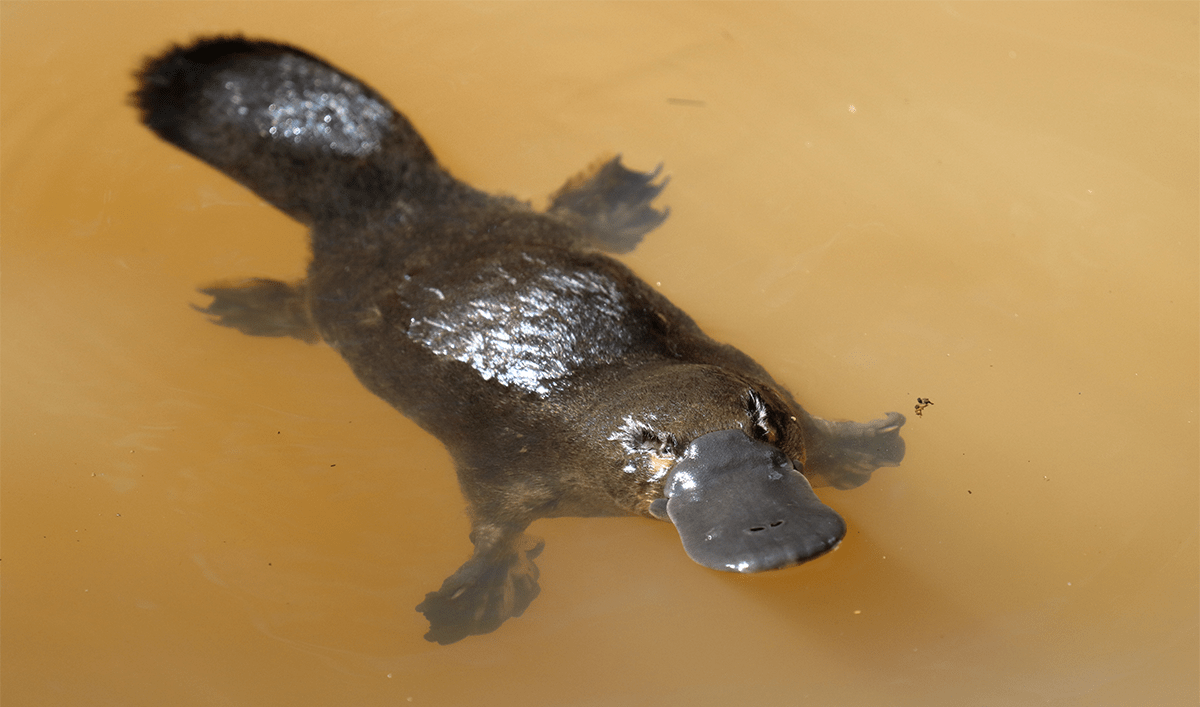
One glance at the platypus and you’ll forgive the naturalists who assumed it was a clever hoax upon first encountering preserved specimens more than 200 years ago. After all, the creatures appear to be a jumble of contradictions—they look like beavers but have duck bills, they’re mammals that lay eggs, and they produce milk without nipples.
Upon closer examination, they’re even more curious. Platypuses glow under ultraviolet light, sense electricity through their bills, have a bewildering multitude of sex chromosomes, and the males possess venomous spurs behind their legs. Now, new research published in Biology Letters has added another oddity to the list: strikingly unique pigmentation structures in their fur.
Biologists from Ghent University in Belgium looked at platypus melanosomes—specialized pigment-bearing organelles inside cells—under an electron microscope. To their surprise, they discovered that the melanosomes were hollow and spherical. Previously, only birds were thought to possess hollow melanosomes, which produce more vibrant iridescent colors in their plumage.
Read more: “Why Hasn’t Evolution Made Another Platypus?”
“This was totally unexpected,” study author Leigh Dobson told BBC Wildlife Magazine. “Hollow melanosomes have never been found in mammals before, and the combination of hollow and spherical isn’t seen anywhere else as far as we know.”
Not even species of echidna—the only other egg-laying mammals—have hollow melanosomes. So what are they doing in platypus fur? The researchers think it has something to do with the platypus’ aquatic environs.
The common ancestors of both the platypus and the echidna likely lived in the water, and hollow melanosomes could have helped insulate them. When echidna branched out for a life on land, they may have lost the structures. Still, the scenario raises questions about why other aquatic mammals like beavers and otters don’t have them.
The team says more research is needed to answer these questions. Until then, like a lot of platypus anatomy, it will remain an intriguing mystery. 
Enjoying Nautilus? Subscribe to our free newsletter.
Lead image: My wild world / Shutterstock