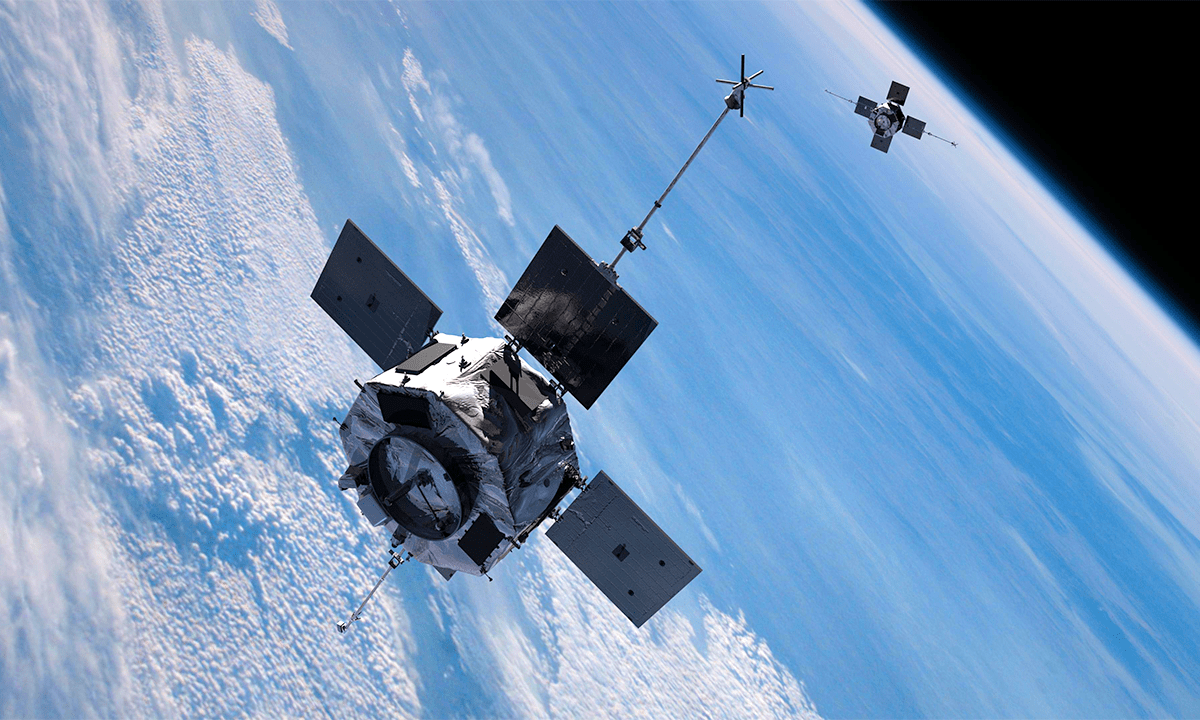
Later tonight, Van Allen Space Probe A will re-enter Earth’s atmosphere, beginning a fiery descent that will mark the end of its mission. Decommissioned in 2019, the probe wasn’t estimated to crash back on Earth until 2034 (its counterpart, Space Probe B is scheduled to remain in orbit until 2030), but that timetable was pushed up due to particularly fierce solar weather, dwindling fuel reserves, and a shrinking window for technicians to safely decay its orbit.
While NASA scientists still can’t predict where the 1,300-pound satellite will land, they estimate the odds of harming someone to be 1 in 4,200 (better than the odds of winning the lottery, but still incredibly remote).
The spacecraft had already lingered longer than scientists originally thought it would. First launched in 2012, Van Allen Space Probes A and B were scheduled for a two-year mission studying the twin belts of energetically charged particles held in place by Earth’s magnetosphere: the Van Allen radiation belts. Instead, they kept plugging away for five more years in the harsh, radioactive environment, collecting data and transmitting it back to Earth.
“This mission spent seven years in the radiation belts, and broke all the records for a spacecraft to tolerate and operate in that hazardous region, all with no interruptions,” Van Allen Probes project manager at Johns Hopkins, Nelofar Mosavi, said in a 2019 statement. “This mission was about resiliency against the harshest space environment.”
During their time in space, the Van Allen probes are credited with making a number of discoveries about the radiation belts, including their tendency to split into a third belt during times of intense solar activity; that surges of charged particles can distort the shape of Earth’s magnetosphere; and that the acceleration of extremely energetic ions whizzing toward Earth is due to their electrical charge, and not their mass.
Read more: “Visit the 7 Most Extreme Planets in the Universe”
“The Van Allen Probes rewrote the textbook on radiation belt physics,” Johns Hopkins Van Allen Probes project scientist Sasha Ukhorskiy said.
When they were decommissioned in 2019, the probes had contributed data to over 600 scientific studies, a number that’s grown to more than 700 today. Going forward, the scientific knowledge they gathered will help future satellites withstand radioactive conditions in space. Altogether, it’s a pretty good run for a couple of rugged spacecraft.
If you happen to be gazing up at the sky tonight and notice a streak of fire, say goodbye to Probe A—and maybe whisper a “thank you.” 
Enjoying Nautilus? Subscribe to our free newsletter.
Lead image: NASA