What does the Chinese black market have to do with the world’s tiniest porpoise? Nothing and everything, it turns out.
The vaquita, the smallest cetacean in the ocean, is native to the Gulf of California where it lives alongside a fish called the totoaba. The swim bladders of totoabas are highly prized in traditional Chinese medicine and fetch such a high price on the black market that they’ve been called the “cocaine of the sea.”
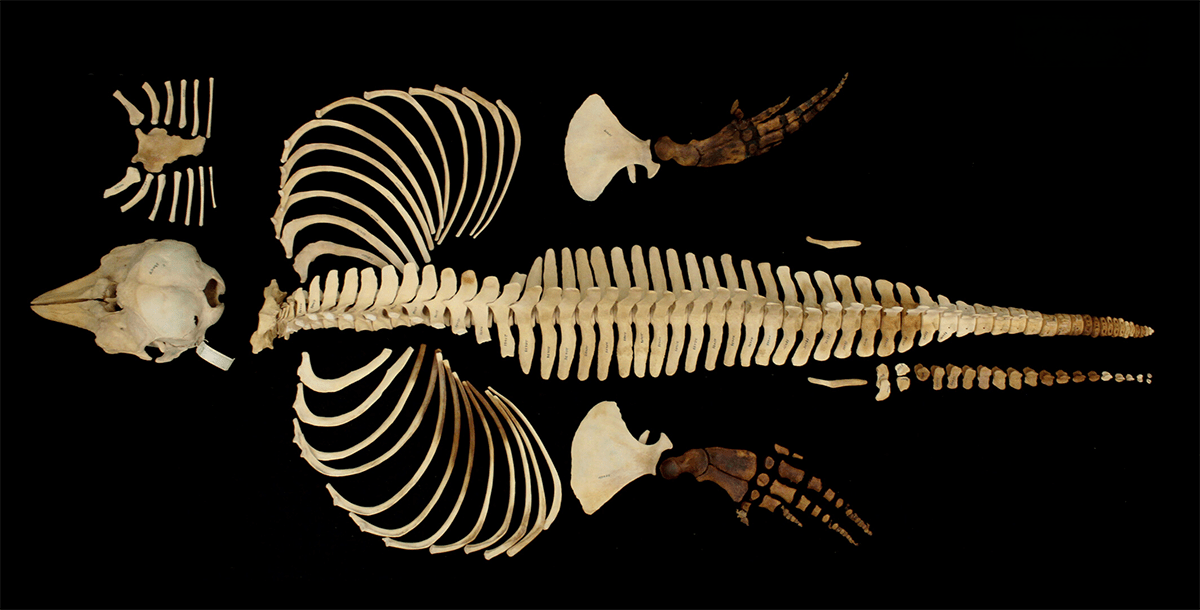
Unfortunately, the gillnets used to snare totoabas also entangle vaquitas, and the little marine mammals are critically endangered. In fact, vaquitas are now so rare that the future of the species is in limbo. Additionally, museum specimens are also sparse and fragile, so studying these unique animals presents a conundrum. That’s why marine biologists set out to completely digitize a vaquita skeleton, detailing the process in the journal Marine Mammal Science.
Read more: “We Can Write a Different Ending for Critically Endangered Species”
The researchers took a comprehensive approach to create their digital vaquita. Using a medical CT machine, they created cross-sectional images of a skeleton collected in 1966 (along with some other specimens). They then photographed the individual bones and went over them with the X-ray equivalent of a fine-toothed comb—a micro-CT scanner capable of resolving structures smaller than a human hair.
“This project required an unusually intricate imaging workflow to capture the vaquita skeleton at multiple scales, from whole-bone structure down to microscopic internal detail,” study author Marianne E. Porter of Florida Atlantic University explained in a statement. “By integrating medical CT, micro-CT, and high-resolution photography, we were able to reconstruct both the external morphology and internal architecture of each bone in a way that preserves anatomical fidelity while remaining fully interactive in digital form. The result is not just a model, but a layered dataset that reflects the true complexity of the specimen.”
If conservation efforts fail, the vaquita could vanish, but at least future generations will be able to study what we lost. 
Enjoying Nautilus? Subscribe to our free newsletter.
Lead image: Knaub, J.L., et al. Marine Mammal Science (2026)